Day 07: worth-it isn't in the tool.
"Is ChatGPT Plus worth $20 a month?" is the wrong question.
For someone pushing it hard daily, easily.
For someone whose actual usage the free tier would cover, they're paying $20 for a Pro they never needed.
Same price, opposite answer.
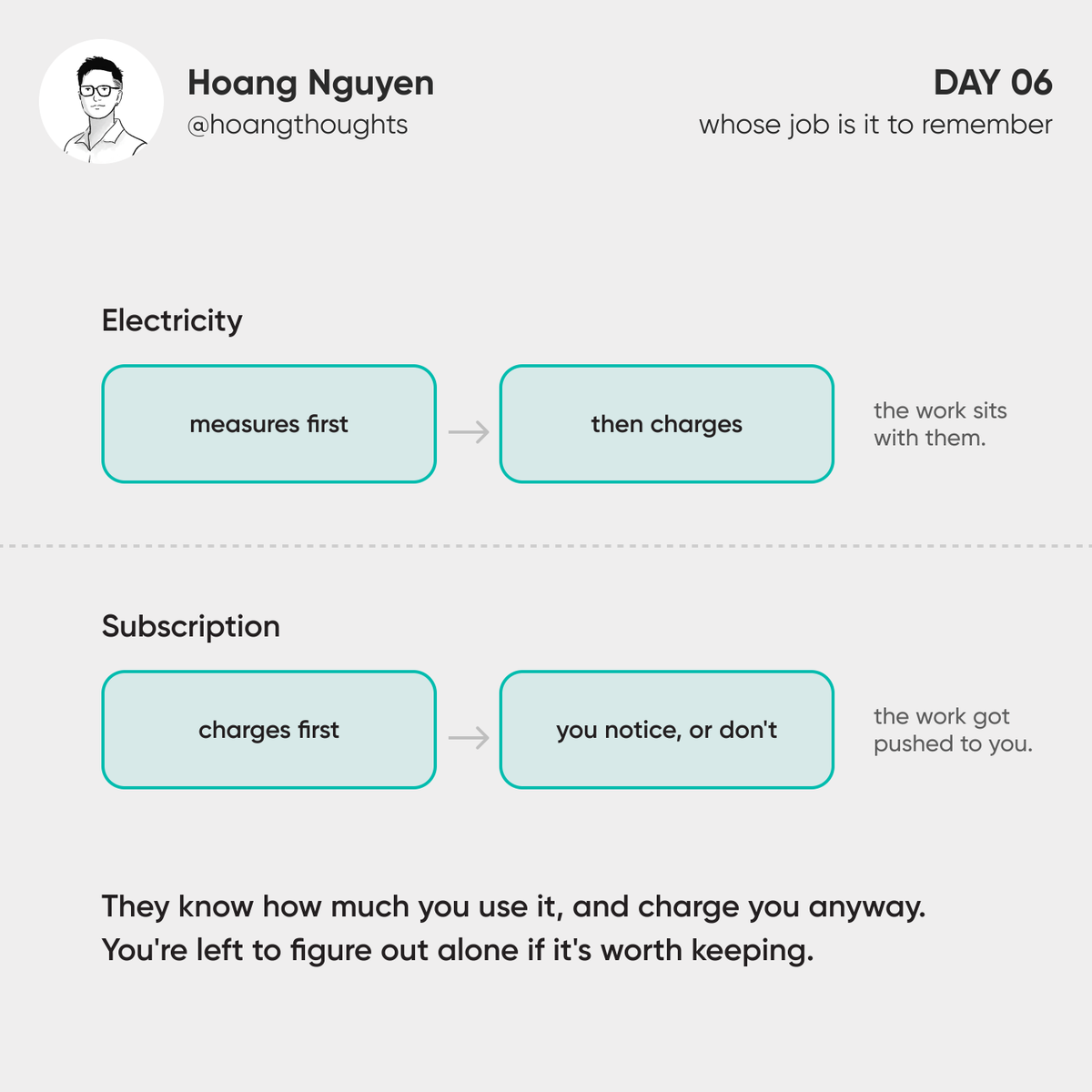
Day 06: whose job is it to remember.
The electric company measures your usage to bill you. The work of proving it is on them.
Subscriptions flipped it.
They know how much you use it, and charge you anyway. You're left to figure out alone if it's worth keeping.
Day 05: the trial I never cancelled.
I have never once cancelled a free trial before it turned into a paid plan.
Not because the product won me over. Because swiping away the reminder was easier than finding the cancel button.
Day 04: price is the easy half.
I can tell you to the dollar what Photoshop costs me every month. I cannot tell you the last time I actually opened it.
That gap, between knowing the price and knowing the value, is most of where money quietly goes.
Day 03: guess vs count.
Guess how many subscriptions you're paying for right now. Write it down.
Now go count.
The gap between the two numbers is the part of your money running on autopilot.
Day 02: how a subscription gets forgotten.
Cancelling is never one click. It's a survey, a confirmation, a "are you sure" screen.
So you put it off till the weekend. The weekend you forget. And forgotten is exactly where they want you, because forgotten still pays.
Day 01: the meter disappeared.
Your electricity bill measures what you used and charges you for it. The meter is on the wall, the price tracks reality.
Netflix charges the same whether you watched 40 hours last month or zero. Most software subscriptions quietly took the meter off the wall.
That's the shift nobody announced. Not more subscriptions, just ones that stopped telling us if we use them.
Day 00: thinking out loud.
The irony took me a while to admit. I keep posting about building with AI, and I'd lost track of which AI tools I still actually use enough to justify.
So I'm building something to answer that. Committing to think out loud here every day while I do.
ChatGPT Agents launched yesterday.
Small detail I can't stop noticing: every icon in the UI has a face. The folders, the lightning bolt, the coffee cup. They blink, tilt, react when you hover.
The agents stop feeling like a tool, and start feeling like small characters living inside the product.
A really lovely piece of craft.
I just redesigned https://t.co/DdTaMyqlpD for $5.70.
Production-ready HTML, fully responsive and content-fit, as shown in the video bellow.
Here's the cost:
→ 8 prompts total
→ 3 AI tools (Claude Chat + Claude Design + AI Landing Page library)
→ 40 minutes
Final cost: $5.70 (extra credit) and an hour.
—
For years the AI story has been "cheaper labor, faster output." That's the shallow version.
The real shift: the cost of shipping good work has collapsed. What used to be gated by budget, headcount, and timeline is now gated by whether you can frame the problem well enough for the tool to reach its best.
If you can, 8 prompts get you a production landing page for the price of a coffee. If you can't, the same 8 prompts will still give you 8 prompts' worth of mediocrity. The tool doesn't care. It reflects back the frame you bring.
Which means the gap between people who understand AI and people who don't isn't narrowing. It's widening faster than most companies are willing to admit.
The tools got cheap. Taste didn't.
And taste is the one thing you can't get for $5.70.
You think you're prompting the tool.
The tool is prompting you back.
Every "make it better" takes a specific word out of your vocabulary and replaces it with something looser.
Anthropic shipped 2 major things this week, and leaked a third.
→ Opus 4.7 (new flagship model)
→ Routines (Claude Code can now run 24/7 like a cloud employee, triggered by schedule, API, or GitHub events)
→ Leaked: an AI design tool that would compete directly with Figma, Adobe, and Wix
Stock prices of Figma, Adobe, Wix, GoDaddy dropped 2-4% the same day the design tool was announced.
Two releases and a leak. One week.
For context: most enterprise software companies ship something this big once or twice a year. Anthropic just did it in 5 days, and apparently has more in the pipeline.
This is what a company in sprint mode looks like. While OpenAI is dealing with the GPT-6 delay rumors and Google's Gemini updates feel measured, Anthropic seems to be operating on a different clock entirely.
Whether this pace is sustainable, or whether it's a sign of something bigger coming, is anyone's guess.
But it's worth pausing to notice: the rate of change in AI just went up another notch this week, and most people haven't even fully absorbed last week yet.
AI can now turn your sketch into a photorealistic product shot in real time.
The gap between "idea in my head" and "visual I can show someone" just collapsed into a single motion.
Whether that's exciting or scary probably depends on what you do for a living.
Either way, worth paying attention to.
Anthropic just leaked a full app builder inside Claude.
5 years ago, I predicted exactly this. In 2021, I wrote that AI would build entire apps from a single command. Before ChatGPT existed. The article got 28K reads and earned over $2,000 on Medium.
Then Lovable, Bolt, v0 made it real. You could prompt your way to a working app. But it still felt like a niche tool for early adopters.
Last week, Anthropic leaked an app builder inside Claude. And that changes things. Not because it's new. But because when the model provider builds it natively, it stops being a feature. It becomes the default.
Here's what I think happens next:
—
01. Every AI company will become an app builder.
OpenAI has Canvas. Google has Firebase Studio. Now Anthropic. Selling a model is not a business. Selling a platform that builds things for you is.
02. SaaS will start breaking.
If anyone can build a custom tool from a prompt, why pay $49/month for someone else's version? Only SaaS with data network effects too deep to replicate in a chat window will survive.
03. Companies will stop hiring builders. They'll hire thinkers.
When execution is nearly free, the scarce skill isn't "can you build this?" It's "do you know what to build and why?"
04. You'll carry an app store in your pocket that builds apps on demand.
Want to travel somewhere tomorrow morning? Tell your AI.
It builds a tool that connects flight booking, hotel availability, itinerary planning, and budget tracking in one place. Built for your trip, your dates, your budget.
No downloading 4 different apps.
No comparing subscriptions.
No compromises.
Need a CRM for your freelance business? Describe how you work and it builds one that fits. Need a workout tracker that matches your injury recovery plan? Same thing.
The app store doesn't disappear.
It just becomes your AI building exactly what you need, the moment you need it, for an audience of one.
—
The prediction I made in 2021 took 5 years to land.
These four won't take nearly as long.
I follow a rule called 10-80-10.
→ First 10%: I do the thinking. The brief, the goal, the context, the expected outcome. This is where my judgment lives, and I never outsource it.
→ Middle 80%: AI does the heavy lifting. Drafting, researching, building, executing.
→ Last 10%: I come back in hard. Editing, challenging, pushing back until the output meets my standard, not AI's default.
The first and last 10% is where taste compounds. The middle 80% is where AI gives you leverage.