Copies multiply quietly.
"Send the CSV," "share the folder," "add the contractor."
Every export creates a ghost copy. Every handoff expands exposure.
Best privacy: Data never moves. Compute where it lives, share only results.
Financial institutions need robust KYC that reduces operational risk and liability.
Current model: collect documents, store them indefinitely, become liable when (not if) breaches happen.
Better model: customers verify identity once and generate cryptographic compliance proofs. Institutions verify compliance without storing sensitive data.
This eliminates data storage liability, streamlines verification, and reduces breach exposure - while giving customers control over their credentials and privacy.
It's not just about reducing risk or building trust. It's about restoring self-sovereignty within regulatory frameworks - not against them.
Our variant of MPC makes this architecture possible. And it's live now, not theoretical.
Most people touching crypto today are not “in crypto.”
They are holding value in Stablecoins, moving money across borders, or starting to see real assets show up on-chain.
That is already three working rails: money you can hold, money you can move, and assets you can program.
The real scaling work now is giving institutions and individuals credible guarantees about how their data and rights are handled.
Tokenization is not 1996 internet.
It is the moment right before the browser. The potential is clear, but the system is still missing the piece that makes everything inevitable.
In 1996 the internet already had pull. Email worked. Search worked. Commerce was taking shape. People understood why it mattered.
Tokenization has no anchor use case yet. Not because the idea is weak, but because the rails underneath are unfinished.
We still need identity that stays portable without turning into exposure.
We need compliance that works because the rules are enforced by the system, not by whoever sits in the middle.
We need settlement that behaves the same no matter where the asset lives.
And we need liquidity that can move instead of dying in someone's silo.
Once those foundations exist, tokenization becomes infrastructure. Not crypto assets. Just assets, running on rails that are programmable, auditable and final.
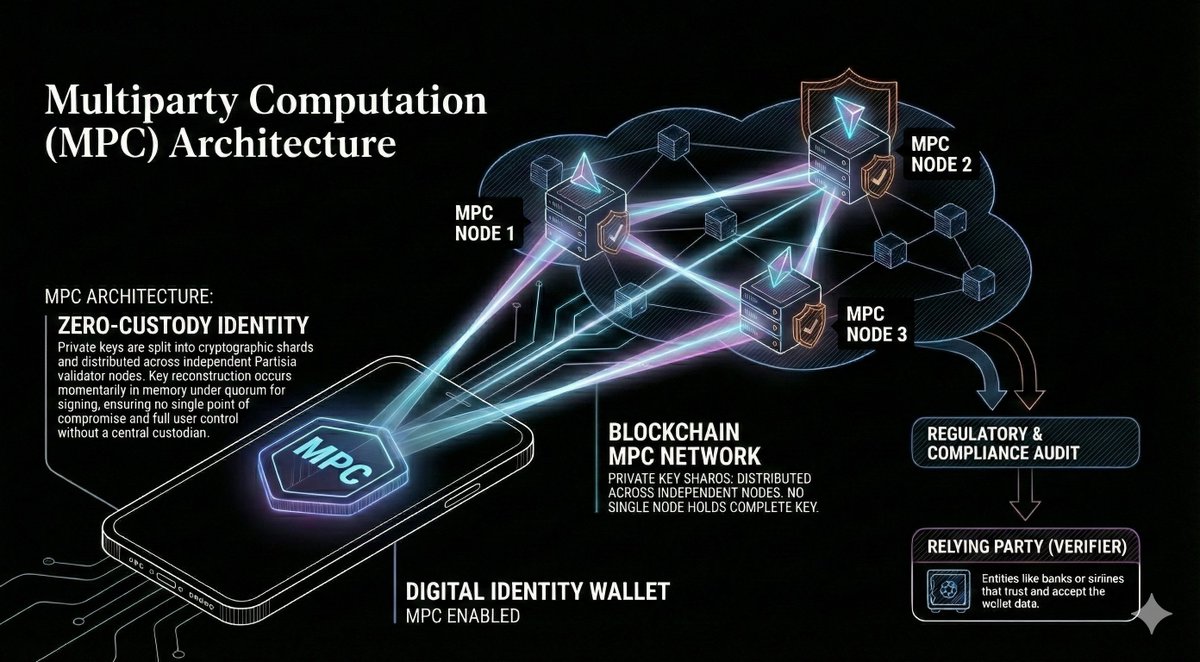
What idOS shows here is the real strength of MPC!
Keys generated with high-entropy, split into independent shares, and only reassembled when the user signs.
It feels seamless, but the security model underneath is what makes user-controlled identity actually viable at scale.
This is what user-controlled identity looks like.
Privacy preservation in digital health is a problem.
Not because the data is sensitive, but because the architecture still treats duplication as normal.
Hospitals, labs, insurers, apps… each one takes its own full copy.
It feels harmless until you look closely.
Entire medical histories drifting into systems that only needed a single answer.
Full records spread across vendors with no clear justification.
At some point the question becomes unavoidable:
why are we still moving the data at all?
Anchor records where they originate
and shift verification to portable IDs that disclose only what the request requires.
Access improves. Exposure falls.
Who is ready to rethink the architecture instead of reinforcing the old one?
An ecosystem thrives when its apps, creates real value and collaboration.
At Partisia Blockchain (PBC), we’re excited to see this vision unfold as our dApps launch and connect, empowering our community and partners to grow together.
A thread 🧵👇
If trust is the currency of digital identity, overexposure is its fastest depreciation.
Institutions demand certainty. Users demand discretion. Both are reasonable.
Digital IDs should secure data, scale access and reduce friction, not widen the attack surface.
Concerns about breaches are legitimate. But privacy-first design lets verification happen without revealing the underlying data.
When systems share only what is essential, confidence rises and risk drops.
This builds a more resilient and inclusive identity framework for everyone involved.
A simple place to start is asking whether your current identity flow protects trust by design or assumes it will be given.
What’s your biggest privacy pain point right now?
Quantum FUD’s hitting $BTC hard.
Public keys exposed = private keys cracked.
But what if you could shield your assets without migrating chains or trusting custodians?
No bridges. No burns.
Just quantum-safe liquidity that stays yours.
We’ve been battle-tested since ‘23.
Compute confidentially, enabling private payments for wallets, platforms and institutions.
We fix privacy where it actually matters in computation, not custody.
At the UNDP Blockchain Impact Forum, we joined @hedera, @Cardano_CF, and @NEARWEEK to explore what it truly means for blockchains to serve the public good.
For us, when trust becomes measurable, privacy stops being a tradeoff.
That’s why we build beyond chains creating infrastructure that secures digital sovereignty.
To know what’s true, you don’t need to see everything.
The goal isn’t to make money invisible it’s to make it accountable and private by design.
Financial systems are learning what confidential computing already proves: confidential finance isn’t rebellion it’s balance restored.
Privacy isn’t the edge case anymore. It’s the missing foundation of digital finance.
For too long, “private” meant isolated, fragmented protocols, incompatible standards and no way to prove what’s hidden. That era’s gone.
We’re in a phase where assets can stay confidential and compliant, where transactions remain encrypted but still verifiable, where oversight exists without exposure, and interoperability reinforces sovereignty instead of weakening it.
Trust must be quantifiable, if web3 wants to move real capital.
That starts with builders who treat privacy not as an option, but as the default.
Why do institutions still struggle to bring RWAs on-chain?
Because most infrastructure still forces a choice between compliance and usability.
We built something that removes that trade-off.
Every login, recovery, and proof happens without ever exposing a key.
Credentials aren’t stored on one device or server, they’re split, encrypted, and only reunite when you authorize it.
Lose a wallet? No panic.
Your identity rebinds instantly, verified by you, not a password.
No seed phrases. No custodians. No waiting.
We rebuild access through math, not memory.
That’s functional autonomy, where security, compliance and recovery finally align.
Not all MPCs are built the same.
Some just hide data. Others rebuild trust from the ground up.
Most privacy tech ends at encryption, assuming everyone plays fair.
But what happens when privacy needs proof?
We don’t rely on blind trust.
Every computation runs through accredited nodes, backed by real collateral and verified on-chain.
If something goes wrong, it’s caught and penalized.
This is privacy you can audit.
Secure computation. Accountable privacy. Where math meets market truth.
The burn is live, and now you can track it in real time!
As of this post, we’ve burned:
- Cumulative USD Value of ETH burned: $62,333
- Cumulative USD Value of LINEA burned: $231,025
https://t.co/ikYuZ8VNWp
Onchain compliance isn't optional for institutions, it's foundational.
Linea is establishing ACE as the standard for compliance in our ecosystem.
We’re proud to be part of @chainlink's ACE partner ecosystem alongside 20+ leading compliance providers.