@leahfiles Whatever's going on the disingenuousness is real. People would do well to review the Bush family e.g Neil, or the Bidens, but ole Neil et al, in his role of as vulture capitalist, off shored a staggering amount of American technology to China/Asia during the late 80's early 90's
@leahfiles It's the British East India Company model - private militaries to enforce colonialism/imperialism & capturing the mass trade in pushing the consumption of mostly, it you truly think about it, unneeded stuff & any & all competition must be squashed in every circumstance ala 6GW
@harris4491@chrismartenson Not necessarily, besides Houthi strikes there are other points to consider such as any oil flowing through the East-West pipeline must now transit the Suez Canal into the cul-de-sac known as the Mediterranean as Bab el-Mandeb Strait is officially a war zone, many factors!
A lot of people are asking whether Jensen Huang should return to Nvidia.
That certainly isn't a bad idea.
But claiming he lost his job over marital infidelity is an absolute farce when Bill Gates, Jeff Bezos, and figures in the Epstein files faced no such standard.
Infidelity was the cover story for ham-fisted US politics against China.
Huang wanted to keep selling GPUs to Chinese firms and backed open-source AI, and just like Washington's ASML ban forced China to build its own chipmaking machines, GPU restrictions will only push China to build cheaper alternatives.
Training a 3-trillion-parameter model takes 10,000 parallel-processing GPUs and massive power, where China's grid already holds an unbeatable advantage.
Ousting the founder who saw that reality won't stop China; it just hands them the lead.
#Nvidia #AI #China #Economics #TechPolicy #SteveKeen
@GregorPepe@McFaul I believe that China will continue to attempt to keep the U.S at arm's length. To me, currently relations between China & the U.S/West represents an encumbrance, a liability with little to offer except for the preponderance of bellicose rhetoric imo
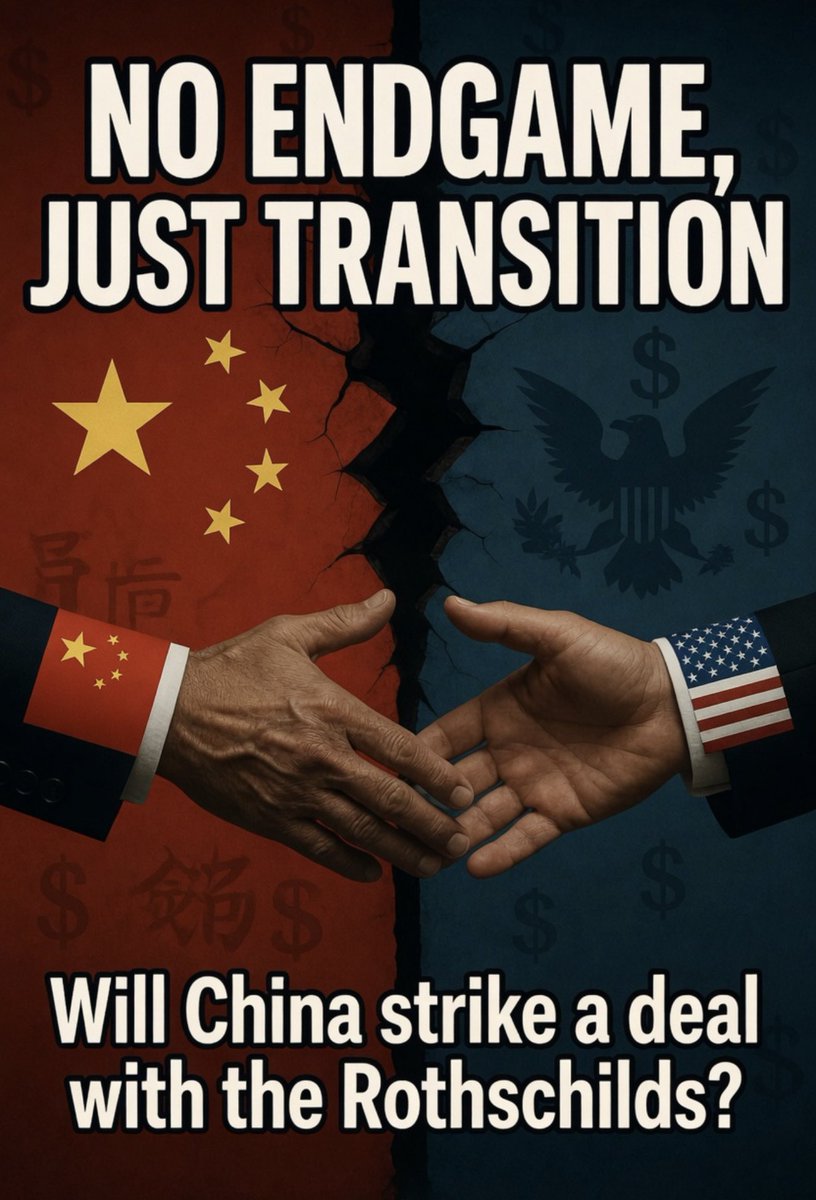
Will China strike a deal with the Rothschilds?
Or, more bluntly: will Iran/China/Russia cut a deal with the US/Israel?
Pragmatic observers and political scientists tend to see some kind of agreement as inevitable. Financial and power elites have always been remarkably flexible—supporting multiple sides when it suits them, regardless of ideology or geopolitics. Profit tends to decide: divide the spoils, carve up the territory, move on. Why should this time be any different?
I see it differently.
At first glance, there’s little difference between the Chinese and Western economic—especially monetary—systems: both are controlled by a narrow group at the top of the pyramid.
But the crucial difference is this: in the West, corporations sit at the top, buying influence, politicians, and power. In China, corporate influence is tightly constrained. The state—presented as both technocratic and merit-based—keeps a firm grip on the economy and the financial system.
China’s leadership will never open the door to external financial power structures that could hollow out its sovereignty. They went through a brutal learning curve. After the 1911 revolution, they experimented with Western-style parliamentary democracy. The result? Chaos—ten heads of state, forty-five cabinets, fifty-nine prime ministers in just sixteen years. The subsequent one-party attempt under the Kuomintang also ended in collapse and defeat. The current system, whatever one thinks of it, has proven resilient—and they intend to keep it.
When the West managed to dismantle the Soviet bloc at the end of the last millennium and China was still weak, it entered a golden era and became the hegemon. Regime changes, destabilizations, resource grabs—standard operating procedure. That era is now running out of road. Multipolarity—built on cooperation, mutual respect, and non-interference—is emerging, and the West will resist it hard.
Which is why I don’t expect any lasting deal in the Gulf. There will be no World War III—but neither will there be a durable truce or genuine mutual respect. Tensions between East and West—call it BRICS vs. G7, or the Global South vs. the Global North—will keep rising.
The current conflicts, along with new cold wars, will continue. And the process will end the way it so often has for empires, most recently the Soviet one:
not with a negotiated equilibrium, but with financial, moral, and social exhaustion of the Empire of Chaos.
#Iran #BRICS #multipolarity
China's economic miracle works because China hasn't sunk trillions into endless wars.
While the USA is going to spend 1.5 Trillion USD in 2027 on wars, China will spend the equivalent on infrastructure for its people.
@Its_ereko "What's the "international community"? The countries the Pile already owns, agreeing with each other. What's a "rogue state"? A country the Pile doesn't own yet"
@andy_buksterlin Polling Data: An Economist/YouGov poll (Oct. 23–26, 2026) found only 26% of Americans approved of Jeffries, while 47% disapproved. A separate Indivisible poll showed only 28% of registered voters viewed him favorably