My wife grew up on the metric system, and she says the mile is the most ridiculous unit ever invented.
For years, she had me. But history claps back....
The word comes from Latin, mille passus, a thousand paces.
A Roman pace was two steps, counted each time the same foot hit the ground. A thousand of those made a mile.
Along the Appian Way, built in 312 BC, stone markers stood at every thousand paces, counted outward from a gate in Rome's old wall. A traveler read the distance off the road itself.
The strange number came much later. In 1593, Parliament under Elizabeth I set the mile at 5,280 feet so it would divide evenly into furlongs, the length of an English farmer's furrow.
So the odd number is a Roman soldier's stride, adjusted to fit an English field.
I love that. Every time you say "mile," you are still counting the steps of a legionary marching south out of Rome.....
...on the Appian Way that you can still walk today, counting the old mile markers as you go
The poet Statius called that road the queen of long roads.
Minimalist interior design strips a space down to its essential elements using clean lines, a neutral palette, and open negative space.
Core Principles :
Less is more
Quality over quantity
Negative space
Subtle texture
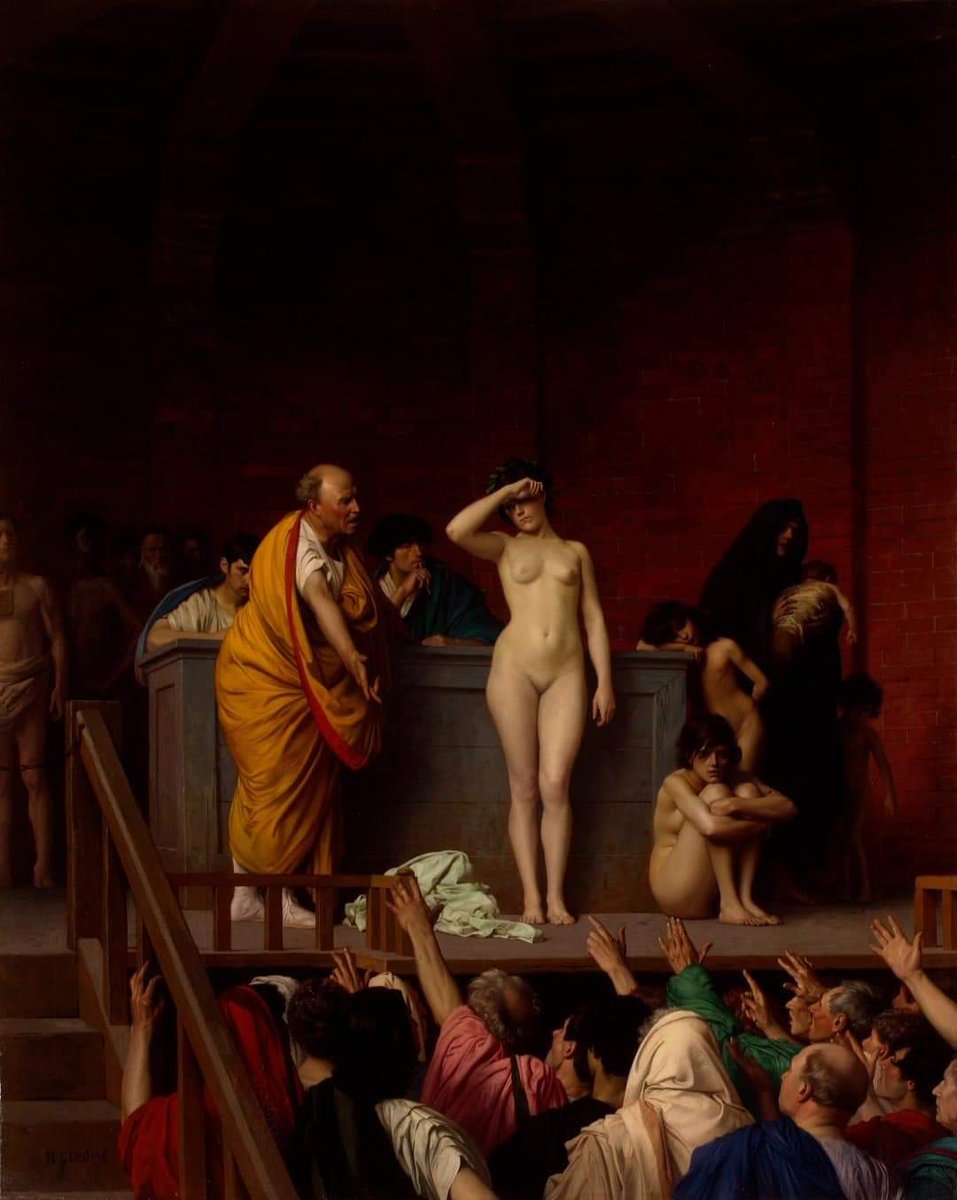
Slavery in ancient Rome is well documented. Various literary sources, legal documents, inscriptions and artistic representations show how common enslaved people were in everyday life. Yet we don't know exact numbers, making it hard to fully understand their importance to Roman society and its economy. Slavery played a significant role in Roman society. Enslaved people were in city, countryside, households and businesses and ownership wasn't limited to elites. Today, it's difficult to quantify their numbers. However, by exploring surviving objects we can build a picture of the difficult and varied lives those enslaved in ancient Rome endured, helping us better understand their impact.
In Roman world there were many different ways someone could be forced into slavery. These included children born into slavery, people captured in war, individuals who were sold or self-sold into slavery and infants abandoned at birth. Less common were children sold by their parents, people being enslaved for debts or as punishment for crimes and people who were victims of kidnapping and piracy. We know of two slavery markets in Rome. One was by Temple of Castor in Forum, other near the Saepta Julia in Campus Martius.
Capture during war saw many enslaved, especially during Republican period (509-27 BC). As a result, origins of those enslaved shifted with Rome's geographical expansion. Augustus' pacification of Mediterranean, at the end of 1st Century BC, reduced number of people enslaved through warfare. Still, supply of captives continued thanks to conquest of new territories such as Britain and Dacia (modern-day Romania), frontier warfare and suppression of revolts.
Romans also traded enslaved people across and within borders of Roman territory. In imperial times (27 BC - 476 CE), imported people could come from areas just beyond Roman frontiers – Ireland, Scotland, Eastern European countries bordering Rhine and Danube, Black Sea area, Arabian Peninsula and Africa. However, enslaved people could also come from within borders of Roman empire, for example from Thrace, Asia Minor and Syria. As mentioned by Roman writer Varro, Ephesus (on coast of modern-day Türkiye) was a centre for Roman slave trade. When Roman authors do reference an enslaved person's origin, it's usually a province in the empire's borders, such as Cappadocia and Phrygia (both modern-day Türkiye) or Syria.
The question of race and slavery in Roman times is a complex one. In Roman world, enslaved people came from a range of ethnic backgrounds, often the same as their masters. Traders had to disclose origin (natio) of people they were selling, indicating Romans saw certain personal characteristics, physical strength, character and behaviour, as connected to where someone was from. These in turn could deter or encourage buyers. In a letter written during Caesar's invasion of Britain in 55 BC, Cicero jokes about unlikelihood of finding British enslaved peoples educated in literature or music.
Scholars estimate about 10%-20% of Roman empire's population were enslaved. This would mean, for an estimated Roman empire population of 50 million (in the 1st Century CE) between 5-10 million were enslaved. This number would have been unequally distributed across the empire, with a higher concentration of enslaved people in urban areas and in Italy. Surviving evidence shows that enslaved people had a wide range of occupations. Many carried out hard manual labour under strict supervision, but they could also perform more specialised activities with higher degree of autonomy. Some were highly autonomous and were even responsible for other enslaved people, known as vicarii.
Today, it's difficult to fully appreciate relative prevalence of these enslaved occupations or to measure exactly how much of the Roman workforce they accounted for...
📷 : Slave Market in ancient Rome (1884 CE), by Jean-Léon Gérôme (1824-1904).
#archaeohistories
You are very bold in your ignorance.
Yes. The money is sent to Rome. It is used to direct humanitarian aid funded by the Pope. This includes emergency funding for natural disasters, war relief, refuge support, and funding for impoverished dioceses across Africa, Asia, and Latin America.
The money collected also helps in funding the central administration that serves the Church worldwide, such as running diplomatic missions (Nunciatures) that advocate for local populations and supporting missionary territories that cannot support themselves financially.
I work in one of the most imporverished dioceses in the world, and I feel their impact and help.