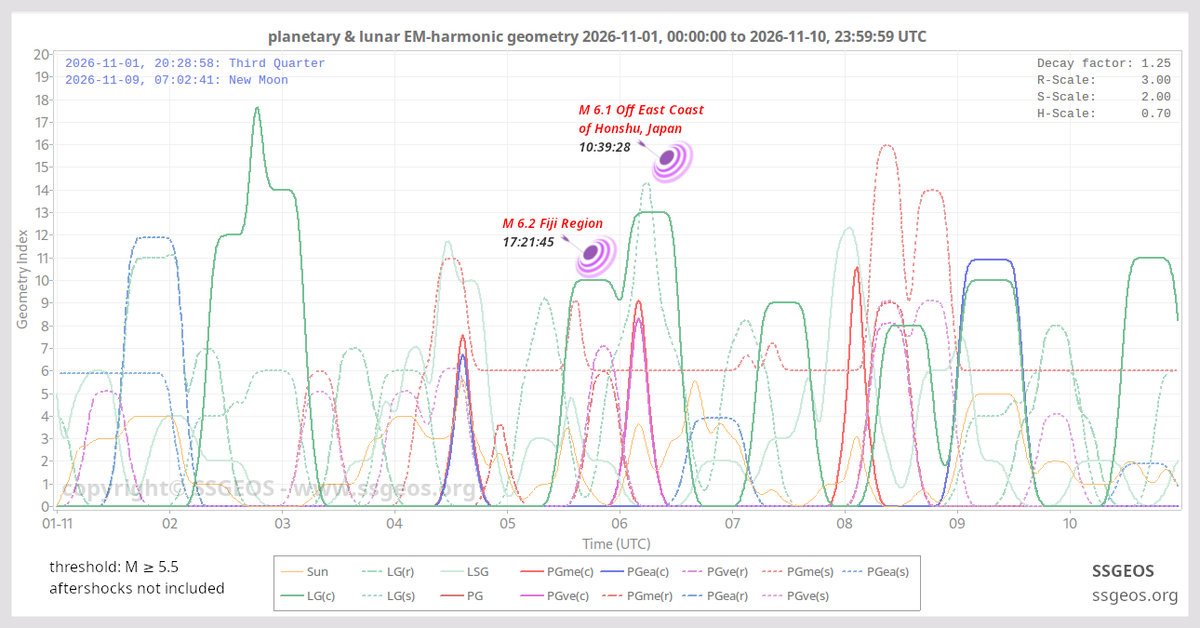
Today (11th) there's a rare convergence of opposite/wide 112°30' between the Moon and four outer planets. While this particular geometry is called a "half semi-right angle" in SSGEOS terminology, the same set based on 45/2 is known in traditional astrology as "16th-harmonic aspects":
- Semioctile (or sexdecile): 22.5° (1/16)
- Sesquioctile: 67.5° (3/16)
- Quinsemioctile: 112.5° (5/16)
- Sepsemioctile: 157.5° (7/16)
In astrology aspects are related to musical intervals (octave, fifth, fourth) as well as arithmetic divisions of the circle since at least the time of Ptolemy.
Johannes Kepler pushed the musical/geometric analogy further. He derived additional aspects (including the 45° and 135° family and the quintile series) from the sides of regular polygons and from harmonic proportions, arguing that the same geometric principles that produce musical consonance also produce effective planetary configurations.
The SSGEOS framework, built from scratch, is based on the 0°, 90° and 180° harmonics of the electromagnetic wave. However, the common ground is the same: vibration. Everything in the Universe is vibration, whether we measure it as sound waves or EM-waves, the underlying principle is the same.
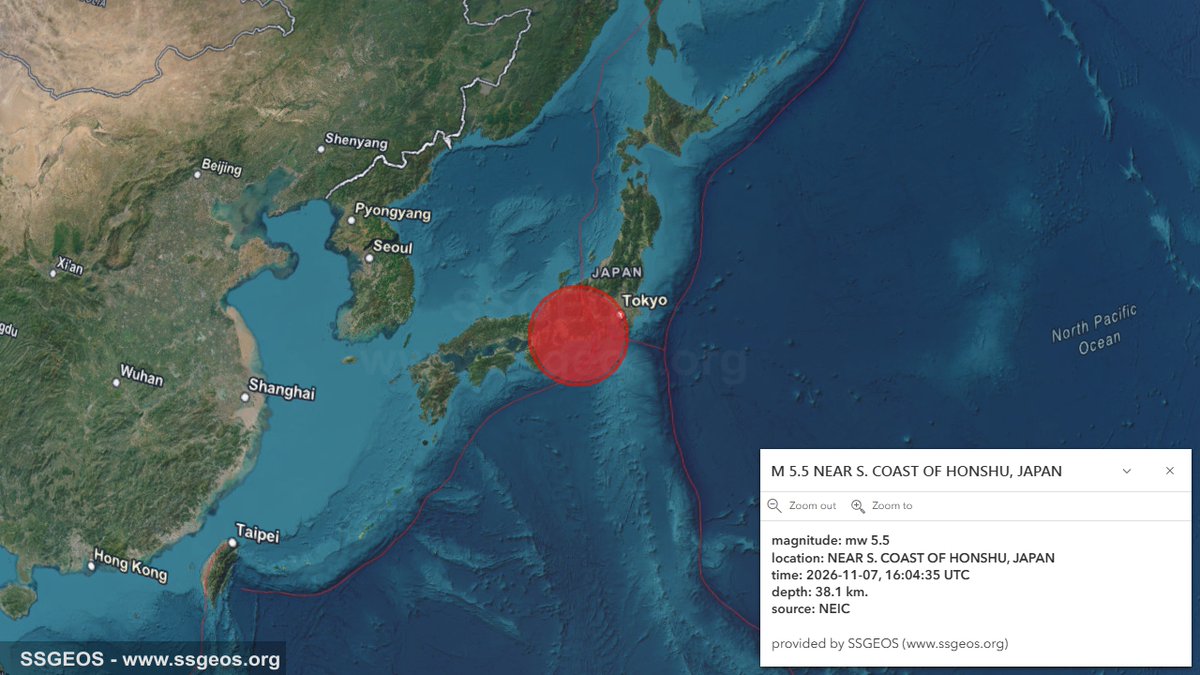
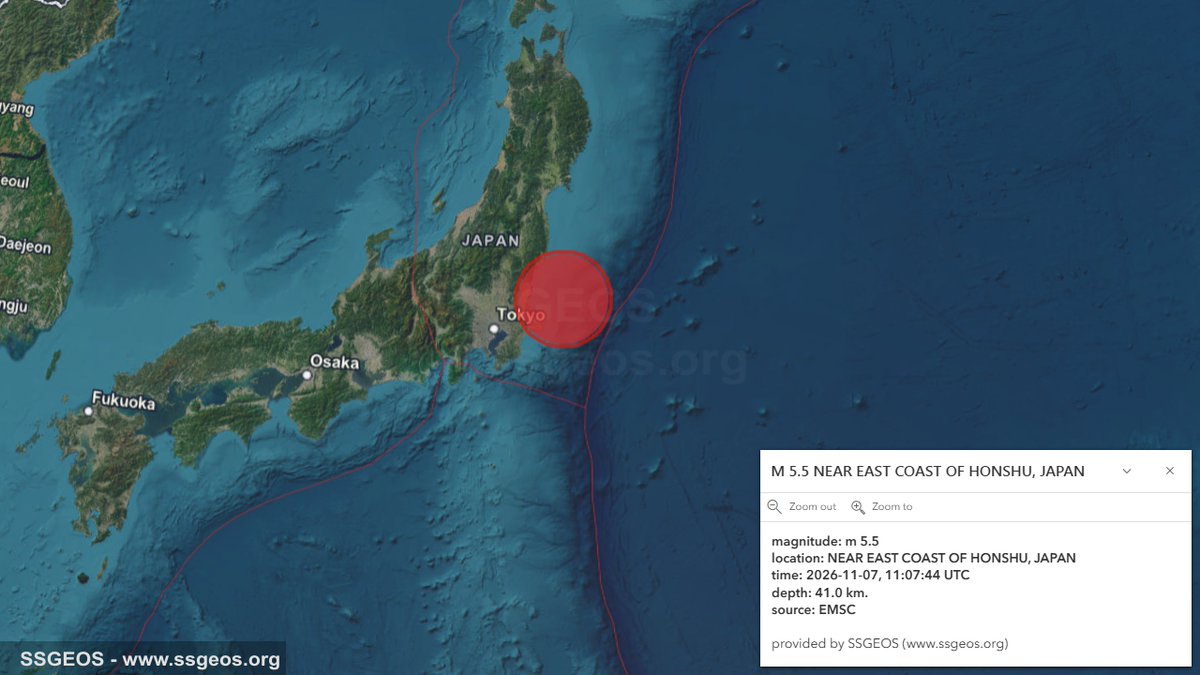
The planetary-lunar peaks around the New Moon that I discussed in the latest forecast thus far resulted in a M 6.4 at Santa Cruz and another strong shake (M 5.7) in Japan this morning. Japan has been seismically very active near eastern and southern Honshu.
Notable moderate #earthquake M 5.1 LAKE VICTORIA REGION, TANZANIA. Based on historical data, East Africa has experienced some major tremors (M6.9-7.2) in the past. Last time was M7.0 in 2006 in Mozambique. Last time in Tanzania was 1910 (M6.9) and 1919 (M 7.0).
WHAT IF THE GREAT FLOOD HAPPENED THOUSANDS OF YEARS BEFORE THE SUMERIANS EVER EXISTED?
I've been digging into something that I think needs a hell of a lot more attention.
Around 14,600 years ago, something extraordinary happened. Scientists call it Meltwater Pulse 1A.
Global sea levels rose roughly 14 to 18 metres in just a few centuries. That's about 450 to 600 feet of water added to the world's oceans.
I've been working on maps showing what different parts of the world looked like before this period of rapid melting and how those coastlines changed as the ice age came to an end.
The Persian Gulf was once largely dry land. Australia was connected to New Guinea and Tasmania through vast stretches of exposed land. Britain was connected to mainland Europe. Huge sections of the coastlines of China, Japan, North America, and South America looked completely different.
Then the slow moving pulse came. We're talking about rising oceans that kept taking land away from people over generations.
Think about living along a coastline where your grandfather's village is now underwater. Your father remembers land that no longer exists. By the time your grandchildren are born, the place your ancestors lived has completely disappeared.
You think people wouldn't tell their children about that?
Of course they fucking would.
Thousands of years later, the Sumerians are writing about a great flood that destroyed an earlier world. The Hindus have Manu. The Greeks have Deucalion.
Indigenous peoples across the world have their own accounts of lands disappearing beneath water.
What if they were recording something their ancestors had been talking about for thousands of years?
We already know that prehistoric people lived on land that is underwater today. Archaeologists have recovered stone tools from submerged landscapes around Australia. Researchers have also documented Aboriginal oral traditions that appear to describe coastlines that disappeared thousands of years ago.
The question is how far back those memories could go.
Meltwater Pulse 1A may have been one of the earliest and most dramatic chapters in a much longer period of flooding. Many of the coastlines shown in these maps disappeared thousands of years afterward.
This is why I'm comparing the geography, the dates, the archaeological evidence, and the ancient stories.
If we're going to investigate the origins of the Great Flood traditions, we should probably start by looking at the times when enormous parts of the human world actually disappeared underwater.
I think they were remembering the end of a world their ancestors once knew.
I think we've been looking for that world in the wrong fucking millennium.
@JasonWilde108 It's very well possible that these cultures around the world refer to the same event(s), given the similar stories and names in their traditions.
https://t.co/t19SrsBAlF
With the research currently conducted at Mount Ararat, Türkiye, it is interesting to note that the story of a flood is not limited to West Asia. Flood stories from around the world share the same plot: waters rise, a few survive, life starts again. Not only that, some even share practically the same name associated with the flood:
- In West Asia, the survivor is Noah (Arabic Nūḥ, Syriac Nūḥ, Greek Nōe).
- In China, Nüwa (女媧) patches the broken sky and stops the waters; in some tellings Nüwa and Fuxi survive a flood and remake humanity.
- In Hawaiʻi, Nuʻu (also Nana-nuʻu, Lana-nuʻu, “floating Nuʻu”) rides out Kai-a-ka-hina-liʻi and lands on Mauna Kea.
- Across Polynesia, Nuku-tawhiti, Nunuku, Ruanuku - voyaging and deluge figures in the same Pacific name family as Nuʻu.
- In Central America the god Titlacahuan instructs Nata to hollow out a great ahuehuete (cypress) and to get inside when the heavens come crashing down.
What conclusion can we draw from this?
@AbdulAl1417 We have a crossbreed dog from Bulgaria that has its tail straight most of the time and only somewhat up when his hunting instincts kick in. I think many shepherd-like dogs also have a straight tail.
Can anyone confirm that this is a wolf and not a dog? It was spotted in our region by someone who took this picture. There have been 8 unconfirmed reports of spotted wolves in our region this year, only 2 of which with a picture.
@Ruhbillimi2 Many single wolves have been spotted in the Netherlands in recent years, even in the middle of villages. The packs are primarily in the central and eastern parts of the country.