Binance is the most successful trading venue by a mile – and it has also expanded into payments and other real-world use cases to make the offering super compelling for many.
I have a lot of respect for what they, and many of the crypto CEX’s have built – but it bothers me that the onchain activity is still a fraction of the total activity.
Let's explore why that matters and how I think we finally flip the script this year.
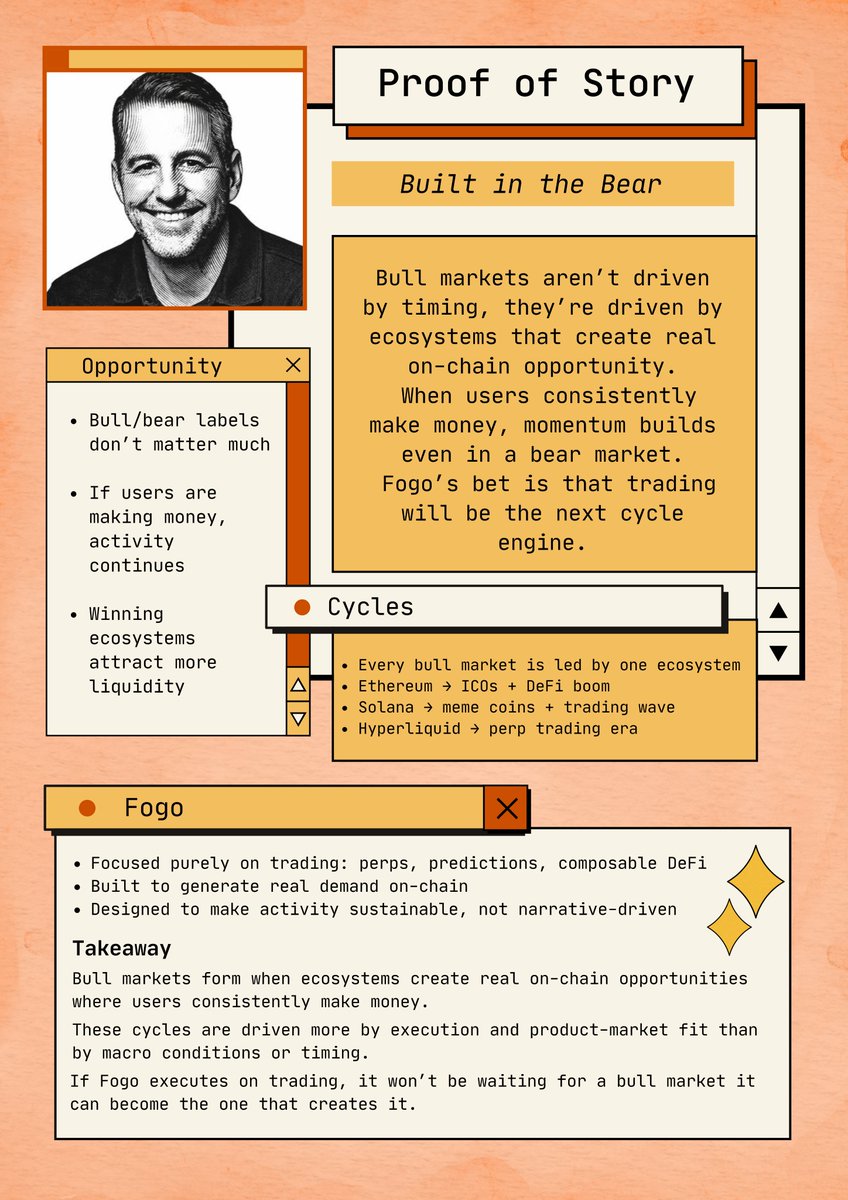
Proof of Story: Built in the Bear
Robert Sagurton breaks down a key idea: bull markets don’t just happen, they’re built.
This episode focuses on why L1s drive cycles and how Fogo plans to create its own momentum.
Here’s the recap:
1. Where Bull Markets Come From
Big cycles always start from one place.
•Ethereum had ICOs.
•Solana had trading and meme coins.
•Hyperliquid had perps.
People made money → activity grew → a bull market formed.
2. It’s About Opportunity
It doesn’t matter if the market is “bearish.”
If users are:
•making money
•finding opportunities
They stay and the ecosystem grows anyway.
3. What Fogo Is Trying to Do
The focus is simple:
•Perps
•Predictions
•Composable DeFi
Instead of trying to do everything, Fogo is targeting areas where real demand exists especially trading.
4. Building an Ecosystem That Prints Opportunity
The goal isn’t just usage, it’s profitability for users.
When:
•Traders make money
•Apps generate activity
•Liquidity grows
That’s when momentum builds and that’s what turns a chain into the center of a cycle.
5. Execution Is Everything
Fogo already has the foundation a scalable L1.
Now it comes down to:
•Shipping products
•Attracting traders
•Creating real on-chain activity
6. The Core Idea
Bull markets aren’t random. They’re created when one ecosystem gives users consistent ways to win.
Fogo’s bet is that if trading is built with the right speed, liquidity and user experience, it can become the core engine that drives the next crypto cycle.
HODLing has meant riding ATH all the way down, while swing traders win.
HODL is dead for most; trade smarter around what you believe. And the market being dominated by retail AI agents (CoLo’d) that take into account mean reversion and overbought and oversold conditions, are not far off.
If a way more performant perps DEX comes out (in @TheHUB ) that can arb Hyperliquid given the latency – will the traders continue to pay the HL priority fees to get the arb done? Or will they just stop trading on HL as it no longer makes sense?
Nobody knows – but seems like a lot riding on that question. 🤔
I can tell you I’ll be supporting optimized solutions and BD deals/incentives to force that answer.
And this is the reason it’s always better to optimize before you expand – as otherwise you’re just creating a giant target of capital/liquidity for the more optimized to take.
And cross-chain capital moving easier and easier with @near_intents and @wormhole
The pattern is simple: when an L1 ships real ways to have positive experiences onchain, it tends to drag the market with it.
That was true for Ethereum, it was true for Solana, and more recently it’s been true for Hyperliquid.
Here is why I think Fogo can do the same with perps, predictions, and composable DeFi and why I don’t spend much time worrying about the current macro sentiment of the day
Canton isn��t “the enemy.” They’ve executed, found real PMF, and built a sustainable business serious players clearly value.
Until we have multiple examples like that on the permissionless side, we don’t have much ground to stand on. So I’d rather treat them as motivation than something to throw shade at.
And with smarter, purpose‑built environments like Fogo, the HUB, etc., I think we will get to more sustainable models that serious institutions can’t ignore.
Bit of a level set video here on how all these things I’m talking about fit together.
Also, we didn’t start Fogo to enable a predictions product – we started it to build the best trading L1 and fix what traders hated about existing venues.
But the perps stack being built turns out to be a huge advantage for predictions too (as evidenced by the legacy venues having to toss their “trading environments” recently). So that’s becoming another part of the Fogo story, and it will happen natively on Fogo.
Here’s what I’m focused on and how it all fits into the bigger picture: