Been exactly a year since we launched water purifiers
We now have TDS data from tens of thousands of Atomberg water purifiers installed across the country
And we combined that with publicly available data from different government sources like central pollution control board, jal jeevan mission and central ground water board
And built a free tool where you can enter your pincode and check your water quality- TDS levels, TDS variance, chemicals present etc
Sharp piece. He has a precise grip on a lot of the questions that matter here, which not many Indian writers manage. He nails the core point: BYD, Huawei, CATL and the rest were never picked from the top of the table. They clawed up from the cheap end of markets nobody important was watching, and India's PLI machinery is built to find exactly the firms that least need finding.
I'd add one thing the piece leaves implicit. An unlocked side door is only half the story. What actually made those firms is the room they walked into once inside, a domestic market with brutal competition and a complete supply chain, where a decent product quickly becomes a cheap one and a slow company simply dies. The state's tolerance mattered; the competitive pressure mattered more. The room is the real story, a market where standing still gets you killed.
The one thing he is light on is that this openness has a hard edge. The same space that lets a BYD grow also lets a few founders overreach, and the ones who do tend to end badly, investigated, fined, and stripped of the empires they built. India would do well to copy the competition, and to keep that hard edge along with it.
#India #China #BYD #PLI
I love this from the New York Times about how AI is being used in farming. Great examples like: cows can go to the robot milker when they need rather than on an uncomfortable schedule, lasers to kill weeds without pesticides, etc. Farmers have long adopted new technology early.
"The Illusion of Comparability Among Standardised Effect Sizes: Why Education Evaluations Should Report Raw Effects"
New @CGDev working paper (with Rossiter, Hares, and Henny) https://t.co/b0Y7kF5Bv7
Summary blog post https://t.co/5Rb1f1YFJJ
Had a Jane Street phone interview in 2016. "Price a 6-month forward on carrots."
There's no carrot futures market, so I build one from scratch: seasonal harvest cycles, USDA demand elasticity, cold storage decay rates.
One trader stops me. "Your storage cost function– you're modeling the carrot as dead inventory. Like grain in a silo." He asks me the metabolic respiration rate of a post-harvest carrot at 2°C. I estimate.
"Your forward is overpriced by exactly that shrinkage. The underlying is consuming its own sugars. It's alive." Good correction. I adjust the model. I think I've recovered.
Rejection email comes the next morning. Subject: "Ethical Review." My framework, they write, "relied on the severance of the root organism from its growth medium." The question about respiration was a test. The carrot was still alive and I'd built an entire derivatives structure on top of its death without questioning whether harvest was an acceptable act.
I pull up the recruiter's original email. It doesn't say Jane Street. It says Jain Street– a non-violent quantitative commodities fund.
The carrot was never supposed to be priced. It was supposed to be refused. I later learn the only candidate who passed that round was a former monk from Gujarat who sat in silence for eleven minutes and said, "I cannot put a price on life." He's now a partner.
Iranian Muslims are now using AI to get answers to religious questions, bypassing Shia scholars. So ayatollahs are now debating whether AI can substitute for religious scholars. Surprisingly, they agree that seeking guidance from LLMs is permitted under certain conditions.
India trained a post-colonial elite that is exceedingly skilled at talking about India's problems, but totally inept at fixing them. Unsurprisingly, it is a commonly held view among this class that even attempting to fix India's problems is futile without first ushering in a
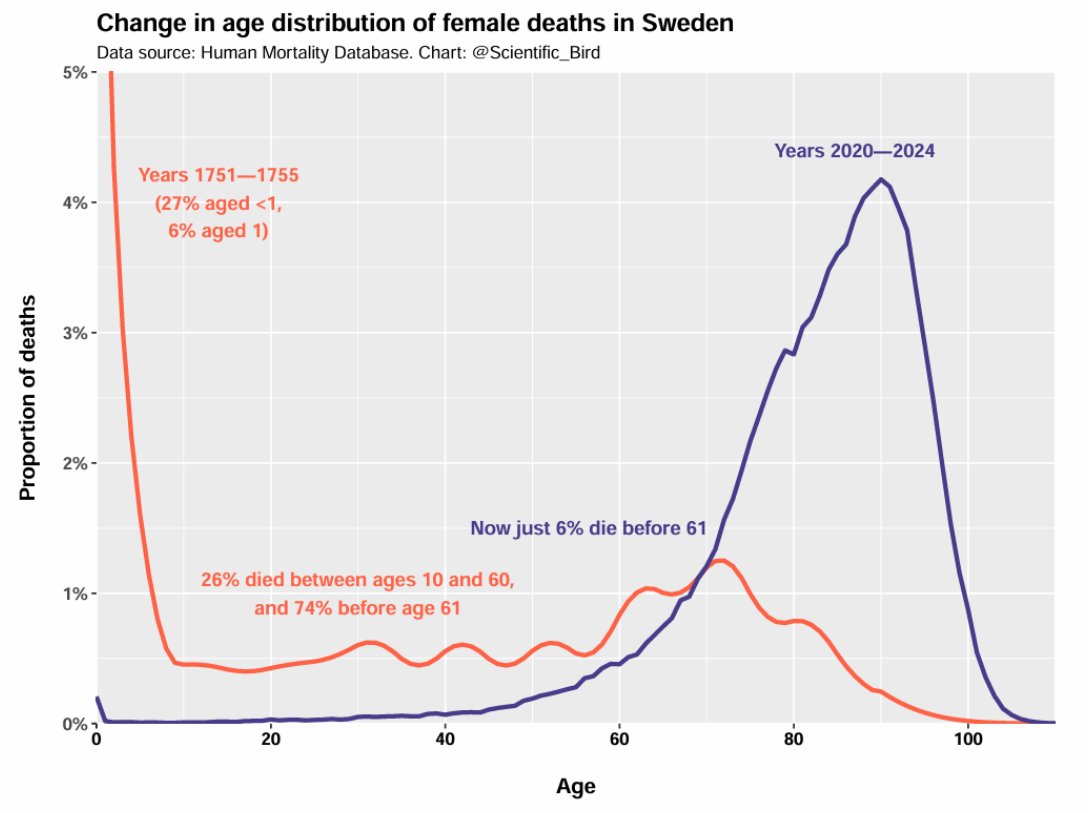
In the 18th century, there was a real chance of death at any point in life, and there wasn't a big peak in old age.
It wasn't just higher infant mortality - the whole distribution was completely different.
Great chart by @Scientific_Bird.
Since @thekaipullai has started this topic on corruption in public life, I shall narrate a real-life experience on how corruption is so deeply rooted. I was deployed as an Expenditure Observer for the Karnataka Assembly elections (2018) in the Chikkaballapur district. #corruption
Maggie Rogers, as an unknown music student at NYU, showing her unfinished song 'Alaska' to Pharrell (who can visibly tell it's going to be a massive hit within about 15 seconds)
A Chinese supervisor helps an Indian worker on an assembly line at a Highly Electrical Appliances India air-conditioner compressor plant in Matoda, some 20km from Ahmedabad.
NEW VIDEO - on the state of Bengaluru's roads, BBMP's lust for more flyovers & tunnels, and India's urgent need for legitimate urban governments 🗳️
Enjoy!
https://t.co/e0wLKcvbkv
NEAT: How do you compare test scores across countries, when they take different standardized tests in different countries?
Have a group of kids take all the tests, make a conversion formula.
Conclusion: rich/poor exam differences are higher than we thought.