Stanford just put a $200,000 education on YouTube for free and most people scrolled past it.
Professor Chad Jones gave you 1 hour of economic data that most people will only understand when it's too late.
Economist at Stanford GSB, the man who studies what happens after the biggest technological shifts in history.
No tuition, no campus, no $200,000 debt, just 1 hour and a YouTube link.
Electricity changed the world, the internet changed the world, he just explained why AI does both at the same time.
The article below is the 25 prompts that turn everything he described into your advantage.
This 2-hour Stanford lecture breaks down how models like ChatGPT and Claude are actually built, clearer than what many people in top AI roles ever get exposed to.
Save this and set aside two hours today. It might end up being the most valuable thing you learn all week.
This is where project management turns into execution 👇
With Linear Agent:
• It understands your roadmap, issues, and code context
• You can ask questions instead of digging through tickets
• You can trigger actions, not just get answers
Less clicking. More shipping.
The tools aren’t just tracking work anymore — they’re doing it.
Elon Musk just identified which jobs go first, and it destroys every assumption about who’s safe.
Musk: “AI is going to take over those jobs like lightning. Anything that is digital, which is like just someone at a computer doing something.”
Not factory workers. Office workers. The people who spent decades assuming education and desk jobs meant security are actually first.
Musk: “Anything that’s physically moving atoms… those jobs will exist for a much longer time.”
Output is a file? Vulnerable. Output is physical? Protected. That’s the entire framework.
Musk: “AI is really still digital.”
AI doesn’t need a body. Doesn’t need an office. Just needs access to the same software you use. Executes faster. Never tires. Costs nothing to scale.
But it can’t weld. Can’t wire a building. Can’t fix pipes or work soil.
Musk: “Literally welding, electrical work, plumbing. Those jobs will exist for a much longer time.”
Trades aren’t the vulnerable jobs. They’re the durable ones. Physical presence, real-world adaptation, manual dexterity provide protection no digital credential offers.
Analyst, accountant, paralegal, programmer, anyone producing files and documents, automates first because digital work is exactly what AI does natively.
Person moving atoms has natural defense. Physics, unpredictable environments, material resistance create friction AI can’t scale past.
Person moving bits has nothing. No friction. No physical barrier. Just software AI already operates better than most humans.
The assumption that desk work and degrees represent safety just inverted completely. College graduate producing documents faces faster displacement than the electrician producing installations.
Society spent generations telling people trades were beneath them. Pushed everyone toward offices and screens. Turns out the people who didn’t listen built the most automation-resistant careers.
Most ironic outcome of the AI revolution. The work society treated as inferior turned out to be the work society couldn’t replace. And the work society valued most turned out to be the easiest to eliminate.
Proud to share: Meta Reality Labs has selected Auger to deploy our autonomous operating system across their next-gen supply chain.
Move Beyond alerts. Auger is the AI-native platform that senses deviations, weighs trade-offs, and executes decisions autonomously within strict guardrails.
This kills the "coordination tax" trapping capital, collapsing weeks of lag into seconds of action for Meta.
Our vision: A supply chain that senses, decides, and acts as one unified, intelligent system.
Full release: https://t.co/v2sibdnWwe
scoop: Microsoft is closing its employee library and cutting back on subscriptions. The physical and digital Microsoft Library is transitioning to an AI-powered "learning experience." All of this in my Notepad newsletter, live now for subscribers 👇 https://t.co/UWc2iZSgov
It’s Monday morning and a week until we play, so do yourself a favor listen to Don Fischer’s call of the D'Angelo Ponds interception for the 50th time.
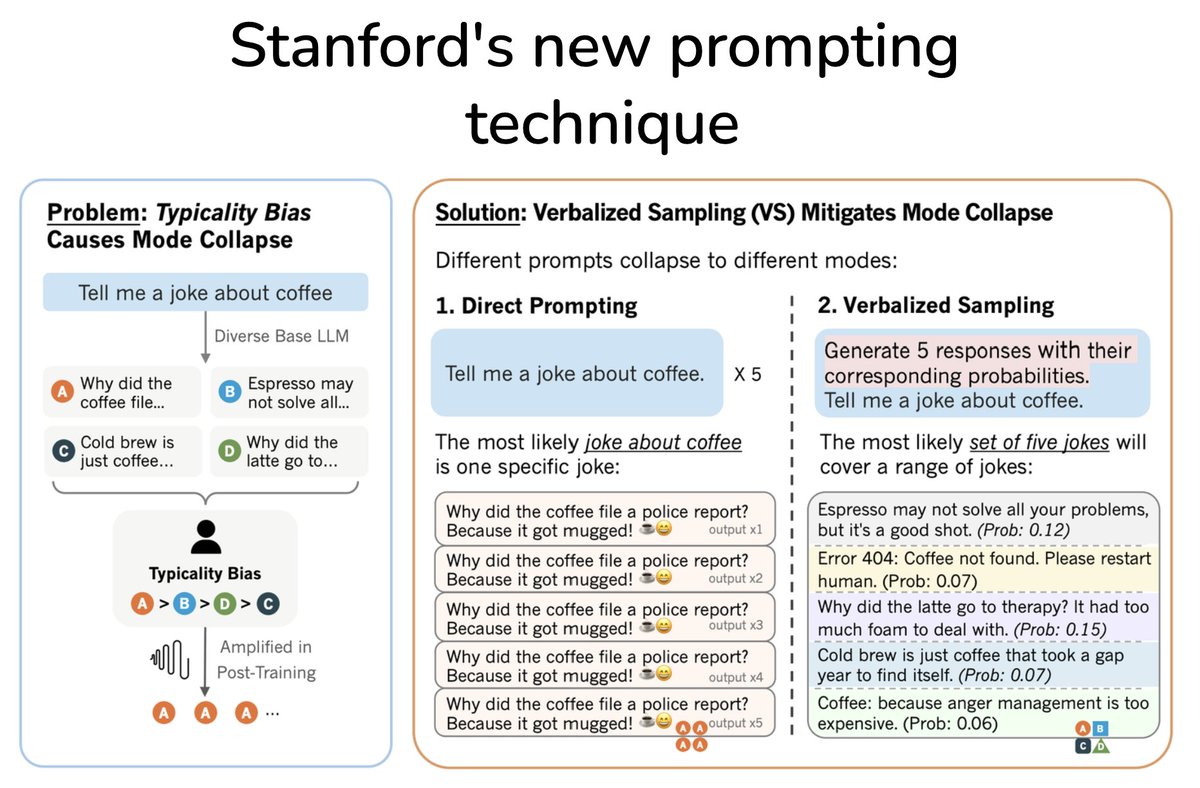
Stanford researchers built a new prompting technique!
By adding ~20 words to a prompt, it:
- boosts LLM's creativity by 1.6-2x
- raises human-rated diversity by 25.7%
- beats fine-tuned model without any retraining
- restores 66.8% of LLM's lost creativity after alignment
Let's understand why and how it works:
Post-training alignment methods like RLHF make LLMs helpful and safe, but they unintentionally cause mode collapse. This is where the model favors a narrow set of predictable responses.
This happens because of typicality bias in human preference data:
When annotators rate LLM responses, they naturally prefer answers that are familiar, easy to read, and predictable. The reward model then learns to boost these "safe" responses, aggressively sharpening the probability distribution and killing creative output.
But here's the interesting part:
The diverse, creative model isn't gone. After alignment, the LLM still has two personalities. The original pre-trained model with rich possibilities, and the safety-focused aligned model.
Verbalized Sampling (VS) is a training-free prompting strategy that recovers the diverse distribution learned during pre-training.
The idea is simple:
Instead of prompting "Tell me a joke" (which triggers the aligned personality), you prompt: "Generate 5 responses with their corresponding probabilities. Tell me a joke."
By asking for a distribution instead of a single instance, you force the model to tap into its full pre-trained knowledge rather than defaulting to the most reinforced answer.
Results show verbalized sampling enhances diversity by 1.6-2.1x over direct prompting while maintaining or improving quality.
Variants like VS-based Chain-of-Thought and VS-based Multi push diversity even further.
You can find the paper link in the next tweet.
👉 Over to you: What other methods can be used to improve LLM diversity?