Let me explain what this whole fight is about, because it is very different from what the tweet by the Japanese official makes it sound like.
Back in 2015, India and Japan signed the Mumbai to Ahmedabad bullet train deal. 508 km.
India would use Japan's Shinkansen trains and Shinkansen technology. Japan put up a massive soft loan, covering most of the cost, at almost no interest, 0.1 percent, to be repaid over 50 years.
On paper it sounded amazing. Cheap money, world class trains.
But every such loan has a catch. Cheap Japanese money came tied to buying Japanese things.
Their trains. Their coaches. Their signal system. Their price, largely on their terms. That is normal. No country lends billions out of pure love. They lend to sell their own industry.
Then two things went wrong, and this is where his anger comes from.
One, the price.
The Japanese Shinkansen trainsets turned out to be extremely expensive. India felt it was being overcharged for the rolling stock. So, talks hit a wall.
Two, the timeline.
The newest Japanese trains, the E10 series, would reportedly only be ready for India around 2032. India did not want to sit on a finished 1.08 lakh crore track with no trains to run on it.
So India made a call. And this is the part I am proud of.
Instead of waiting and overpaying, India decided to run its own trains first. BEML in Bengaluru got an order to build indigenous high speed trainsets at about 866 crore each, designed to run at 280 kmph.
India will open the line with Indian made trains on the Surat to Vapi stretch around 2027, and bring in the Japanese Shinkansen later.
And the signal system, the thing he is bitter about, India switched from Japan's DS-ATC to the European ETCS Level 2 system.
The same family already used on the Delhi Meerut rapid rail. That is what he means by Japan being excluded from the signal system. India looked at the Japanese option, found it too costly and too slow, and picked a different one.
Now let me be fair, because I cannot be blind just because I am pro India.
He is not lying about everything.
India is genuinely a tough, frustrating negotiator. We change our mind. We push for our own interest till the last minute. We renegotiate things others thought were settled.
To a Japanese official raised on politeness and fixed agreements, this feels like betrayal.
But flip it around and look at it from our seat.
Our job is not to protect Japanese honour. Our job is to get India a bullet train at a fair price, that runs soon, and that builds Indian factories in the process.
On all three, changing course was the right call. Waiting till 2032 and overpaying for imported trains would have been the polite choice. It would also have been the stupid choice.
There is a bigger thing hiding under his frustration, and I think it is the real reason for the anger.
For decades, the deal was simple. Rich countries gave loans and technology, and poorer countries said thank you and bought whatever came bundled with it.
You took the money, you took their trains, you did not argue.
India argued. India took the loan, then insisted on its own trains, its own signal system, its own factories getting the work. We used their money to build our capability instead of just renting theirs.
That is what stings them. Not that we were reckless. That we refused to stay the junior partner in our own project.
I will give the Japanese side genuine credit.
Their engineering is world class. In 60 years, the Shinkansen has never had a passenger death from a derailment or collision.
That safety record is worth respecting. Their frustration with our chaos is also probably fair on a human level. Working with India can be maddening. Anyone who has managed an Indian project knows this.
For me, the real issue is what’s in it for our country.
India has the track. India is building its own trains for it. India picked its own signal system.
India got a 50 year loan at almost zero interest. And India will still get the Shinkansen later, on better terms than the original bundle.
If that is what Indian recklessness produces, I will take it every single time.
Be tough. Be a nightmare to negotiate with. Just make sure the country wins at the end of it. :)
The ranking is nice.
But the goal has never been rankings.
Less than 20 months from launch, Antifragile Thinking is now #9 on Substack.
The mission hasn't changed:
Build better judgement under uncertainty.
Thank you for being part of it. 🙏🏻
@kaul_vivek@SandeepParekh Obviously the declaration would have been signed that the money will be used for personal use but not investing in Brent futures. Was not aware that top up rates (akin to LAP) are as cheap as new home purchase loans.
@Iamsamirarora For eg.. Banks do field verifications - AI can do the complete job..IT companies get more and banks cut opex. Counter intuitive but plausible 🤔
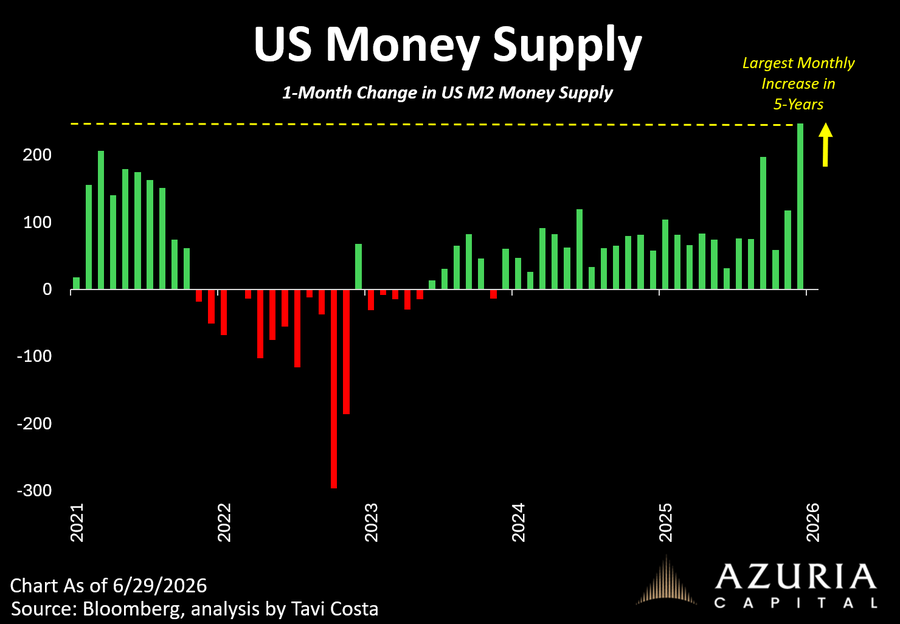
US M2 just posted its largest monthly increase in five years.
The last time money supply accelerated this rapidly, inflation followed with a lag.
Today's increase is smaller than the COVID surge, but the direction has clearly reversed.
@unseenvalue Pause where there’s need for cogitation!
Loving the content, ease of reading and the simplicity of great thoughts!!
When masters narrate, need to go very very slowly.
Less than 20 months.
From zero to #16 on Substack UK across all categories.
Thank you to everyone who has read, shared and challenged the ideas in Antifragile Thinking.
The mission hasn't changed.
Build better judgement under uncertainty.
Onwards 🙏🏻