You know @VitalikButerin.
You know @IOHK_Charles.
You know @gavofyork.
But most investors still haven’t heard of the fourth man: @feindura.
The co-creator of ERC-20 and web3.js is now building @lukso_io — an entirely new digital foundation for identity, ownership and culture onchain.
By the time everyone knows his name, it may already be too late.
2014 I was locked out my banks count while traveling India. I noticed that with only 250 rupees left in my pocket and had to sleep on the streets of Kanyakumari. Only the kindness of locals helped me through that crisis. I feel for the Paraguayans.
Paraguay just froze a single bank and locked out 3 million people. that's roughly 60% of every adult in the entire country.
salaries, pensions, life savings. gone overnight, and they can’t do anything about it.
I know most of us in western countries don't have these problems (yet), but this is the entire reason crypto exists. just trust is a terrible foundation for the one thing you can't afford to lose.
I'm so sick and tired of people writing crypto off as "just speculation" instead of finally waking up, after decades, to how unacceptable the traditional financial rails actually are.
sadly it always takes a black swan that hits people personally before they finally get it.
@easonchaiii@EFDevcon reminds me of last Token2049. My theory is that the organizers are giving out free tickets to make the venue look busier. I remember a group of nice asian ladies grabbing all they could get.
TBF, India has a much different concept of personal space.
The Binance hacker might have just pulled off one of the smartest moves I’ve seen in crypto.
First, Tether froze $1.5 billion in USDT.
Then Circle froze another $800 million in USDC.
At that point, it looked like the hacker’s money was trapped.
But apparently, he had already planned for that.
Instead of holding the stolen USDT in a wallet, he allegedly deposited it into Aave and used it as collateral to borrow ETH.
Then he walked away.
That’s where the story gets crazy.
Tether can freeze the USDT sitting in the wallet.
But it can’t freeze the ETH he already borrowed.
So now Aave is left holding frozen collateral, while the hacker is sitting on liquid ETH.
And unless the protocol can recover it somehow, he may not even need to pay the loan back.
Two companies froze billions of dollars in seconds.
But someone who understood how to use DeFi may have found a way around both of them.
Pretty insane when you think about it.
@alice_und_bob I was wondering how you’re doing and glad to see this post. Wouldn’t a fall back option be to join an existing consultancy? Feels like this is a current bread and butter job.
Breaking: Michael Burry says the AI boom is running on one giant loop and time is running out
Here's his breakdown:
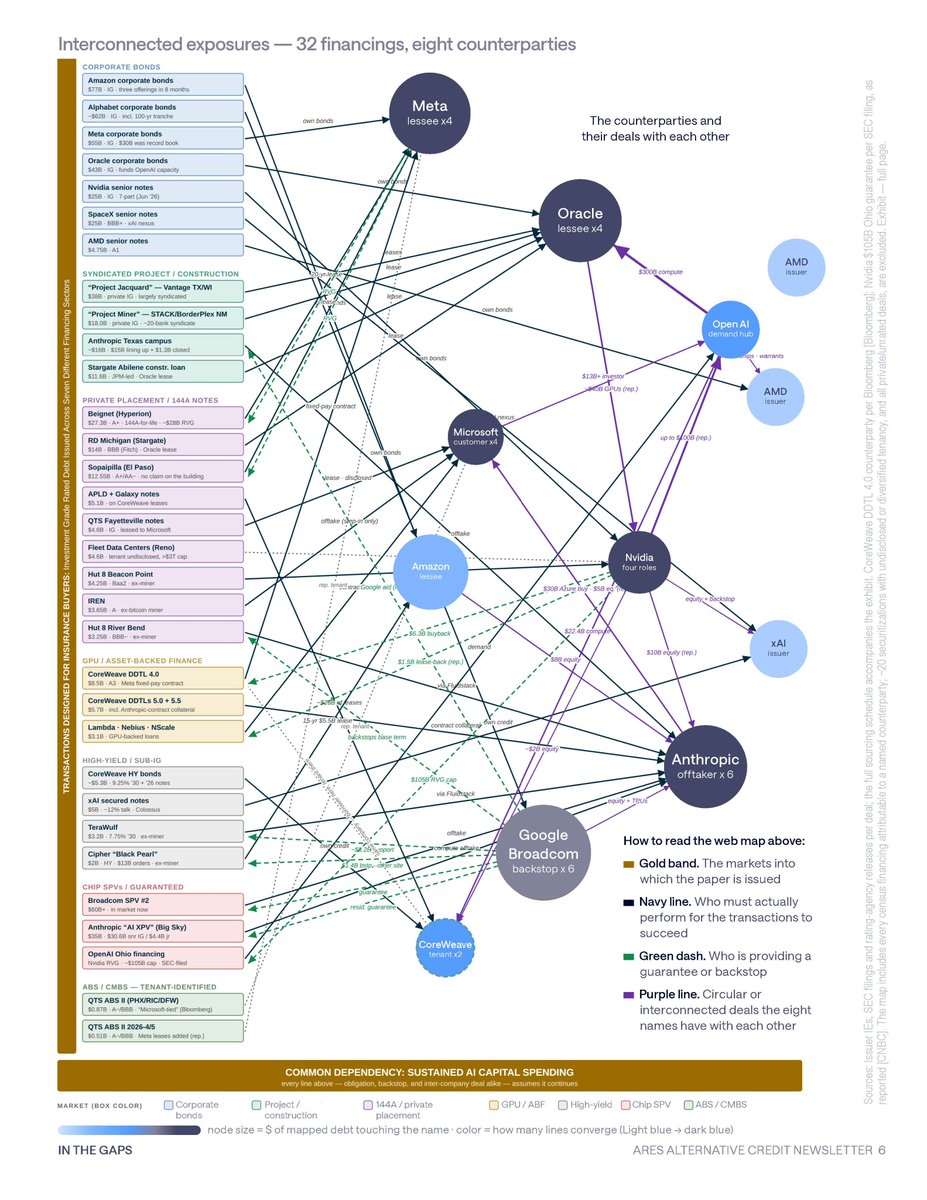
1. Burry shared a report from Wall Street lender Ares tracking $573B of AI financing from the last 12 months
2. All of it runs through just 8 companies: Meta, Oracle, Microsoft, Amazon, OpenAI, Anthropic, Broadcom and Nvidia
3. They lend to each other, guarantee each other's debt and buy from each other, so one company's loan is backed by another company's promise to keep spending
4. Every deal depends on one thing: AI spending never slowing down
5. If AI revenue disappoints for even one season, the guarantees could all get called at once, right when the companies backing them are at their weakest
6. Burry says it's the same circular financing that turned the 2000 telecom fiber boom into a bust
Burry claims the stock market in the first stage of grief and the crash is soon
Welcome @alexdimes7 from @Yieldy_io as our eighth and final Roadshow #5 contestant! 🌊
Yieldy is building a one-click, non-custodial way to route stablecoins toward risk-adjusted yield across chains.
Catch us on X live today from 7PM UTC / 12PM PT
Kryptobesteuerungspläne in Deutschland 🇩🇪 was bisher kaum diskutiert wird
Über die geplante Reform der Kryptobesteuerung in Deutschland wurde hier und in der Community schon viel diskutiert. Ein Punkt kommt mir dabei bisher viel zu kurz und sollte in meinen Augen dringend angepasst werden, sollte der Entwurf durchgehen (was ich nicht hoffe, aber leider relativ wahrscheinlich ist):
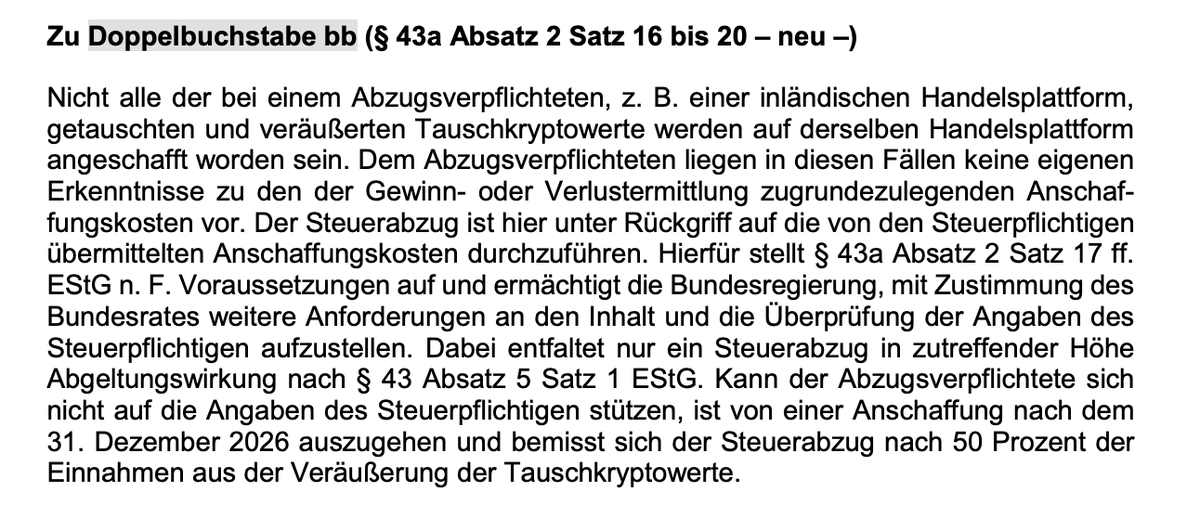
Die geplante 50%-Ersatzbemessungsgrundlage (siehe Screenshots anbei, aus dem Referentenentwurf des BMF (frühestes Entwurfsstadium, noch vor Kabinettsbeschluss, aber die Richtung ist klar erkennbar).
Kurz erklärt: Kennt die Krypto-Plattform deine Anschaffungskosten in Zukunft nicht und kannst du sie nicht sauber und glaubhaft nachweisen, wird pauschal unterstellt, du hättest die Coins nach dem 31.12.2026 gekauft – und die Steuer wird auf 50% des Verkaufserlöses berechnet. Rechnet man das durch, unterstellt der Staat damit faktisch eine Kursverdopplung zwischen Kauf und Verkauf.
Meine Befürchtung: Genau das trifft vor allem Normalverbraucher/investoren hart. Leute, die diese Regeländerung gar nicht mitbekommen, ihre Anschaffungskosten technisch nicht sauber nachweisen können, und die in den letzten Jahren teils mit wenig Gewinn oder sogar mit Verlust gekauft haben. Die zahlen dann unter Umständen massiv zu viele Steuern, obwohl real gar kein entsprechender Gewinn entstanden ist – im Zweifel sogar bei einem Verkauf mit Verlust.
Ich bin auf dem Feld alles andere als ein Experte, aber mir erscheint das implizite Ausgehen von einer Kursverdopplung deutlich zu hoch angesetzt. Bitcoin zum Beispiel steht heute niedriger als vor einem Jahr, und auch im Vergleich zu den Höchstständen der letzten zwei Jahre liegt der Kurs klar darunter. Die allermeisten anderen Kryptowerte sind in diesem Zeitraum noch deutlich schlechter gelaufen.
Der Ottonormalverbraucher wird in meinen Augen, wenn das nicht angepasst wird, deutlich zu viele Steuern zahlen, falls er, was ich bei vielen befürchte, die Anschaffungskosten nicht sauber und überzeugend nachweisen kann.
Oder übersehe ich hier etwas? Bin für jeden Hinweis dankbar.
📄 Quelle: Referentenentwurf BMF, § 43a Abs. 2 (neu)