I’m a massive Paul Weller fan. The whole shebang: The Jam, The Style Council, his solo career. Pretty much his entire back catalogue is bloody good and at times, absolutely brilliant. One of the best British rock stars over the past 50 years. He’s also a bloody stylish bloke.
As I get older I will never understand adults who are embarrassed about their age. Why are you sad and embarrassed that you've existed for a while? Why is it "rude" for someone to ask you how old you are? Why would you want people to think you're in your 20s if you're really in your 30s or 40s or 50s? It should go the other way. Age and experience should be a point of pride, if anything. The glorification of youth, and the desire to stay in that state forever, is the most retarded feature of the modern world. We used to revere our elders. Now we revere 23 year olds. Because why exactly? They don't know anything and haven't done anything. It's insane.
Protestants partake of the Lord’s Supper as Scripture portrays it: a holy covenant meal in which believers remember Christ’s once-for-all sacrifice, proclaim his death until he comes, and truly commune with the risen Christ by faith through the Holy Spirit.
We do not deny the real presence of Christ at the table. We deny that Christ’s presence must be defined by the later metaphysical categories of transubstantiation.
Roman Catholicism does not get to redefine the Supper centuries after Christ and the apostles in a way that goes beyond Scripture, and then compel all Christians to receive that scholastic definition as though it were apostolic doctrine.
The issue is not whether Christ is truly present at the Table. The issue is whether Scripture requires us to confess that the substance of bread and wine ceases to remain while only the accidents remain. That is the burden Rome has not met.
The Roman Catholic backlash to @gavinortlund and @WesleyLHuff has been instructive. Both men are irenic, careful, and respectful in how they address what they believe are errors in Roman Catholic doctrine. Yet both have drawn deeply personal attacks for their apologetic work. This raises an important question many Protestants are asking: why do thoughtful, respectful critiques of Roman Catholicism often provoke such a visceral response?
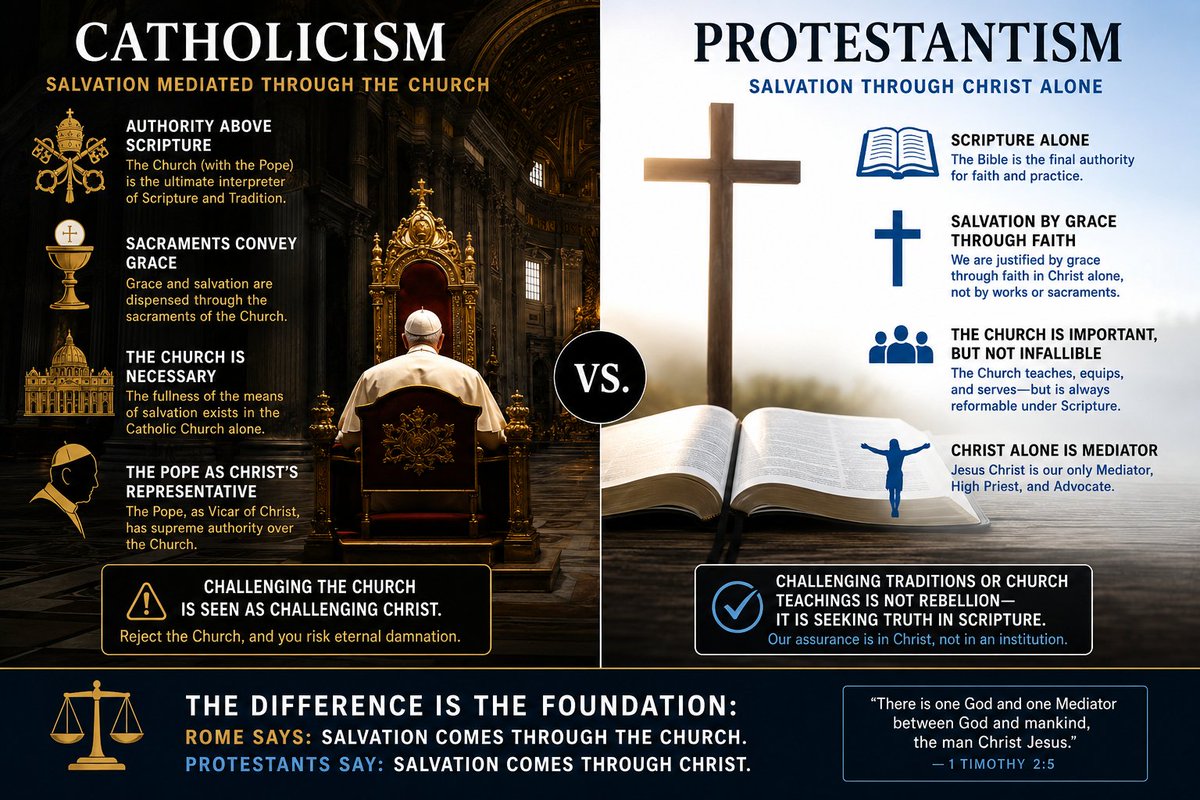
The visceral reaction many Catholics have when Rome is challenged makes sense once we understand the Roman Catholic system. Rome is not merely one church among others in their theology. It is the visible institution possessing the fullness of the means of salvation, the sacramental economy, the authentic interpretation of Scripture and Tradition, and the Petrine office of universal authority. Therefore, to challenge Rome is not received as a mere doctrinal disagreement. Rather, it is received as an attack on the what they believe is the very structure by which Christ supposedly teaches, governs, absolves, and saves.
In contrast, Protestants are less threatened by challenges to a particular church tradition because Protestantism, at its best, does not locate salvation in institutional submission. The Baptist does not need the Baptist church to be indefectible. The Presbyterian does not need every presbytery to be incapable of grave error. The Lutheran does not need Wittenberg to be the necessary center of visible unity. Protestants argue fiercely, but their assurance rests finally in Christ’s finished work received by faith, not in the claim that one visible hierarchy or institution uniquely dispenses the fullness of saving grace.
That is the real issue: Rome’s authority claims make historical criticism an existential threat. Protestantism can admit that church history is messy because the visible Church is always in need of reform. Protestants can also recognize ambiguity in the historical record and draw reasoned conclusions that differ from others without collapsing the faith. Rome cannot do this so easily. If too much historical complexity is admitted, Rome’s claim to be the indefectible guardian and interpreter of the apostolic deposit begins to weaken. History must produce clear answers because Rome must show that she has always taught what she now requires believers to confess—whether baptismal regeneration, Eucharistic transubstantiation, or papal supremacy. If the historical record shows change, ambiguity, contradiction, or later accretion rather than apostolic continuity, the entire sacerdotal system is threatened.
So when a Roman Catholic lashes out at a protestant theologian or historian who is making an argument that runs counter to the approved narrative, the issue is often deeper than the topic being debated. The Protestant is arguing about history or doctrine. The Catholic may feel that their whole edifice of certainty, grace, authority, and salvation is being pulled down. And in a sense, the Catholic is right to feel critical importance of the stakes. If Rome is wrong about herself, then she is not merely wrong about secondary matters. She is wrong about the very place she has assigned herself between Christ and the believer.
Activist: "Your cows are putting carbon into the atmosphere."
Farmer: "Where did they get it?"
Activist: "What?"
Farmer: "The carbon. Where did the cow get it before it put it anywhere."
Activist: "From... eating?"
Farmer: "From eating grass. And where did the grass get it."
Activist: "The soil?"
Farmer: "The air. The grass pulled it out of the air last spring. The cow ate the grass. The cow breathed some of it back out. It went back into the air it came from."
Activist: "But it's still going into the atmosphere."
Farmer: "It's going back. There's a difference between a thing going somewhere and a thing going back. You've described a circle and you're frightened of it."
Activist: "Then just don't have the cow."
Farmer: "The grass still dies in autumn. It rots where it falls. The carbon goes back into the air either way, just without anyone getting fed in the middle."
Activist: "It's not that simple."
Farmer: "It's grass, cow, breath, grass. Or it's grass, rot, air, grass. Same circle, fewer dinners. If that's complicated for you I'd stay away from the water cycle. That one's got clouds in it."
"The fact of the matter is: the more kids are trans, the more money she makes."
I spoke to @piersmorgan about my recent speech at the Cambridge Union. There are people profiting from trans ideology - people who must be called out.
The BBC tries to make selling your daughter to child rapists sympathetic.
👇
It’s a barbaric country that treats women as less than livestock, guys!
@BBCNews
I remember vans like this as kids. Most things have been thought of before. And come around again. The isolation our older generation is feeling, with technology taking over, & less social & community cohesion is worrying. Lovely idea 👍🏻👇🏼 people need people not just packages