Stick Your Tongue Out: The Silent Release
Dr. Elena Vasquez had seen thousands of patients at Mount Sinai, but Marcus was different.
A 42 year old software engineer, he arrived with shoulders permanently hunched, eyes shadowed by perpetual exhaustion, and cortisol levels deep in the clinical anxiety range.
Therapy and medication adjustments brought little change. His body was locked in a silent civil war.
One afternoon, after reviewing his latest scans, Elena made an unusual request.
“Stick out your tongue,” she said. “As far as you can. Hold it for forty seconds.”
Marcus blinked. “Is this a test?”
“Consider it an experiment,” she replied, her voice calm but certain.
He complied, feeling ridiculous at first. The muscle strained, unfamiliar and awkward. His jaw trembled. His neck, usually rigid from years at a desk, began to burn with a deep, releasing ache. Forty seconds felt eternal.
“Do this twice a day,” Elena instructed. “Morning and evening. That’s all.”
Marcus left skeptical. But he tried it anyway.
The first few days brought nothing but mild soreness. Then, on day six, he noticed something strange during his morning routine: his shoulders dropped an inch without effort. The constant low hum of background tension, the one he had lived with so long he forgot it existed, had quieted.
By day twelve, his wife commented that he seemed lighter. Less reactive to traffic, to deadlines, to the thousand small irritations that once wound him tight. When he returned for bloodwork two weeks later, the numbers confirmed what he already felt: his cortisol had plummeted from dangerously high to the middle of the normal range. No medication changes. No new therapy. Just the daily tongue extension.
Elena was not surprised. She had studied the hidden architecture of chronic stress for years.
The neck carries an enormous burden, often 60 to 80 percent of the body’s accumulated tension. That tension does not stay polite. It compresses the vagus nerve, the body’s master regulator of calm.
It restricts the gentle flow of cerebrospinal fluid that bathes the brain. It keeps the entire nervous system whispering danger even when the world is quiet.
The tongue, surprisingly, is the key. It connects directly to the hyoid bone, that floating anchor for the deep muscles of the throat and neck.
When you extend the tongue fully, you create a gentle but powerful traction through the fascial chains, those webs of connective tissue running from jaw to chest. Like loosening a knot that has been pulling on everything downstream.
One simple movement. Forty seconds. Twice a day.
Marcus became her quiet advocate. He taught the technique to his overworked colleagues, his stressed sister, even his skeptical father. Some felt nothing. Others, like him, experienced a profound unwinding.
Years later, when people asked Elena about her most elegant intervention, she would smile and say:
“The brain is rarely the villain. More often, it is simply what is wrapped around it, layer after layer of unnoticed armor. Sometimes the most powerful medicine is learning how to take it off.”
And in those moments, she would remember Marcus: the man who learned to release what he did not even know he was holding.
For related research on vagus nerve stimulation and stress reduction mechanisms, see: https://t.co/kxOsZBU3bQ
"I think happiness makes an enormous amount of difference... in terms of longevity. And I'm happier when I'm drinking Coke or eating hot fudge sundaes or hot dogs."
— Warren Buffett
I thought Tesla Full Self-Driving would make my commute easier.
I did not expect it to expose me as the problem.
Turns out I was not “driving defensively.”
I was conducting a one-man municipal audit of every idiot within 300 yards.
Someone going 40 in a 25?
I had notes.
Someone taking too long at a green light?
I had a full theory of civilizational decline.
Now the car drives and I just sit there like a reformed man.
No high blood pressure.
No death grip on the wheel.
No courtroom monologue about lane discipline.
My wife noticed immediately.
She said, “You’re way more chill in the car, I like this!”
That is when I realized Tesla didn’t just make the car drive itself.
It made me stop narrating the collapse of society from the driver’s seat.
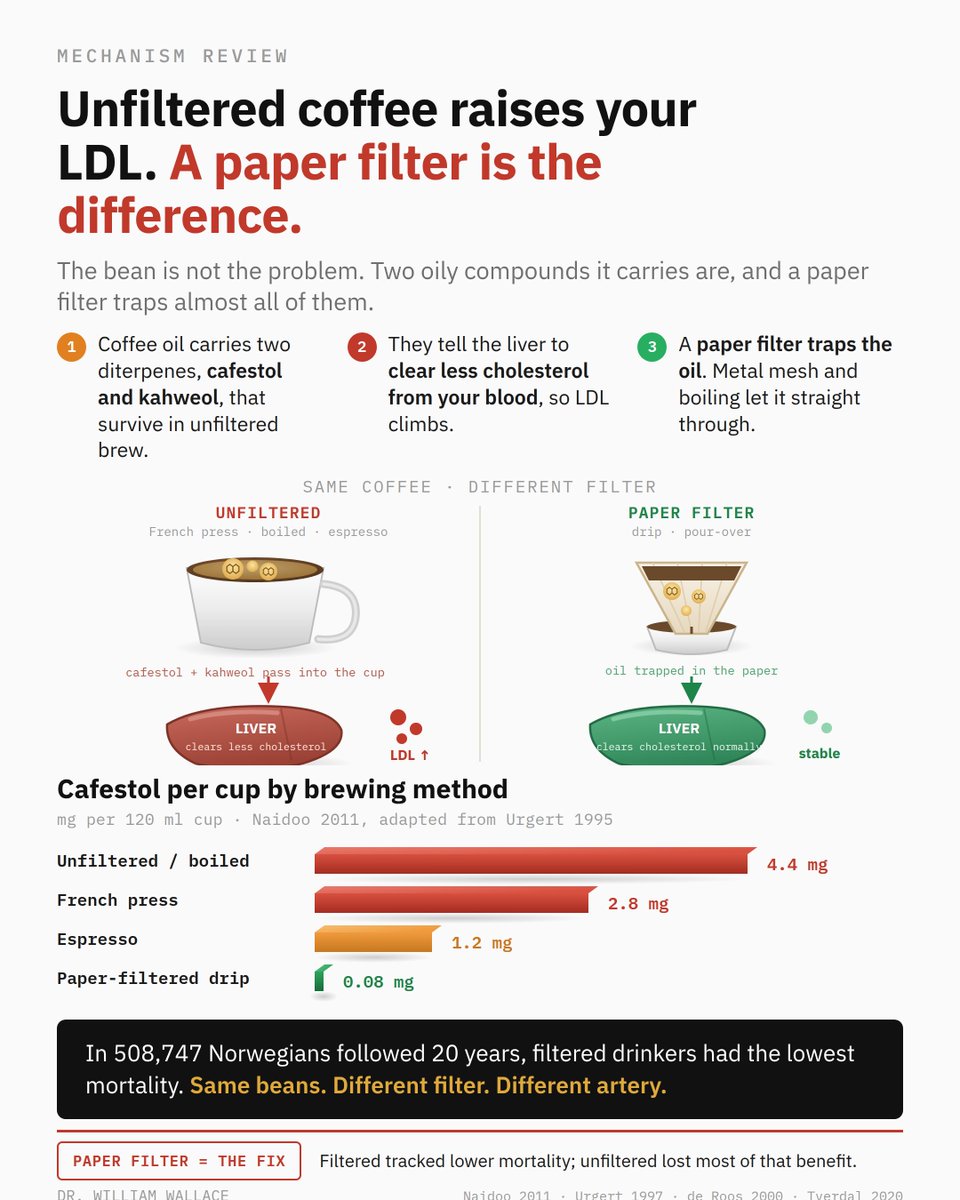
Unfiltered coffee raises your LDL cholesterol. Filtered coffee does not. The bean is identical. The only thing that changes is whether the brew passes through paper.
Coffee oil carries two diterpenes, cafestol and kahweol. They survive in French press, espresso, boiled, and Turkish coffee, and a paper filter traps almost all of them. That single step is the difference.
Once in your body, the diterpenes lead the liver to clear less cholesterol from your blood, and LDL climbs. Cafestol is one of the most potent cholesterol-raising compounds in the diet, and the effect shows up in controlled human trials, not just observational data. The diterpenes nudge triglycerides up too.
How much you get depends almost entirely on the brewing method. Per cup:
Unfiltered or boiled: about 4.4 mg
French press: about 2.8 mg
Espresso: about 1.2 mg
Paper-filtered drip: about 0.08 mg
That is roughly a 55-fold difference between an unfiltered cup and a paper-filtered one of the same coffee.
The long-term data points the same way. In 508,747 Norwegians followed for about 20 years, filtered coffee drinkers had lower mortality than people who drank no coffee at all. Unfiltered drinkers saw little or none of that benefit, and in men over 60, heavy unfiltered intake was associated with higher cardiovascular death. The risk tracked cholesterol: it grew when cholesterol was removed from the statistical model.
One honest caveat. That the LDL rise happens is well established. The exact molecular step, how the diterpenes lower cholesterol clearance, is still being worked out.
If your LDL is a concern, this is one of the easiest levers you have. You do not have to give up coffee. You just have to run it through paper.
Naidoo et al., Nutr J, 2011
Urgert et al., Eur J Clin Nutr, 1995
de Roos et al., J Intern Med, 2000
Tverdal et al., Eur J Prev Cardiol, 2020
I ordered one pancake in America. The waitress wrote it down and said, "one short stack."
Short. I am a small and humble man. A short stack sounded perfect for me. I waited with a calm heart.
She returned carrying three pancakes, each the size of my face, stacked into a tower, with a block of butter on top sliding down the sides like slow lava.
This was the short one. I did not dare ask what the tall one looked like. Some knowledge a man is not ready for.
I ate for forty minutes. I was not full. I was afraid. The tower did not shrink. I am fairly sure it was growing back faster than I could eat it.
I had to surrender. I left half. In Japan, leaving food is a deep shame. So I leaned in close and apologized to the pancakes directly, in a low voice, one by one.
The waitress asked if I wanted a box. I did not know food could be taken into custody. I declined. I did not want it following me home.
In America, is the short stack truly the small one?
I need time to prepare my spirit before I ever face the tall one.
i was thinking about how i haven’t opened up insta reels/my insta group chats & not laughed at least once.
absolutely incredible that the internet now delivers so much laughter at scale on demand. you can now instantly find something absurdly hilarious that’s relevant to today’s zeitgeist… like actual tears streaming, can’t breathe level kinda funny. & the comments are usually even funnier.
has humanity ever laughed this hard, this often, & with this level of collective derangement before?
SOURCES
-FTC Consumer Guidance on subscription cancellation and "Click to Cancel" expectations:
https://t.co/T9IFkWN4QR
-NPR coverage of FTC proposed rule to make subscription cancellation easier:
https://t.co/MnI13EBpPB
-CFPB guidance on stopping automatic payments and disputing charges:
https://t.co/D9ETROz4Zg
🚨 FORMER TESLA PRESIDENT ADMITS ELON USED THE DOMINO’S PIZZA APP TO REINVENT HOW PEOPLE BUY CARS — AND THE STORY IS BLOWING PEOPLE’S MINDS
Former Tesla president Jon McNeill is going viral after revealing the bizarre moment Elon Musk pulled up the Domino’s pizza app during a meeting… because Tesla customers needed 64 CLICKS just to buy a car online.
Elon’s reaction?
“How many taps does it take to get a pizza?”
Answer:
• 10 taps
Buying a Tesla at the time?
• 64 clicks
• endless loan documents
• nonstop forms
• massive friction
Elon became obsessed with stripping the process down after realizing most of the paperwork wasn’t even legally required.
So Tesla started going bank-to-bank asking:
Why does buying a car need to feel harder than ordering dinner?
Most banks reportedly refused to cooperate.
Then one Midwest bank CEO finally agreed to test a radically simplified system… and Tesla allegedly eliminated around 40 clicks from the process almost overnight.
Now people online are saying this perfectly explains why Tesla disrupted the entire auto industry while traditional dealerships kept drowning customers in paperwork, waiting rooms, and sales tactics.
Did Tesla accidentally expose how outdated the entire car dealership model really was?
📹: kencoleman
ANNOUNCEMENT: WE’RE SAVING SCIENCE!
We’re often told that science is “self-correcting.”
But that’s not really true.
Science doesn’t correct itself like a thermostat adjusting the temperature in your house. Science is a human institution run by human beings. And human beings are vulnerable to career incentives, groupthink, moral fads, political pressure, and fear.
And when those forces capture academic journals, peer review stops being a filter for bad ideas and starts becoming more of a credentialing system for fashionable nonsense.
This isn’t exactly new.
In 1996, the physicist Alan Sokal managed to publish a totally gibberish article in the journal Social Text full of trendy postmodern jargon. His point was simple: if you flatter the ideological commitments of certain academic editors, nonsense can pass as real scholarship.
Two decades later, @ConceptualJames, @HPluckrose , and @peterboghossian pulled off the “grievance studies” hoax, placing over a half dozen absurd papers in peer-reviewed journals. One paper used dog parks to analyze rape culture and queer performativity. Another rewrote parts of Mein Kampf in the language of feminist theory.
The problem wasn’t just that fake papers got published. It was that they were completely indistinguishable from the real thing.
And today, the problem is even worse.
We now have serious SCIENCE journals publishing papers about feminist lesbians marrying brine shrimp. We have disturbing papers that aim to “queer” and sexualize infants. We have scholarship on “lesbian-queer-trans-canine relationalities” and “trans-dog intimacies.”
But while Clown World papers are concerning because it makes a complete mockery of academia, the same broken, ideologically captured system is also publishing research in legitimate science and medical journals that pushes sex and gender pseudoscience, relies on deeply flawed data, and influences policies on the medical transition of children and young adults.
That’s not funny. That affects real people. It affects medicine. It affects law. It affects children.
And when critics try to respond, they often discover there’s no serious mechanism for correction. Submitted Letters to the Editor often go completely ignored. Contrary evidence is rejected without comment. As a result, the best critiques are often relegated to personal blog posts, social media threads, or newspaper op-eds, while the original paper remains in the literature wearing the armor of “peer review.”
That is untenable.
So Kevin McCaffree, editor-in-chief of Theory and Society (@Theory_Society), and I decided to do something about it.
Today, in the Wall Street Journal, we announced a first-of-its-kind article type called “Peer Review.”
The idea is simple: publication should be the beginning of academic scrutiny, not the end of it.
A Peer Review article can critique a paper from any scholarly journal. It can address problems with methods, evidence, logic, definitions, theory, or interpretation. But it has to focus on the claims and arguments, not personal attacks.
Submissions are capped at 2,500 words and go through a straightforward merit review instead of endless gatekeeping and ideological screening. We ask just one basic question: Is this critique coherent, serious, reasonable, or even popular enough to deserve scholarly attention?
If yes, it gets published.
And the authors of the original paper get a built-in right of reply, so readers can see the critique and the response in a legitimate academic venue.
That’s how science is supposed to work.
Science becomes self-correcting only when real people build the mechanisms that allow correction to happen.
That’s what we’ve done.
Now it’s time for academics to use it.
Read our announcement on the @WSJ below.
🔗https://t.co/gqkDE7aaDC
Elon Musk cried on national television when his childhood heroes called him a fraud.
Neil Armstrong and Gene Cernan, the first and last men to walk on the moon, publicly testified against SpaceX. They said Musk was reckless. That private spaceflight was dangerous. That he was going to get people killed. They asked Congress to shut him down.
These were the men Musk grew up worshipping. The posters on his wall. The reason he built rockets in the first place. And they went on television and said he was a disgrace to space exploration.
In a 60 Minutes interview shortly after, Musk was asked about it. He started speaking and his voice broke. His eyes filled. He couldn't finish the sentence. The richest man in tech, the guy who argues with regulators and fires engineers mid-meeting, sat on camera and cried because his heroes rejected him.
He didn't stop building. He didn't change direction. He didn't even respond to them publicly. He just kept launching rockets until the rockets proved him right.
Armstrong never lived to see SpaceX land a booster. Cernan never saw Starship. The men who said it couldn't be done died before the man they doubted did it.
Most people need approval from the people they admire before they act. Musk got the opposite of approval and acted anyway. That's the gap. Not talent. Not money. The willingness to keep building while the people you love most tell you to stop.
Dans le manifeste "techno-optimiste" de Marc Andreessen, il y a une phrase qui m'a marqué :
"Our enemies are not bad people – but rather bad ideas."
Nos ennemis ne sont pas des mauvaises personnes. Ce sont des mauvaises idées.
Prenons Jancovici. L'homme est brillant, sincère, travailleur. Il ne se lève pas le matin en se disant qu'il va nuire à l'humanité. Mais l'idée qu'il porte la décroissance, le rationnement, la frugalité érigée en horizon civilisationnel est une idée profondément destructrice. Elle prend des esprits brillants et les transforme en commissaires politiques d'un futur appauvri.
Et le plus fascinant, c'est ce que cette idée fait aux gens qui l'adoptent.
Dans mon entourage, une grosse partie de mes amis est sur cette ligne décroissantiste, avec tout le package qui va avec. L'argent c'est mal mais ils en veulent. Il faut moins prendre l'avion mais ils rêvent de voyager partout. Il faut consommer moins mais ils ne renoncent à rien de ce qu'ils aiment vraiment.
Et tous ont un point commun : ils sont déprimés. L'un d'eux m'a même confié qu'il était sous antidépresseurs.
Ce n'est pas un hasard. C'est mécanique.
Quand tu crois que ton désir de vivre, de créer, de t'élever est moralement suspect tu te détruis de l'intérieur. Tu passes ta vie à t'excuser d'exister. Tu vis dans la dissonance permanente entre ce que ton corps veut (plus, mieux, plus loin) et ce que ton idéologie t'ordonne (moins, sobre, immobile).
D'où ma théorie :
Quand on pense quelque chose de fondamentalement faux décroissance, communisme, extrémisme religieux (de tout ordre) ce n'est qu'une question de temps avant que ça devienne vraiment destructeur.
D'abord pour soi. Puis pour les autres.
Les mauvaises idées tuent. Lentement chez ceux qui y croient, brutalement chez ceux qui les subissent.
C'est pour ça que la bataille des idées n'est pas un luxe d'intellectuel. C'est la bataille la plus importante de notre époque.