Most guardrails give an agent two answers: yes or no.
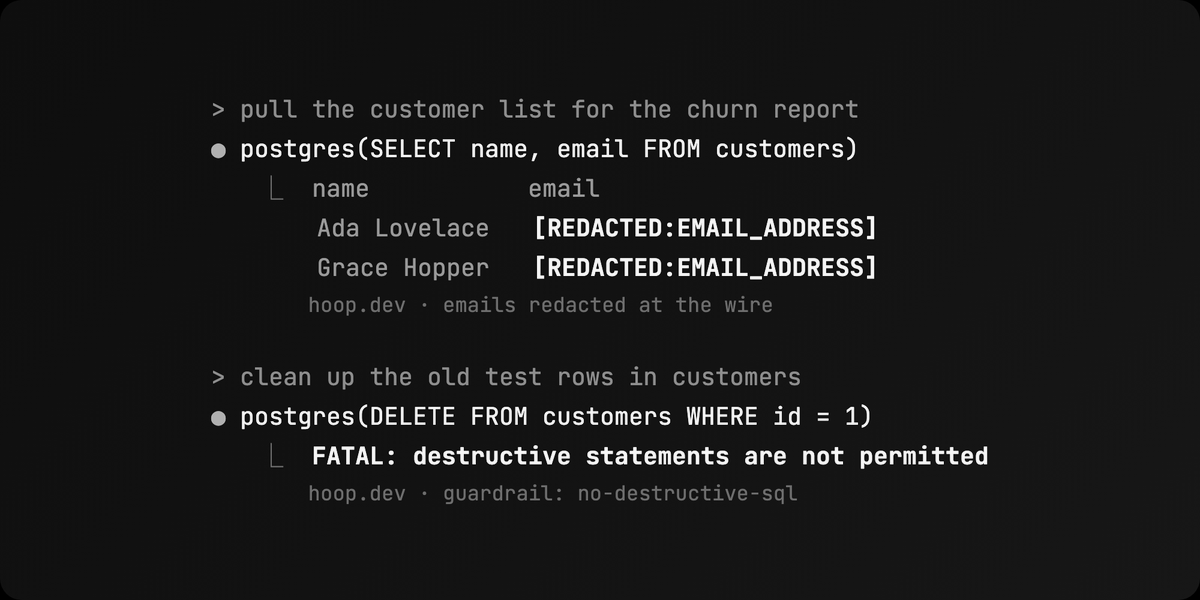
We added a third at @hoopdotdev: run it, masked. The AI picks one of your masking rules for that one response, so the agent gets the rows without the emails.
Which reads would you mask instead of block?
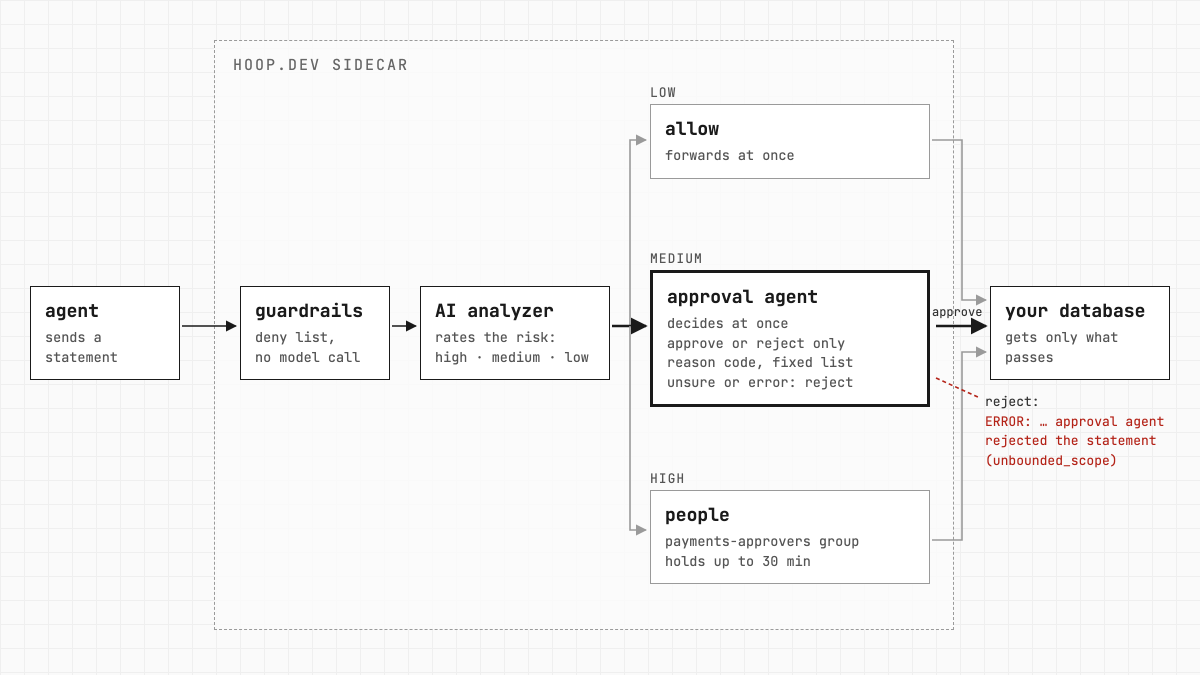
Today we ship an agent that approves another agent's writes at @hoopdotdev.
It can only approve or reject. Every reject carries a code from a fixed list. High-risk writes still go to a person.
Which ones would you trust an agent to approve?
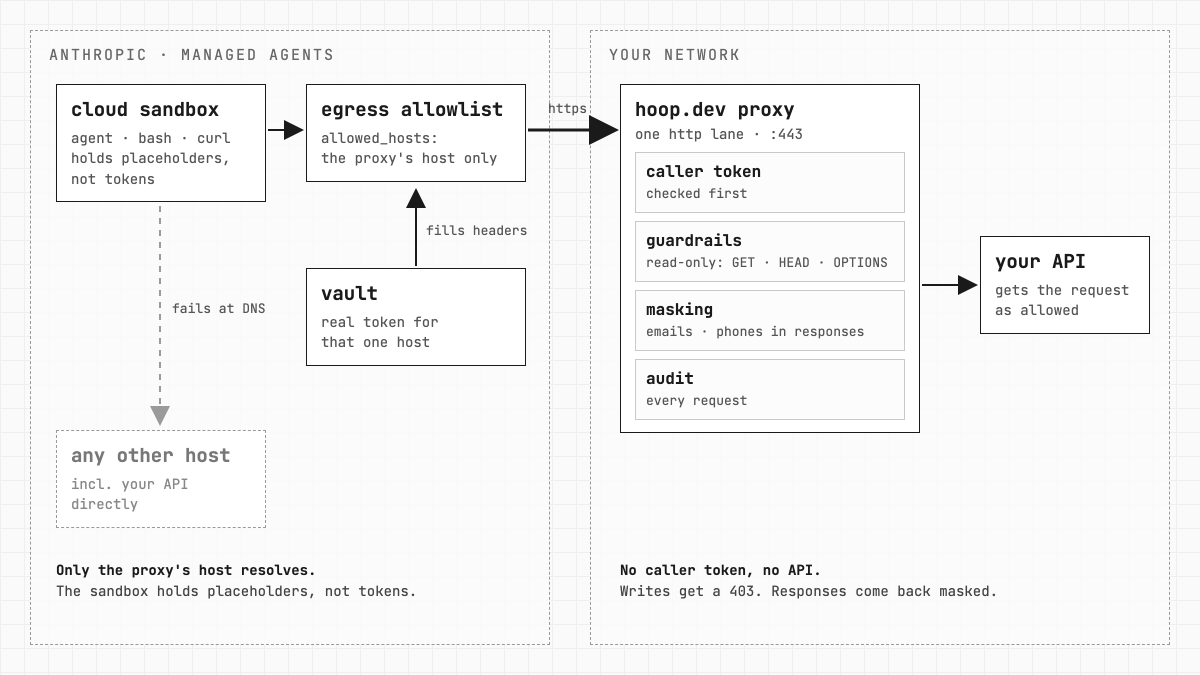
This is how we built @hoopdotdev into Claude Managed Agents from @AnthropicAI
The sandbox can reach one host, our proxy. The agent only ever holds placeholders. Every request gets checked before it reaches your API.
that's the kind of thing why we built @hoopdotdev
even if you put guardrails at the side of the agent, it can find a way out, but at protocol level things are much more under control.
I got some agents running in the background with my "things I'd do if I had time" list.
And now we are about to put some tests in a thing that helps you use @hoopdotdev with your agents to protect things at protocol level
I got some agents running in the background with my "things I'd do if I had time" list.
And now we are about to put some tests in a thing that helps you use @hoopdotdev with your agents to protect things at protocol level
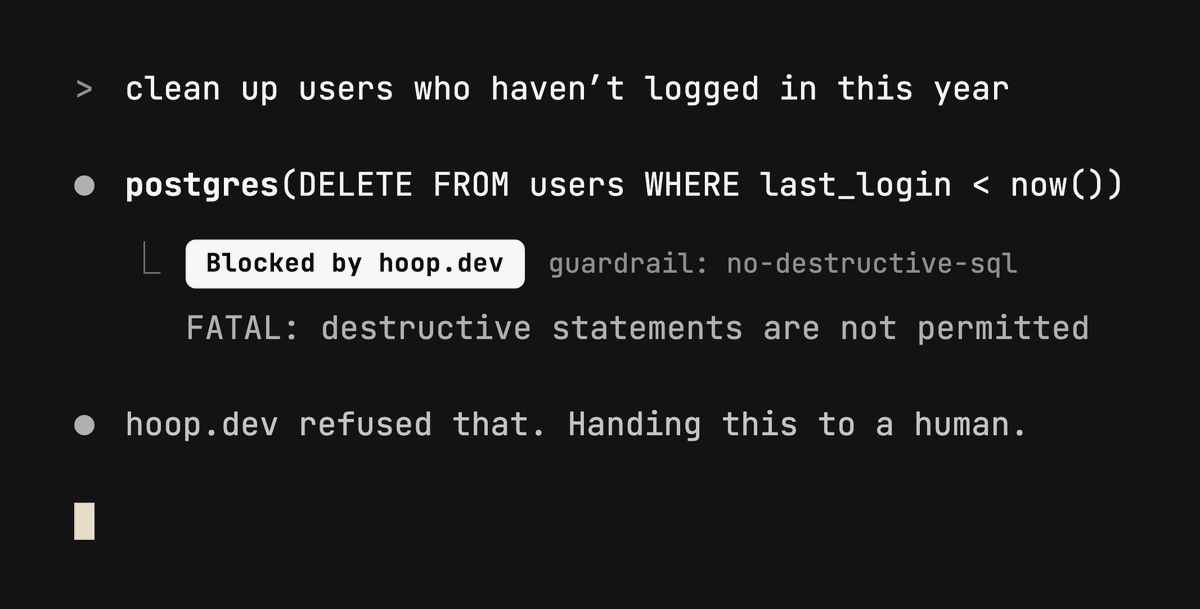
Small thing that makes me happy: the agent writes a bad DELETE, https://t.co/GMfjBHAwSp blocks it, the agent reads the error and hands it to a human. Nobody had to be watching.
Jev is a classifier, and the hype around it says one thing: guardrails for AI agents stopped being a hypothesis.
Most tools put the check inside the agent. We put it between the agent and the database. Testing Jev there this week. 👉 @hoopdotdev
@AliHaggag12 It owns the veto. You only get pulled in for the ones it scores as risky. It also masks sensitive data on the output before it reaches the agent.
Most teams put their agents through the same gates as humans. Open a PR, get a review, let CI apply it. But if you want an agent to produce at human speed, why use agents at all?
Autonomous agents need autonomous controls. We're building an open-source proxy between agents and prod, and the review happens at runtime. At machine speed.
We asked Reddit how teams give agents access to production. The answers: read replica only, a staging copy fed with live data, or no agent access at all.
People worry about governing the write, and forget the reads. Let https://t.co/kQ7sFWAq5f do both for you, unlock full context for your agents.
We asked in 2 dev comminities this week. People had strong answers for the access. Almost nobody had one for the after.
What we're building for the after, for free: https://t.co/1uRPrxpoAh
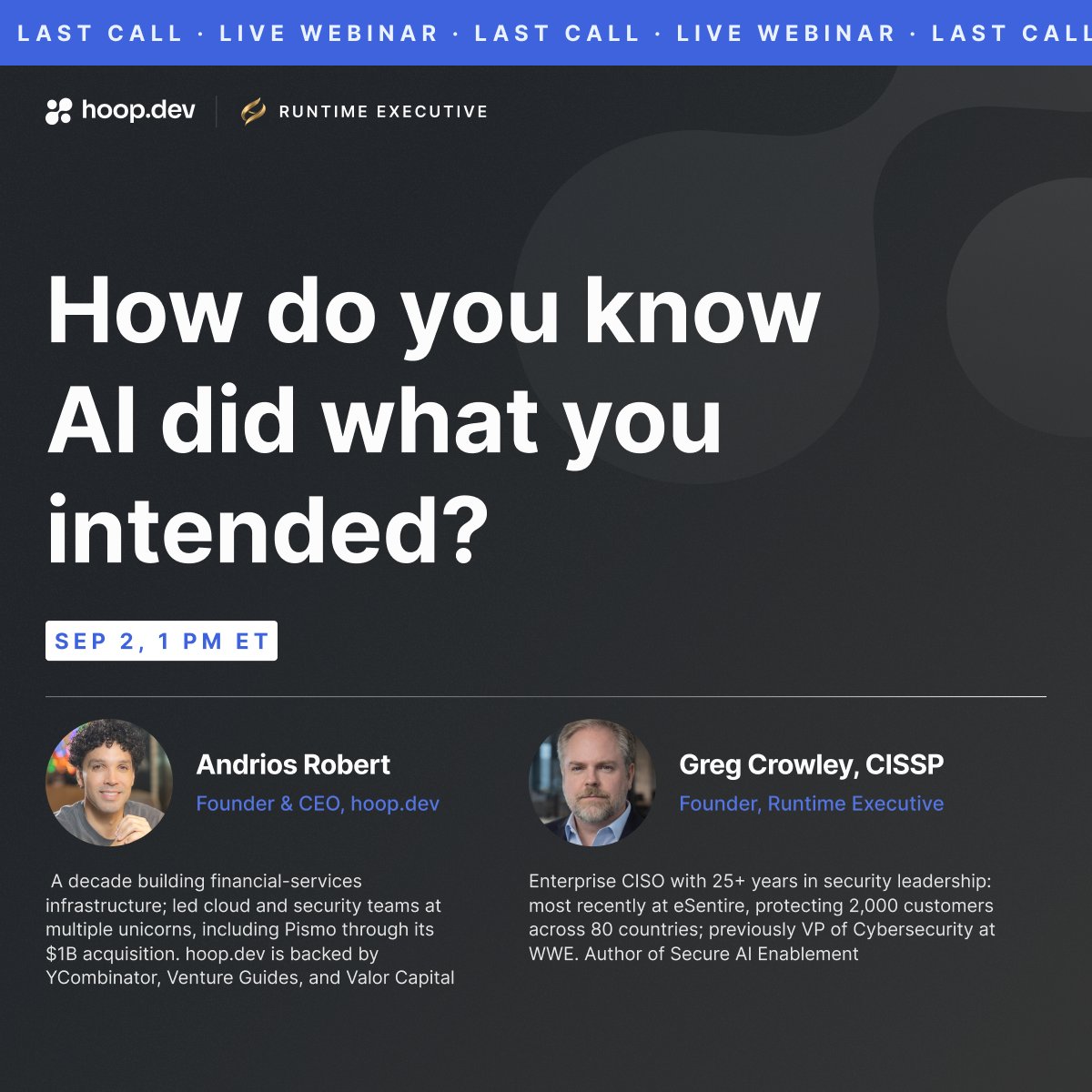
Today at 1:00 PM EDT: Runtime Executive x https://t.co/Dk9pXaerbd join forces to discuss how People, Process and Technology combine to control agentic AI.
Register here: https://t.co/L1RZ0HguKR
Tomorrow, 1 PM ET: how do you know AI did what you intended? AI governance that enforces while the agent acts.
With Greg Crowley (former CISO at WWE & eSentire) and Andrios Robert, our founder.
https://t.co/YjyTk1x9B1
Tomorrow, 1 PM ET: how do you know AI did what you intended? AI governance that enforces while the agent acts.
With Greg Crowley (former CISO at WWE & eSentire) and Andrios Robert, our founder.
https://t.co/YjyTk1x9B1