$DUSK scales complex state verification using PLONK. @DuskFoundation relies on universal setups. This cuts witness overhead and keeps proof generation lightweight.
#dusk
#dusk uses Kadcast and Kademlia routing with XOR distance metrics instead of messy gossip protocols, keeping global @DuskFoundation communication fast under heavy loads! $DUSK
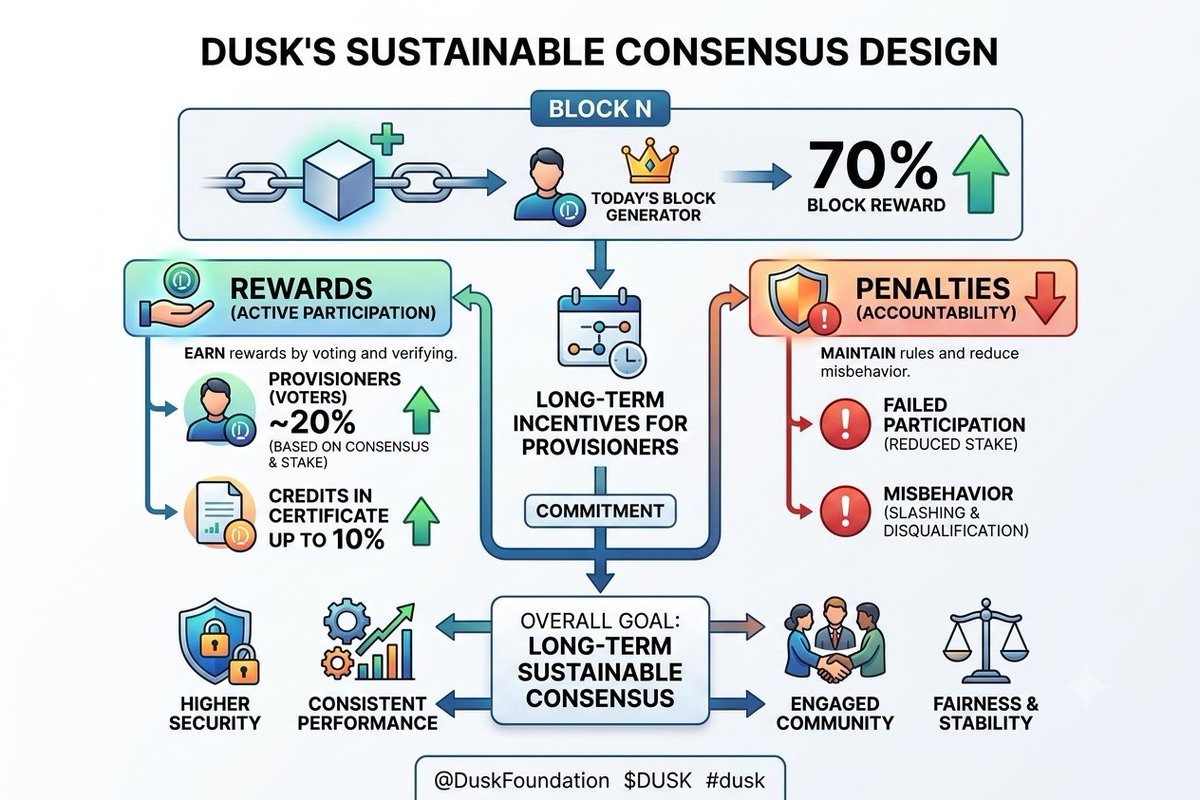
#dusk’s consensus design is not only about rewarding today’s block generator. It is about keeping provisioners active through rewards, penalties and long-term participation. @DuskFoundation $DUSK #dusk
@DuskFoundation's Zedger separates sending from receiving: SEND creates a pending transfer, while ACCEPT completes it. I’m curious how often these states appear in real usage. $DUSK #dusk
$DUSK Dusk’s rolling finality aims to keep consensus efficient as activity grows. I’m watching finality latency, validator participation and reorgs under stress. @DuskFoundation#dusk $DUSK
@DuskFoundation uses SBA to coordinate provisioners through deterministic sortition. Real network demand will reveal how finality, missed blocks, staking concentration, and performance hold under pressure. $DUSK #dusk
Dusk’s Deterministic Sortition ties stake to committee selection while evolving seeds preserve unpredictability. I am watching stake concentration, committee diversity, provisioner participation, missed votes and churn across $DUSK consensus. @DuskFoundation#dusk
#dusk’s privacy architecture is compelling but real validation comes from usage. If developers drive recurring state updates, proofs, contracts and transactions, $DUSK could show genuine demand beyond technical capability. @DuskFoundation#dusk
#dusk’s Piecrust gives developers a focused Rust-based WASM execution environment. I am watching whether contracts, calls, state activity, users and fees translate infrastructure into real network adoption. That’s the metric that matters most. @DuskFoundation $DUSK
Traditional markets are moving through another wave of volatility, yet Bitcoin continues to show surprising resilience. While equities react sharply to geopolitical tension and shifting interest rate expectations, $BTC has been holding its ground.
This raises an interesting question many investors have been asking again: is Bitcoin slowly evolving into a geopolitical hedge?
During times of macro uncertainty, capital often looks for assets that operate outside traditional financial systems. Bitcoin’s fixed supply and decentralized design make it different from conventional instruments that are closely tied to central banks and national policies.
More importantly, Bitcoin offers something unique in today’s financial landscape — borderless liquidity and financial sovereignty. Funds can move globally without the same structural friction found in traditional markets.
Of course, the debate is far from settled. Some still view Bitcoin as a high risk asset, while others see it gradually emerging as a long-term store of value.
But one thing is clear: every time global uncertainty rises, the conversation around Bitcoin’s role in the financial system becomes stronger.
#Bitcoin #BTC