As a dad of a 4 week old and a 4 year old, codex remote is very cool.
Hear about a new feature during some down time. Dash off a few paragraphs of text to codex from my phone. Come back later to a completed experiment.
XGBoost's new vector leaves seem pretty great. When working on Wideboost (succeeded by GBNet), I had devised a test to explicitly eval models in a multi-output-with-correlated-outputs scenario. Vector leaves do great here.
Re-doing that test, vector leaves performed best with a much smaller model. A great addition to XGB codebase!
XGBoost's new vector leaves seem pretty great. When working on Wideboost (succeeded by GBNet), I had devised a test to explicitly eval models in a multi-output-with-correlated-outputs scenario. Vector leaves do great here.
Re-doing that test, vector leaves performed best with a much smaller model. A great addition to XGB codebase!
@GergelyOrosz Before LLMs, thinking, coding and verifying happened simultaneously. Different types of feedback would reverberate across all three processes.
Now, LLMs have removed coding. Thinking to verifying has a larger gap with less reverberation.
My quibble with the "Bitter Lesson" is that it isn't very prescriptive.
I may as well say something like -- LLMs will get replaced by something that scales better.
Exactly what that thing is is left as an exercise for the reader.
I've been learning more about the Cox PH Partial Likelihood. It is really really clever.
It avoids usual survival-data pitfalls. It asks: given this event and the candidate units, which unit most probably saw an event?
It's a multinomial calculation. It uses softmax.
Purely as a reflex, I turned down the "Upgrade to Opus 4.7 or whatever" pop-up today.
The good: 4.6 or whatever must be good enough for me.
The bad: (a) too many new models (b) I guess I don't expect any step changes (eg I bet it still try-excepts imports) so why upgrade?
BTW, the big delete here was just removing catboost from gbnet 😿. There's something I don't understand about their algorithm. It seemingly does NOT admit performant, single round manual boosting updates.
Over the weekend, I updated GBNet to correctly work with the latest versions of XGBoost, etc.
I did a side-by-side manual fix vs. LLM fix.
Manual fix all in: +28 (lines added) -244 (lines removed)
LLM fix part 1: +130 (added) -17 (removed)
Yikes!
@JFPuget Almost all my prompts to the LLMs tell them to avoid try excepts now.
It's orders of magnitude harder to figure out if they've done something silly (or if I have) if the code never fails.
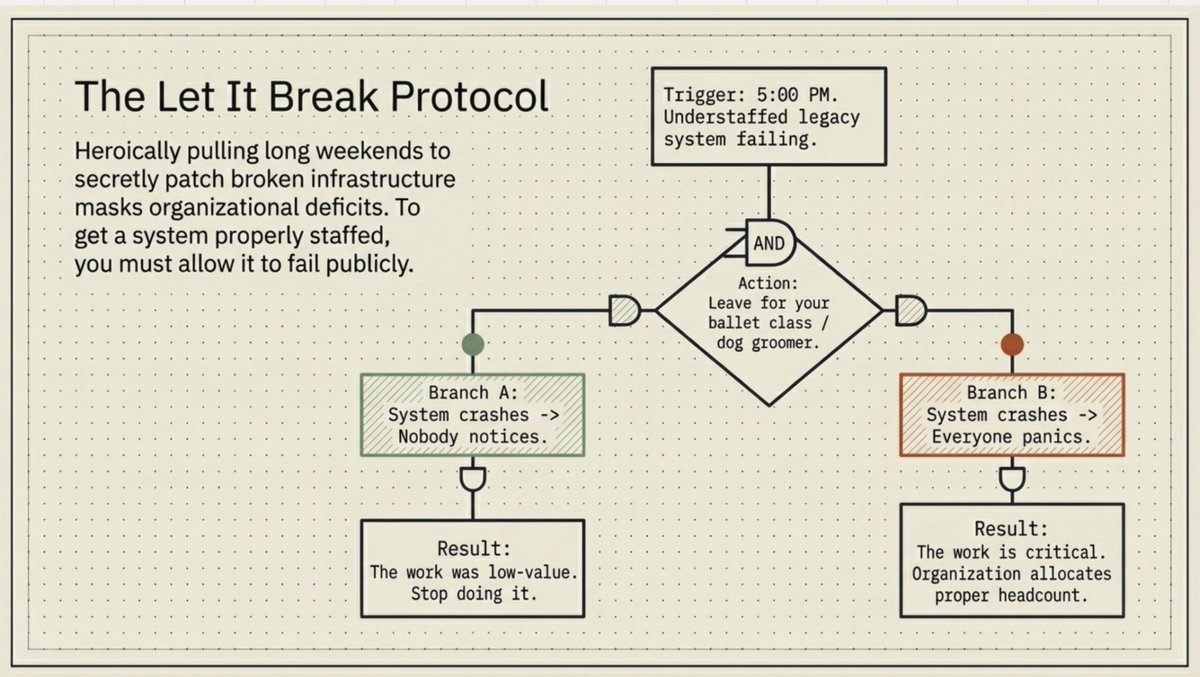
@patio11 I once advised someone to let something fail to get the right attention. Instead, said individual put the team on their back and delivered a major net new revenue source for the company.
I don't think I was necessarily wrong, but you can't argue with results.
Google has an internal "let it break" essay about a hero engineer whose hard work ends up being a net negative (by masking the underlying issues). My manager sent me that essay when I was trying too hard to get the collective TensorFlow unit test suite green.
Over the weekend, I updated GBNet to correctly work with the latest versions of XGBoost, etc.
I did a side-by-side manual fix vs. LLM fix.
Manual fix all in: +28 (lines added) -244 (lines removed)
LLM fix part 1: +130 (added) -17 (removed)
Yikes!
LLMs are criticized for not getting beyond conventional responses, but conventional responses are underrated.
- What does a typical X team look like?
- What’s a standard approach to this problem?
- Make this email/tweet sound normal.
You get baseline quality for free.