built the website for my open source app. the 3d mark opens into the real ui, then scroll plays out a full agentic flow
acpira, a lightweight desktop app for claude code, codex and anything acp
Introducing Ling-3.2-air, an open-weight model that shares Ling-3.0-flash-VL’s native multimodal architecture.
124B total, 5.5B active. Stronger workflow automation and professional document reasoning. AutomationBench-AA rises from 15.7% to 61%.
Full benchmark results below.
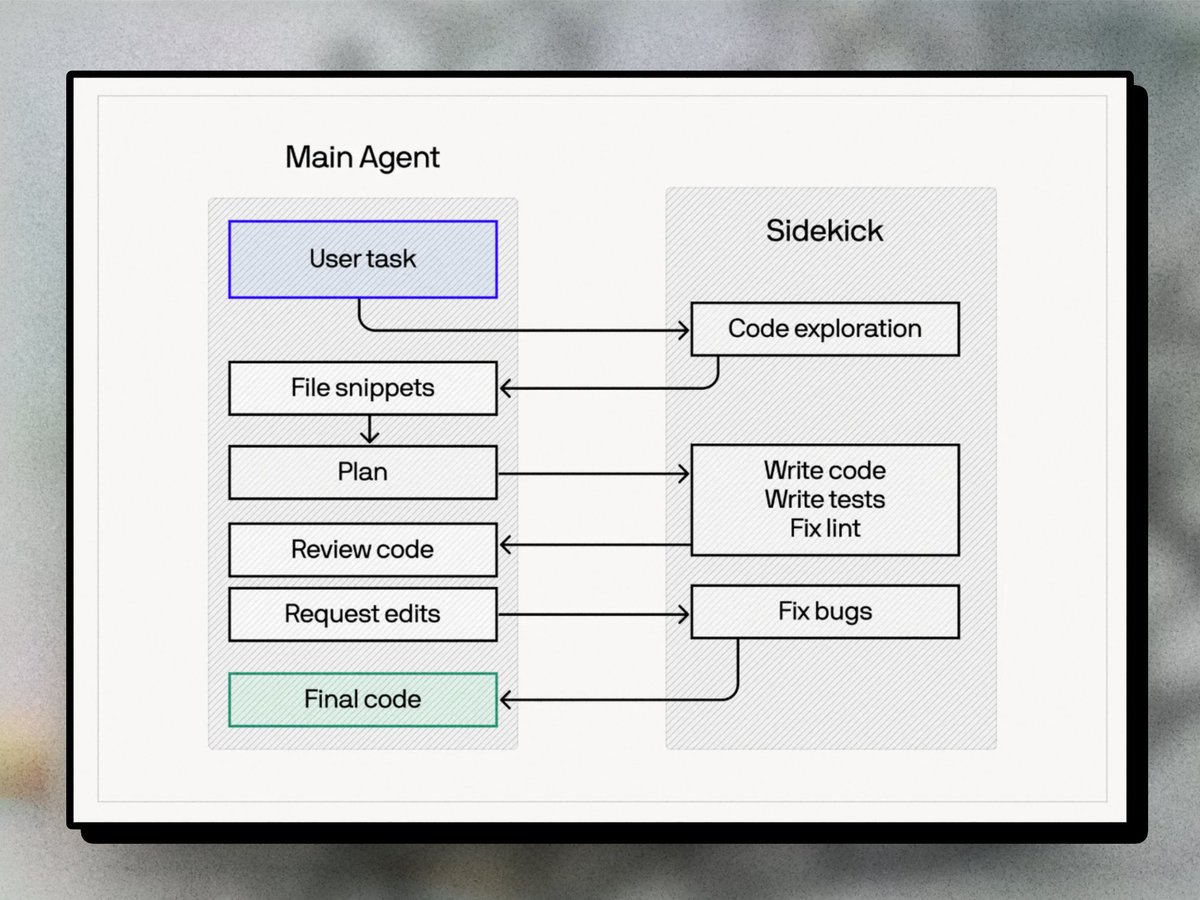
so why have a sidekick at all, when subagents can run in parallel? because each subagent starts cold, rereads the code and pays to rebuild context
a sidekick keeps its own cached context across handoffs (mentioned in devin's fusion blog: https://t.co/1bu9Vv18Fu)
two ways to make agents from different harnesses work together
sidekick: a second model in the same stream, taking turns
subagents: other harnesses summoned in parallel
fable 5.2 in claude code plans, gpt-6.2 astra in codex reviews, three gemini 4 neons in antigravity build
@hxiao wonder if this same wsp loop could fix overthinking in smaller local models or target specific refusal directions in weight space (kinda like heretic)?
devin's fusion runs opus as the lead and swe-2 as its sidekick, and shows both in one stream, like a single model.
same devin here, running inside acpira over acp. i tried showing it the other way: each handoff drawn as a relay. swe-2 takes over, works, hands back
it's pure defensive writing. ask whether A works and it replies "i found B, though B does not prove A and isn't equivalent to A."
not sure if it's alignment or post-training overcorrection, probably both. feels like openai's safety anxiety holding back new models.
GPT models have gotten unbearable.
I tell it there's an app on my device and I want to set it up. Does it start the setup? Nope. It starts the interrogation:
Does the app exist?
What's the app like?
What's the latest update?
Is this app even legal?
What will the user use it for?
Who made it?
Is there a better alternative?
It does literally everything in life except set up the app.
And it gets worse. Ask it for something direct and it stops to ask for permission so you have to step in manually. Bro I'M the one who asked for it 💀
I honestly don't know how OpenAI fell from GPT 5.5, one of the most magical models ever, to this unbearable mess.
@naploops thanks bro, literally why i built it in the first place. got tired of juggling claude code and codex all day. stoked it's clicking with your setup too
@AdamHoltererer terminal-bench science is the tell imo. carbon sits at 65 and hydrogen at 50 even on xhigh. rl carried the coding over, extra thinking can't buy back the world knowledge that didn't survive the shrink
sota coding models are plenty smart now. the real gap is inference speed.
prefill eats compute, decode eats bandwidth. either guess tokens (mtp, dflash), stack tensor parallelism, or cram weights into wafer sram like @cerebras.
none of it is cheap.
https://t.co/fCxFdmVQpL
@theo effort labels don't line up across labs tho. carbon on medium already thinks about as much as opus on xhigh. hydrogen xhigh is 54 on AA vs 51 on high, but time to first answer token doubles (19s → 38s). worth testing high vs xhigh on the same task.
https://t.co/m9dqlJyIXs
mapped out what's actually eating my agent's context window. everything it read, ran and thought, as a treemap
built it into acpira, where i run claude code, codex and my own agent. click any block to see exactly what got sent
asked an agent to make my app a frog pond skin and a few widgets. one click, they just hot-plug in
acpira, a desktop app i built for myself and my team, for claude code, codex and anything acp. a month of dogfooding, tauri + rust, under 40mb
open source, MIT: https://t.co/PaGGeyngLU
macos, windows, linux, plus vs code and intellij. it also has its own agent loop for any model api
skins and widgets are plugins the agent writes for you. inspired by @handsher_NGU's /theme concept for claude code