Omni-directional machines in action! 🎡
These robots made with the LEGO Group brick can move smoothly in any direction, and rotate in place.
That makes very precise motion control for both manual driving and autonomous behaviors.
This particular omni-directional vehicle system is a fan-made LEGO® MOC (My Own Creation), built entirely from LEGO bricks.
It includes custom omni-directional vehicles along with dedicated floor plates designed to support accurate motion.
That's a proper project for robotics people!
Let's build more in 2026.
Creator's page: https://t.co/wrbwrm7xCk
~~
♻️ Join the weekly robotics newsletter, and never miss any news → https://t.co/GoA3ZuwoPB
From real-world engineering to 3D. 🤖 I modeled and animated my own omnidirectional Rollbot in C4D. The inspiration comes directly from @XRobotsUK
A short loop, but a great rigging challenge! #Robotics is always a source of #3D art. What other #robot should I try modeling?
#AI
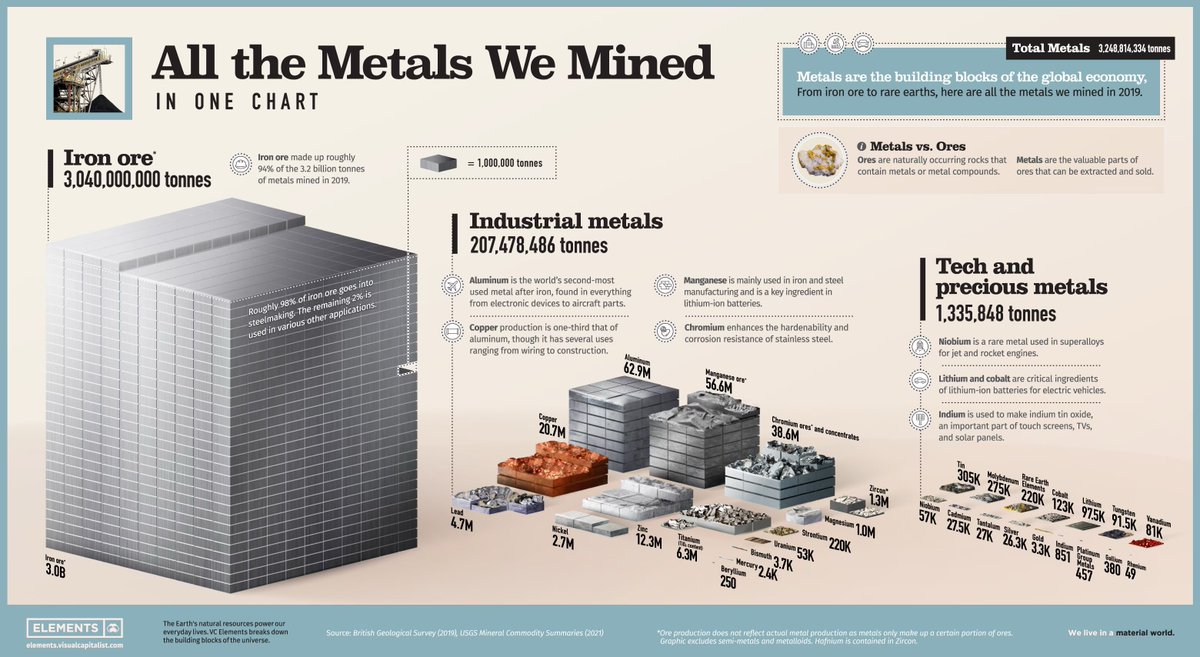
Iron (AKA steel)
Iron alone makes up 94% of all the metal we consume in the economy. We consume 50x more iron than aluminium. Worth considering when you think how much aluminium we use making cars and planes.
Obviously we use all this iron to make steel.
Steel is king when it comes to structural and mechanical objects. It’s the most economic and best understood material for load carrying applications. It doesn’t really have any parallels at economic parity.
Steel is the default, and you only deviate if forced by some uncompromising need (usually weight limits).
One of the most important things about steel is that we figured out how to make thousands of different types of steel; cheap, corrosion resistant, strong, flexible, tough.
We actually call it the “recipe” for making steel, and there are two main things that you adjust in the recipe when making steel.
1. The chemical composition, this is called alloying, but you mix a bunch of elemental powders before melting and you can make different chemical mixtures with different properties.
2. Heat treatment, this is also the grade, you heat the steel up to various temperatures and then cool it down again. Heat it high and you let the metal lattice relax and inclusions move around, heat it low and they stay trapped. Cool it fast and you trap a bunch of stresses inside it, cool it slow and you let the stresses out.
The “recipe” is just a list of steps, which includes a chemical composition and a sequence of heating and cooling steps.
This is how you turn iron into cheap carbon steel, shiny stainless steel, or flexible spring steel.
So even most of those other industrial metals actually also end up in steel too!
Steel is king.
#صباح_الخير
تونس سمحة غير دمروها ناسها المرضة السراق يقع تكريمه والمنافق يقع تعظيموا و الكذاب يقع ترسيموا في اعلي المناصب لهذا مزال برشا خدمة فيك يا تونس ان شاء الله تتحسن و الأمل ديما يتجدد و كما قال الشابي
إذا الشعب يوماً أراد الحياة فلا بد أن يستجيب القدر
@01_mouna شوف المخالفات و باقي التدخلات كلها نسبيا و لكن ادئ المدرب و تعطيه مع المقابلة كان دون المأمول يعني تشبه شوية لمقابلة تونس و السينغال في كاس افريقيا
المهم المدرب كان فاشل و ان شاء الله يفيق و في كاس العالم يمشو يجبوا مدرب اخر و لا يختاروا مدرب اخر من تونس