"Scientists have been on a decades-long quest to adapt some of their most powerful imaging instruments — transmission electron microscopes (TEMs) — to work at the coldest temperatures possible."
"Robert Hovden, an electron microscopist at the U. of Michigan, and his colleagues set out to create [an ultra-cold TEM]. They used a heat exchanger and other engineering tweaks to reduce vibrations from the liquid helium and obtain clearer images." https://t.co/anZC1BfYhJ
This work was enabled by the h-Bar Instruments Liquid Helium TEM stage and the Cornell EMPAD detector. The full manuscript is here: https://t.co/617vZrvTsd
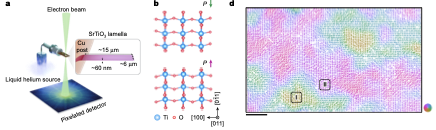
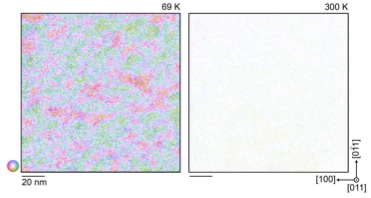
How we imaged a quantum paraelectric: (a) Cool SrTiO3 with liquid helium. (b) Measure atomic polarity by using a sub-nanometer electron beam and detecting every scattered electron (c) Scan the electron beam and map the polarity at ultra-low temperatures.
Watched Factorial Energy founders (Ph.D.s in Chemistry) ring the Nasdaq bell. For the event they hauled next generation battery vehicles onto the middle of Times Square. Massive images of batteries displayed on buildings.
Years of work. One unforgettable morning.
Today, the Factorial team rang the @Nasdaq Opening Bell as we celebrated our next milestone as a public company, trading under $FAC and $FACWW.
Proud of the team, the progress, and the partnerships that made this moment possible.
The next chapter starts now.
CDW melting in 1𝑇-TiSe2 nanoflake by electron diffraction. BF-TEM image of a nanoflake (dotted outline) with corresponding nanobeam electron diffraction patterns at different temperatures. Black arrows highlight prominent CDW peaks that disappear at higher temperatures. The overlapping nanoflakes in the BF-TEM image were separated by assuming each nanoflake has a convex shape. The concave points in the image were identified as junctions where these nanoflakes overlap. Scale bars for BF-TEM image=100nm for diffraction patterns=2nm−1. Liquid helium specimen stage by h-Bar Instruments.
It introduced the kaleidoscope argument: A kaleidoscope pointed at a painting can change how you experience a copyrighted work without creating a new infringing work. Game Genie is a kaleidoscope.
Galoob v. Nintendo said altering gameplay in RAM wasn’t an illegal derivative work (despite RAM being fixed and tangible). You could bend a game you bought, privately, without making or distributing a new permanent copy. A cheat device became a right-to-tinker landmark.