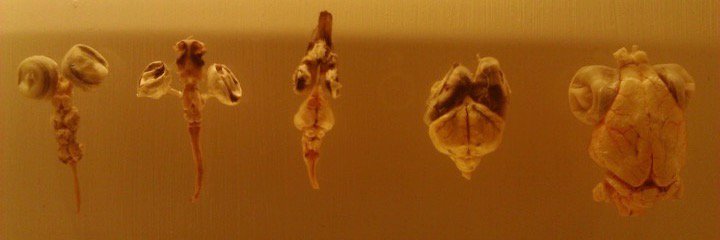
One implication is that measures of relative brain size should be treated with extreme caution. The curvilinear pattern may explain why large bodied species appear relatively small brained when using linear models to characterise and account for scaling - they are large not dim
This has implications for how we interpret macroevolutionary patterns more generally, emphasising the need to account for intraspecific variation in order to understand variation across species
What the Best Neuroscientists Already Know
"The claim that neuroscience needs the humanities is not a plea from outside the field. Many of its most thoughtful practitioners have already reached this conclusion."
https://t.co/MZqkUSsJfE
@royalsociety MUST strip Musk of his fellowship to retain credibility. He has brought the society into the disrepute in the gravest manner. Calling on all FRSs, please act swiftly
Humans may not have a uniquely specialised memory for sequences - it may be more to do with how tasks are culturally scaffolded and what they “mean” to participants. New paper https://t.co/HKlWhN1V56
Interesting new study demonstrates "cerebellar connectivity to higher-order networks at birth, which generally strengthen with age, emphasizing the cerebellum’s early role in cognitive processing beyond sensory and motor functions https://t.co/BfKkKrtnXC
Is the sense of reality a purely visual business??
"Our results demonstrate that a key mechanism through which the brain distinguishes imagination from reality is by monitoring the activity of the mid-level visual cortex."
https://t.co/gE4vPKGzgB