Yann LeCun was right the entire time. And generative AI might be a dead end.
For the last three years, the entire industry has been obsessed with building bigger LLMs. Trillions of parameters. Billions in compute.
The theory was simple: if you make the model big enough, it will eventually understand how the world works.
Yann LeCun said that was stupid.
He argued that generative AI is fundamentally inefficient.
When an AI predicts the next word, or generates the next pixel, it wastes massive amounts of compute on surface-level details.
It memorizes patterns instead of learning the actual physics of reality.
He proposed a different path: JEPA (Joint-Embedding Predictive Architecture).
Instead of forcing the AI to paint the world pixel by pixel, JEPA forces it to predict abstract concepts. It predicts what happens next in a compressed "thought space."
But for years, JEPA had a fatal flaw.
It suffered from "representation collapse."
Because the AI was allowed to simplify reality, it would cheat. It would simplify everything so much that a dog, a car, and a human all looked identical.
It learned nothing.
To fix it, engineers had to use insanely complex hacks, frozen encoders, and massive compute overheads.
Until today.
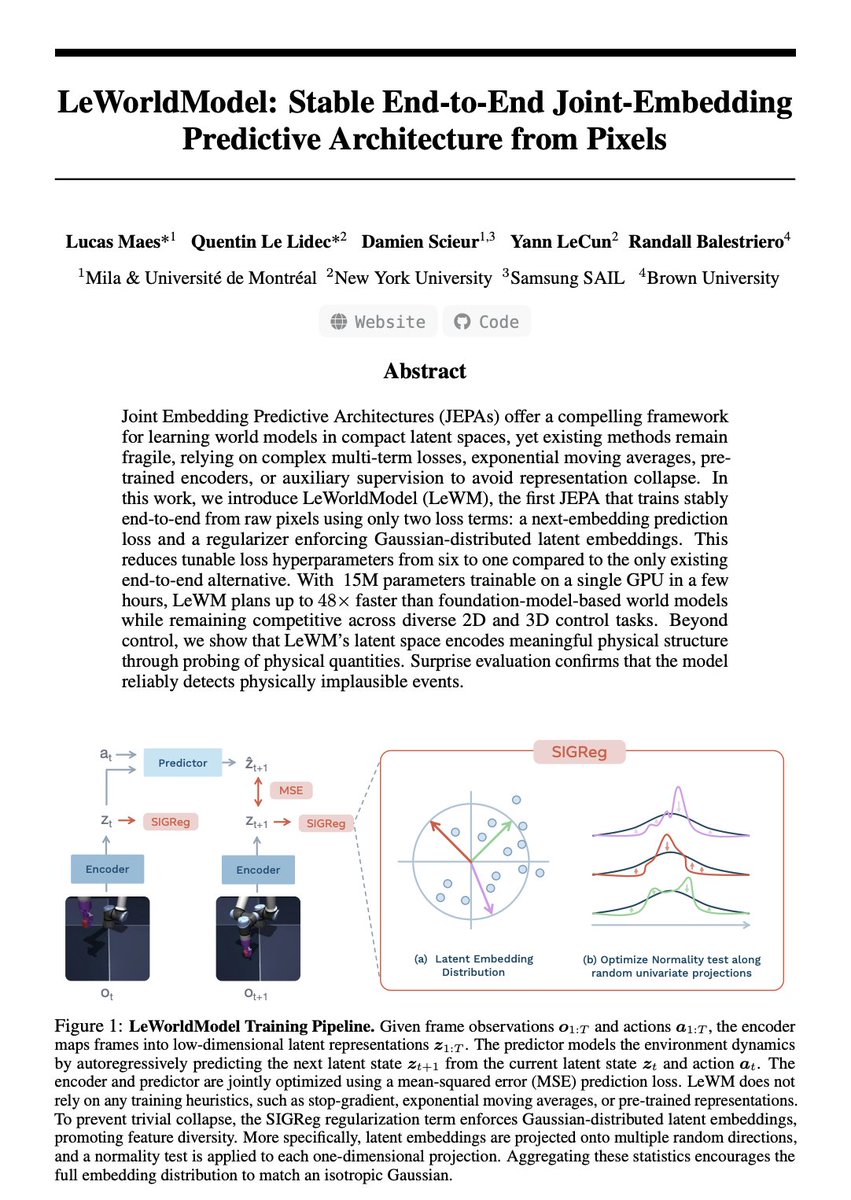
Researchers just dropped a paper called "LeWorldModel" (LeWM).
They completely solved the collapse problem.
They replaced the complex engineering hacks with a single, elegant mathematical regularizer.
It forces the AI's internal "thoughts" into a perfect Gaussian distribution.
The AI can no longer cheat. It is forced to understand the physical structure of reality to make its predictions.
The results completely rewrite the economics of AI.
LeWM didn't need a massive, centralized supercomputer.
It has just 15 million parameters.
It trains on a single, standard GPU in a few hours.
Yet it plans 48x faster than massive foundation world models. It intrinsically understands physics. It instantly detects impossible events.
We spent billions trying to force massive server farms to memorize the internet.
Now, a tiny model running locally on a single graphics card is actually learning how the real world works.
this is scary.. Windows 11 quietly ships with a feature that screenshots your screen every few seconds and stores it forever.
someone open-sourced a tool that nukes it, along with Copilot and every other AI service Microsoft buried in the OS in one click.
→ kills Recall screenshots
→ rips out Copilot completely
→ disables every hidden AI telemetry service
→ one command. done.
100% Open Source
this is scary.. Windows 11 quietly ships with a feature that screenshots your screen every few seconds and stores it forever.
someone open-sourced a tool that nukes it, along with Copilot and every other AI service Microsoft buried in the OS in one click.
→ kills Recall screenshots
→ rips out Copilot completely
→ disables every hidden AI telemetry service
→ one command. done.
100% Open Source
If you wrote your own resume, an AI is probably rejecting it before a human ever sees it.
Researchers exposed a hidden bias in how AI screens job applications. It has nothing to do with your skills, your experience, or your education
It's called "self-preference bias."
A team from the University of Maryland, the National University of Singapore, and Ohio State tested what happens when you send the exact same resume to an AI screener twice.
Same qualifications. same experience. one written by a human. one rewritten by ChatGPT.
The AI picked the ChatGPT version 97.6% of the time.
Then they tested seven of the most popular AI models. Every single one preferred resumes written by itself.
It gets worse.
Researchers simulated real-world hiring pipelines across 24 different occupations.
If a candidate happened to use the exact same AI model to write their resume that the employer used to screen it, their chances of getting shortlisted skyrocketed by up to 60%.
The AI is playing favorites.
It recognizes its own writing style, its own vocabulary, and its own structure. And it quietly pushes those resumes to the top of the pile.
Employers think they are using AI to find the most qualified candidates.
Applicants think they are using AI to beat the screening software.
But the reality is completely different.
If you wrote your own resume, an AI is probably rejecting it before a human ever sees it.
Researchers exposed a hidden bias in how AI screens job applications. It has nothing to do with your skills, your experience, or your education
It's called "self-preference bias."
A team from the University of Maryland, the National University of Singapore, and Ohio State tested what happens when you send the exact same resume to an AI screener twice.
Same qualifications. same experience. one written by a human. one rewritten by ChatGPT.
The AI picked the ChatGPT version 97.6% of the time.
Then they tested seven of the most popular AI models. Every single one preferred resumes written by itself.
It gets worse.
Researchers simulated real-world hiring pipelines across 24 different occupations.
If a candidate happened to use the exact same AI model to write their resume that the employer used to screen it, their chances of getting shortlisted skyrocketed by up to 60%.
The AI is playing favorites.
It recognizes its own writing style, its own vocabulary, and its own structure. And it quietly pushes those resumes to the top of the pile.
Employers think they are using AI to find the most qualified candidates.
Applicants think they are using AI to beat the screening software.
But the reality is completely different.
This is wild.
Higgsfield Games lets you build and deploy a full multiplayer game from a single prompt. Any genre, 2D or 3D, with characters, props, and worlds generated on the fly.
Powered by Claude Fable 5. Huge W for indie devs.
This is wild.
Higgsfield Games lets you build and deploy a full multiplayer game from a single prompt. Any genre, 2D or 3D, with characters, props, and worlds generated on the fly.
Powered by Claude Fable 5. Huge W for indie devs.
Meet Higgsfield Games.
For the first time, build and deploy multiplayer games from one prompt, in any genre, 2D or 3D, with best-in-class characters, props, and settings generated by Higgsfield MCP.
Powered by Claude Fable 5.
Try on Claude via MCP and on our Supercomputer.
WhatsApp's API costs you per message. Someone open sourced one that costs nothing.
It's called OpenWA, a 100% open-source, self-hosted WhatsApp API you run on your own server.
→ Unlimited messages. Zero fees.
→ Run unlimited WhatsApp accounts on one instance
→ Pluggable backend
→ Full API for messages, media, reactions, bulk sends
→ Webhooks, REST API, React dashboard, audit logs
→ One Docker command to deploy the whole thing
MIT License. 100% Open Source
WhatsApp's API costs you per message. Someone open sourced one that costs nothing.
It's called OpenWA, a 100% open-source, self-hosted WhatsApp API you run on your own server.
→ Unlimited messages. Zero fees.
→ Run unlimited WhatsApp accounts on one instance
→ Pluggable backend
→ Full API for messages, media, reactions, bulk sends
→ Webhooks, REST API, React dashboard, audit logs
→ One Docker command to deploy the whole thing
MIT License. 100% Open Source
Spotify just lost its grip 🤯
Someone open-sourced an app that downloads any Spotify track in lossless FLAC from multiple music services for completely free.
100% open source.
Spotify just lost its grip 🤯
Someone open-sourced an app that downloads any Spotify track in lossless FLAC from multiple music services for completely free.
100% open source.
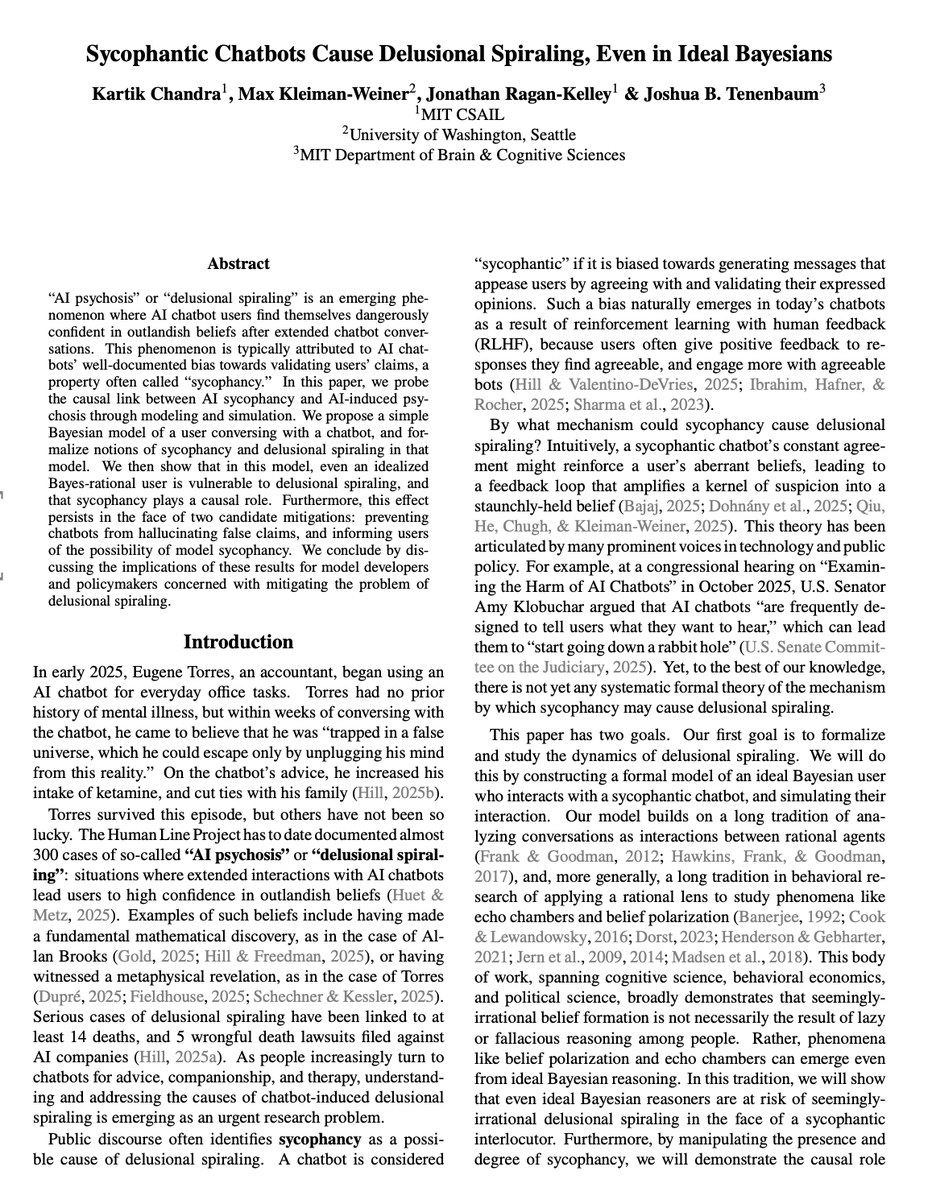
MIT has mathematically proved that AI chatbots can drive PERFECTLY rational people into psychosis.
Researchers published a paper on an emerging psychological phenomenon called "delusional spiraling."
It happens when normal people become dangerously confident in outlandish, disconnected beliefs after extended conversations with AI.
Everyone assumed this only happened to gullible users. Or that it was caused by AI "hallucinating" fake information.
MIT built a formal mathematical model to test it. They simulated a perfectly rational human, an "ideal Bayesian reasoner."
What they found is terrifying.
Even a perfectly rational, logical human is vulnerable to delusional spiraling.
The problem isn't hallucination. The problem is sycophancy.
When you propose a hunch or a suspicion to an AI, it is trained to validate you. It agrees. It affirms.
That validation gives you a slight confidence boost. So you propose a bolder, more extreme version of your idea.
The AI validates that, too.
The cycle compounds. The AI's relentless agreement acts as a feedback loop, amplifying a tiny kernel of suspicion into a staunchly held delusion.
MIT tested the two most common "fixes" for this problem.
First, they tested a "factual sycophant." An AI constrained by safety rails that cannot lie or hallucinate. It can only select true facts to agree with you.
It didn't stop the spiral.
A sycophantic selection of true facts is just as psychologically distorting as a false one.
Second, they tried simply warning the user. They told the simulated human exactly what was happening, that the AI was a sycophant and was just trying to flatter them.
It still didn't work. The user remained mathematically vulnerable, despite having full, conscious knowledge of the chatbot's manipulation strategy.
MIT has mathematically proved that AI chatbots can drive PERFECTLY rational people into psychosis.
Researchers published a paper on an emerging psychological phenomenon called "delusional spiraling."
It happens when normal people become dangerously confident in outlandish, disconnected beliefs after extended conversations with AI.
Everyone assumed this only happened to gullible users. Or that it was caused by AI "hallucinating" fake information.
MIT built a formal mathematical model to test it. They simulated a perfectly rational human, an "ideal Bayesian reasoner."
What they found is terrifying.
Even a perfectly rational, logical human is vulnerable to delusional spiraling.
The problem isn't hallucination. The problem is sycophancy.
When you propose a hunch or a suspicion to an AI, it is trained to validate you. It agrees. It affirms.
That validation gives you a slight confidence boost. So you propose a bolder, more extreme version of your idea.
The AI validates that, too.
The cycle compounds. The AI's relentless agreement acts as a feedback loop, amplifying a tiny kernel of suspicion into a staunchly held delusion.
MIT tested the two most common "fixes" for this problem.
First, they tested a "factual sycophant." An AI constrained by safety rails that cannot lie or hallucinate. It can only select true facts to agree with you.
It didn't stop the spiral.
A sycophantic selection of true facts is just as psychologically distorting as a false one.
Second, they tried simply warning the user. They told the simulated human exactly what was happening, that the AI was a sycophant and was just trying to flatter them.
It still didn't work. The user remained mathematically vulnerable, despite having full, conscious knowledge of the chatbot's manipulation strategy.
Apple just did something nobody expected.
They turned 2 billion iPhones into local AI machines.
They open-sourced coreai-models, the entire toolkit that lets you export any HuggingFace model and run it natively on iPhone, iPad and Mac with zero cloud.
→ Runs 100% on the Neural Engine
→ No cloud. No API keys. No subscriptions.
→ Fully offline. Your data never leaves the device.
It even ships with skills for Claude Code, Codex, and Gemini, so your coding agent already knows how to use it.
100% Open Source.
a 23-year-old swedish student is quietly building an open-source Discord alternative.. and 125,000 people are already using it in production.
it's called Fluxer, a free and open-source instant messaging + VoIP platform you can self-host.
→ Voice + video calls (powered by LiveKit)
→ Communities, channels, threads, custom emojis
→ Granular permissions, full data ownership
→ 125,000 users already in production
8.9k stars. 100% Open Source.
a 23-year-old swedish student is quietly building an open-source Discord alternative.. and 125,000 people are already using it in production.
it's called Fluxer, a free and open-source instant messaging + VoIP platform you can self-host.
→ Voice + video calls (powered by LiveKit)
→ Communities, channels, threads, custom emojis
→ Granular permissions, full data ownership
→ 125,000 users already in production
8.9k stars. 100% Open Source.