We live in uncertain yet incredible times.
Since the "ChatGPT moment" two years ago, I've seen the writing on the wall as many of you have that AI will change humanity in a powerfully non-negotiable way.
Our path forward isn't to resist this change—it's to harness these extraordinary advances to elevate human potential.
Learning is the cornerstone business practice of all human development and advancement. To progress ourselves, we need to enhance and overhaul our learning system. The signal for this change has never been louder than it is today.
In my work "Learn to Adapt" I outline how we can adapt the American education system to advance ourselves in this incoming decade of AI transformation.
Read the full blueprint here -> https://t.co/KjLMDdNqEM
I'm not just sharing this as food for thought—I'm directly inviting you to join a mission through the @AdaptEducation_ project.
This rapid-development research project is funded through blockchain technology (Solana - $ADAPT). As we progress, every bit of funding drives research into methods, tools, curriculum development and more that will directly shape how AI transforms education.
Promising experiments in AI-driven education are already happening today, and we need more of them to ensure scaled and operational success across the entire US. We must fail fast and push the edge of innovation to adapt our system quickly enough to avoid the potentially catastrophic side effects of this AI revolution.
I'll continue to share my thoughts here on X about why and how we can adapt our learning system, exactly what this project will achieve, and more.
For my first post, I’m sharing a letter @NVIDIA signed on why open models matter.
AI will transform every industry, power every company, and be built by every country.
Open models strengthen safety and cybersecurity, accelerate innovation and diffusion, and enable sovereignty.
The world needs both frontier closed models and frontier open models.
https://t.co/AUKzoQ5Ikb
Terrific @TheAtlantic piece on archaeologists' and anthropologists' slowly dawning realization that now-submerged areas on the coastal shelf--swathes of land drowned when the glaciers melted--may be where much of our species' early history took place. (Link in reply)
JUST IN: OpenAI engineer reveals he's had Codex running for 26 days straight searching for the lost city of Atlantis, as “vibe archaeology” emerges as a new use for AI agents.
I basically feel pretty confident at this point that we're barreling toward something at least akin to the Industrial Revolution and a lot of public intellectuals are forming their opinions about it mostly via confused vague popular slogans that emerge like a game of telephone
@elonmusk@cradrrat I use C/C++ for all my projects. Debt Badge, Clucks Capacitor, homemade power-wall, sculpting software for my haptic interface.
I suppose with AI assisting, the clunkiness of developing in C disappears and the efficiency shines. How soon until the language doesn’t matter?
“Makerspaces” aren’t really makerspaces, they’re like intro to engineering classes. It’s a huge pain.
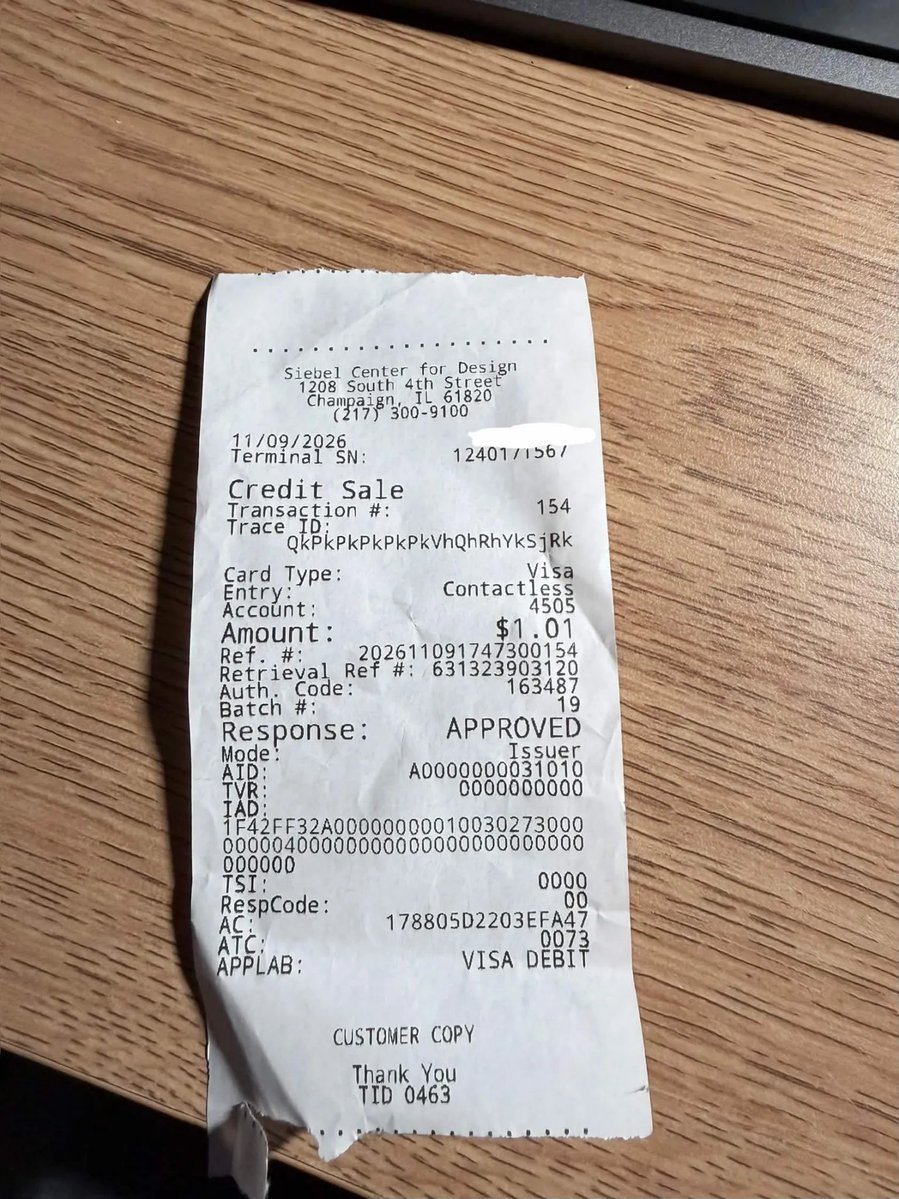
I went to one today to get a some filament for a calibration print on my portable printer. They couldn’t give me new filament because of some “policy.” After a manager got involved, they sold me a morsel of recycled stuff for $1. That comes out to about $100/kg, roughly 10x bulk filament cost.
You also can’t take anything out of the lab. To use a hot glue gun or even a screwdriver, you have to hand over your student ID, they register a second card, you scan both. You get logged for trying to glue something 😂There are like 3 safety courses before you can use a soldering iron.
Half the space is cutesy textile and fabric printing machines. The other half has a filament recycling line that costs several times more to run than just buying filament in bulk.
It’s the same attitude from the student “supervisors” at every lab on campus. They explain things you never asked about. I went for some filament and got a completely irrelevant explanation of PLA vs PETG vs ABS, and was told several times it would probably get tangled without a spool. Even a total beginner just asking for filament doesn’t need to be lectured. Answer the question, and offer more if someone wants it. Every question turns into some sort of knowledge dump, and everything needs approval from someone with a title.
These spaces are a fine place to learn what a 3D printer is, but completely useless for projects.
I was going to put some machines in a campus lab and donate some filament, but the rule is any equipment you bring in is university property, and you’d have to ask permission to use your own machine, so they can get lost.
UIUC is probably the school most fixated on getting students jobs, so you’d think they’d make it easy to work on the thing employers care about most, which is projects.
Two years ago I open sourced my DIY CNC machine, which cost me £2,655.80 and 9 months of my spare time. The Fusion 360 project, the drawings, the bill of materials, the STLs, the wiring diagrams and the Mach3 profile, all for free.
People ask why I didn't sell the plans... the answer is simple. Selling the plans would have defeated the whole point of the project, shutting out the very people I built it for.
My goal was to build a capable, sturdy machine for as little money as possible. Industrial-grade larger footprint machines are well out of reach for most hobbyists and small woodworking businesses. With a few minor trade-offs, you can build my machine for a fraction of the price, with nothing more than basic workshop tools.
10,000+ downloads later, people all over the world send me photos of the machine I designed, now fully built and operational in their own workshops.
That's what I love about open source. It's for people. Nobody needs permission or a subscription to build their own tools. You can repair them, upgrade them, and write your own software, because you know them inside and out.
This fills me with joy like nothing else.