Running an un-attended automated trading system in window servers is a difficult task for most users.
Most of the default settings result in automation failure.
Here are a few system settings to run your automated trading systems seamlessly in windows servers.
Nanoseconds.
That’s the new standard at the NSE.
Faster execution. Stronger infrastructure. A more resilient India.
The wait is over. The nanosecond revolution has begun.
#NSE#NSEIndia#Speed#NSERespondsinNanoseconds.
Excel VBA Crash After Moving File? Fix 👇
Workbooks store compiled VBA (P-Code). Move across PCs → it can break.
👉 Macros crash even if file opens fine.
Fix: Alt+F11 → small edit → Compile → Save
Always recompile after moving files.
Read: https://t.co/XXhwbq4J9y
People keep asking me if AI can help them make money from trading. My honest answer is not really.
As long as there's a human in the loop, you're still dealing with the same creature driven by fear and greed, and that human will keep making the same mistakes. But beyond psychology, there's a bigger problem. There's no real informational edge left in markets. The odds are that everything is priced in. And even when it isn't, operating under that assumption is almost always a good idea.
The people actually making consistent money in markets are high-frequency trading firms, market makers, prop desks etc that have built infrastructural and data moats over years, with significant investment of time and capital. Those are real edges.
So, where does AI actually fit? It's a tool to help you behave better. Not to generate alpha.
What it can do is help you build and test strategies, then execute them systematically, removing emotion from the equation. That means fewer panic sells, less revenge trading, and more consistency. What it can't do is turn a bad strategy into a good one or create a magic money tree.
This is still an edge, just a different kind. AI can make you more disciplined, but not smarter. And if you think about where most trading losses actually come from, that distinction matters more than people realise.
Charges: The Silent Account Killer
Most traders don’t lose to the market — they lose to charges.
1. Just to cover govt/exch fees, you need 8.94% returns.
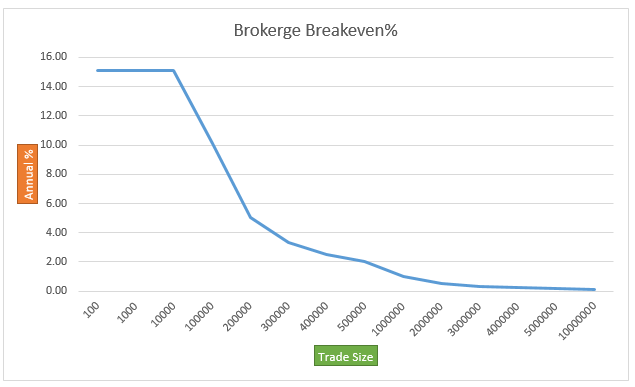
2. To cover brkg, the required return ranges from 15.12% to 0.1%, depending on trade size.
3. With a trade size of ₹100000, you must make ~20.04% just to break even on brokerage and charges.
Before thinking about profits, the market first asks for its cut.
Impact of Trade Size on Brokerage & Returns
Brokerage breakeven isn’t fixed — it drops as trade size increases.
1. With a ₹10000 trade size, you need ~15.12% returns just to cover brokerage.
2. At ₹100000, the required return falls to ~10.08%.
3. At ₹200000, it drops further to ~5.04%.
Same brokerage. Different trade sizes. Your cost efficiency improves only when size increases.
We would like to thank @Nithin0dha for the $100k donation to FFmpeg (pending)!
While this does not solve the funding problems behind FFmpeg and Open Source in general, it's a step forward to a sustainable future for Open Source Software.
Why Static Variables Are the Heart of Excel-Based Trading Systems?
Static variables give your Excel VBA trading system state memory. They allow it to remember — between ticks, between recalculations, between events.
https://t.co/VOD4KjKqH4
Zerodha has announced the beta launch of its Disaster Recovery (DR) platform for major outages. During such events, users will now be able to exit their positions via WhatsApp. More details here: https://t.co/qI0v3lH6Ox