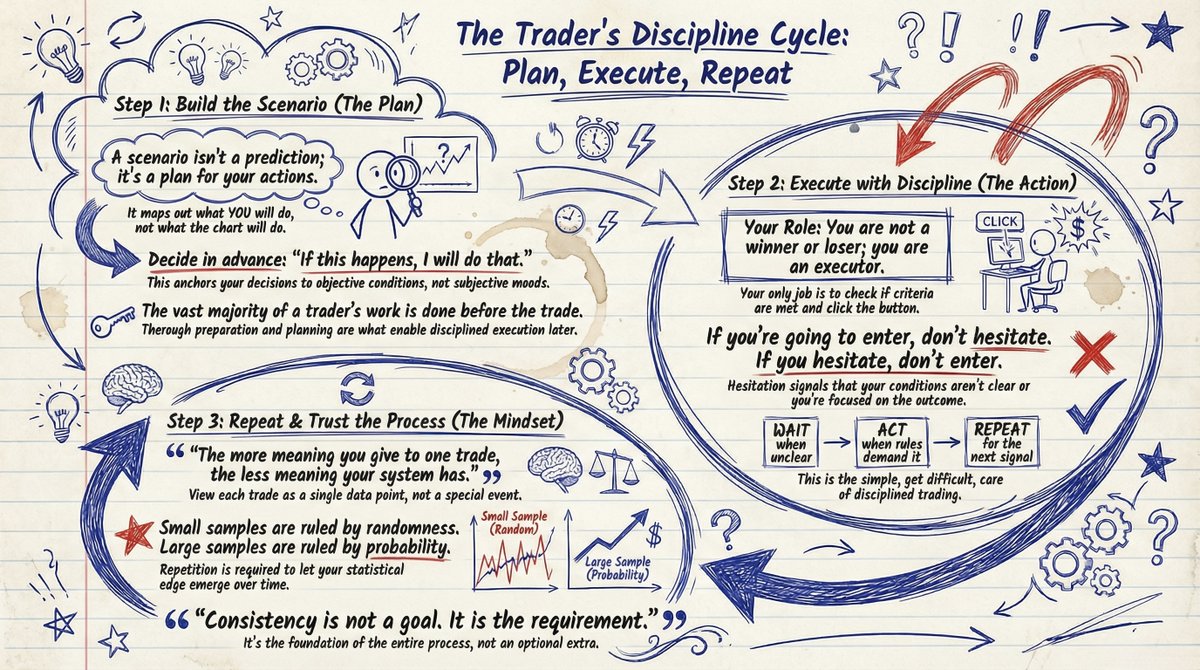
Build an "If this happens, then do this" scenario upfront, then execute it.
You don't need the desire to win or to avoid losing.
If you can execute the process exactly as the scenario dictates, stamp your card once.
Once you've collected 20 stamps, "one trade" is finished.
Imagine a sniper who shoots because he is tired of waiting for the target.
He misses, reveals his position, and fails the mission.
Boredom is not a reason to pull the trigger.
It is part of the job description.
Good night 😴
Before the session, write this sentence at the top of your plan.
“I will not trade my opinions. I will only execute my system.”
Then measure yourself
by how faithfully you obeyed that line.
@samuraipips358 The shift happened for me when I stopped journaling "what went wrong" and started journaling "did I follow the plan." Losses that fit the rules don't need to be endured — they're just data.
Most traders translate “accept losses” as:
“grit your teeth and endure the worst”.
That’s why they suffer.
Real acceptance is:
“I know exactly why this loss exists,
how it protects my capital,
and how it feeds my long‑term profits.”
Tie your self-worth to your process, not your profit.
When profit defines you, a loss will destroy you.
This fear forces you to break your own rules.
Instead, feel pride only when you follow your plan perfectly, win or lose.
Your discipline is your true value.
There are many people who believe that having a system with an edge is all it takes to succeed, but if the trader is still inexperienced, they can't even tell whether that system actually has an edge in the first place.
Most traders abandon the system before the edge ever has a chance to show up, because they cannot bear watching their capital shrink.
Because they never test on a sample size large enough to gain conviction in the edge and always judge based on the tiny sample right in front of them, they keep repeating "Now I finally get it!"→"It stopped working."
You need to test your edge on consistently large sample sizes, and when you move into the execution phase you have to approach it with the mindset that you will never change anything again.
To build the confidence and trust required for that, you need exhaustive preparation and practice.
It is not as simple as "as long as you have a system with an edge, you can succeed."
It takes extremely painstaking effort to create that simplicity.
Trading is BRUTAL.
Months of red.
Months of questioning EVERYTHING.
Months of studying charts until your eyes bleed.
Months of grinding with ZERO to show for it.
But then...
Something SHIFTS.
The patterns start speaking to you.
Your psychology transforms.
Your entries become SURGICAL.
And the market finally pays you.
This is the JOURNEY.
The struggle ISN'T punishment - it's PREPARATION.
Every loss teaches.
Every doubt strengthens.
Every month of grinding builds the trader you're becoming.
The breakthrough is coming.
But only if you REFUSE to quit.
The market rewards PERSISTENCE.
NOT talent.
Most people think waiting is “doing nothing”.
But in trading, waiting is a decision.
A powerful one.
When you don’t see your setup:
Waiting is winning.
When your system isn’t aligned:
Waiting is winning.
When your mind is unstable:
Waiting is winning.
The market only pays traders
who are willing to do nothing
until the right moment arrives.
Waiting is not weakness.
Waiting is a position.
Trading isn't boxing — STOP swinging for the fences.
It's chess.
Every MASTER knows:
• The loudest move is rarely the winning one
• Patience beats power EVERY time
• Your ego wants the knockout... your account needs the checkmate
The market doesn't care about your aggression.
It REWARDS your discipline.
Which game are YOU playing?
After my 4 years of experience and managing above 20cr+
I can confidently say
There is only one type of trader who can make big money
The one who has a system , who trades based on rules only
If you trade randomly, you will never ever be able to make big money