Protein does not become muscle just because you ate it.
After a meal, amino acids arrive in the blood and muscle has to accept them and build them into contractile protein. That building is only half the ledger. Muscle protein is broken down continuously as well, and net change is the difference between the two. Most short studies, including the ones below, measure only the building side.
When researchers cut the daily step count of ten healthy 72-year-olds by around three-quarters for two weeks, the after-meal building response fell by roughly a quarter. Fasted rates did not change. Leg fat-free mass dropped almost 4 percent in a fortnight, alongside worse insulin sensitivity and higher inflammatory markers.
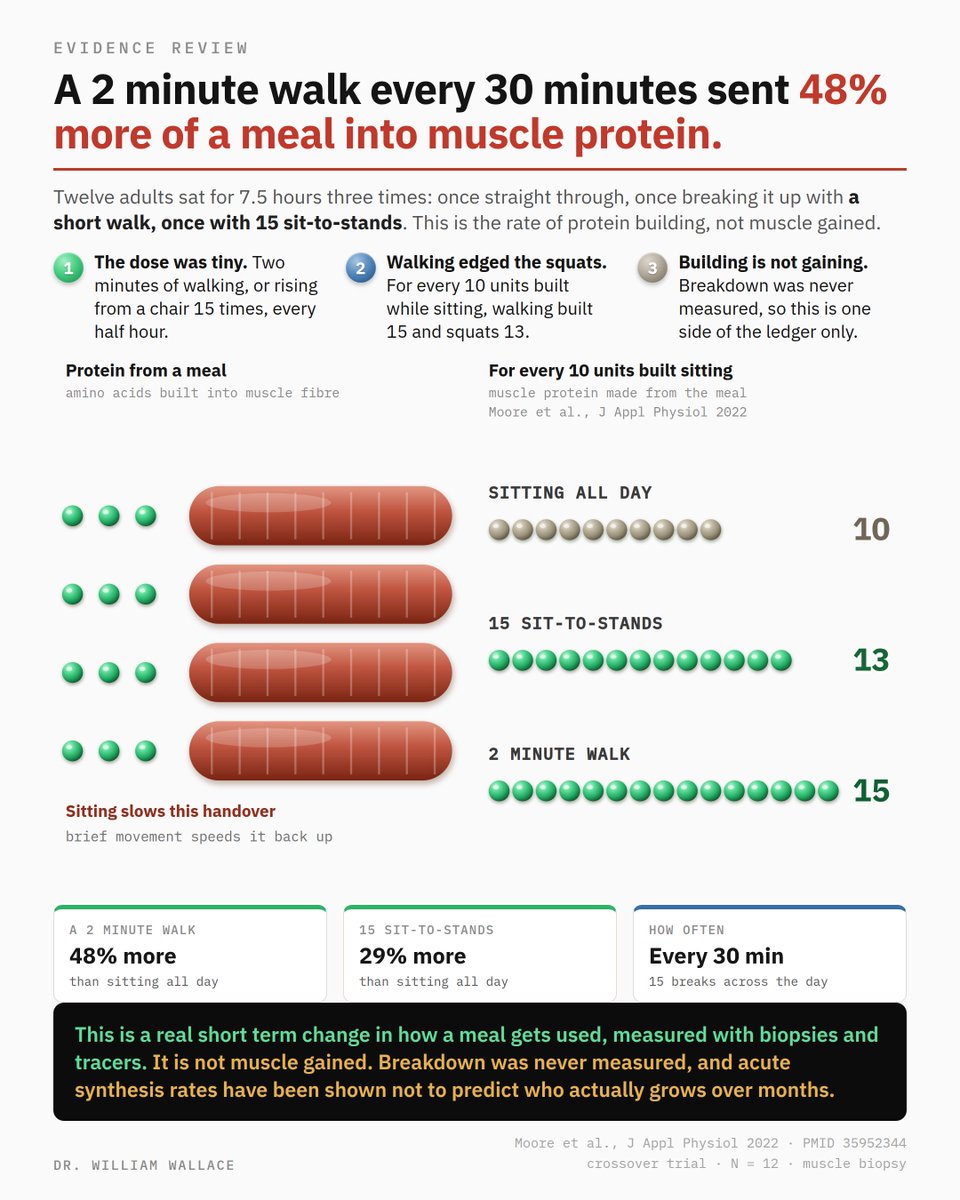
A Toronto group then ran the experiment forwards. Twelve adults sat for seven and a half hours on three separate days, eating identical meals labelled with tracers so the amino acids could be followed into muscle. One day was uninterrupted sitting. On the others, every thirty minutes they either walked for two minutes or rose from a chair fifteen times. Muscle was biopsied directly.
For every ten units of muscle protein built during the sitting day, the sit-to-stand day built thirteen and the walking day built fifteen. Two minutes of walking, taken fifteen times across a working day, changed where a meal's protein ended up.
In 23 untrained men, acute post-exercise building rates rose 235 percent after a first training session, then showed essentially no relationship with the hypertrophy those same men achieved over the following sixteen weeks. The correlations were near zero. Quadriceps volume grew 7.9 percent on average, with individuals ranging from slightly negative to nearly 25 percent, and the acute measurement predicted none of that spread.
So these trials describe how a meal gets handled on the day, which is a real and useful thing to know. They do not identify who builds muscle over months, and they never measured breakdown.
Prolonged sitting appears to blunt what a meal does. Interrupting it costs two minutes.
Moore et al., J Appl Physiol 2022 · PMID 35952344
Breen et al., J Clin Endocrinol Metab 2013 · PMID 23589526
Mitchell et al., PLoS One 2014 · PMID 24586775
On this auspicious day of Ashada Ekadashi, I am very happy to announce the launch of my humble attempt to make history interesting.
https://t.co/SGfD2ebBpO
The idea is actually very very simple
You go to the site, select a year, and It will show you who ruled which part of India at that point in time.
This is from Mizoram.
A disciplined protest by students against the NEET paper leak, demanding the resignation of Dharmendra Pradhan.
- Stick to the cause.
- No stone pelting or violence.
- No damage to public or private property.
- No sloganeering like Umar Khalid Zindabad, Sita ke Pati, Naam rahega Allah ka, Restore Article 370, etc.
- No abusive remarks against the Indian Army.
- No clashes between students and the police.
Northeast India once again sets an example.
Today, let’s dissect and discuss a Complete Blood Count (CBC) like a specialist. But not just any CBC. This actual report is a downright medical emergency. If you see this on the wards, you drop everything. Let me break it down in detail
The story behind this is very interesting. :)
Let me explain.
A while back, people on Reddit started discussing about Jan Aushadhi stores. Someone would post that the adapalene gel there was ₹27 while the branded tube was ₹500. Someone else would check and confirm. Then benzoyl peroxide. Then the salicylic acid face wash at under ₹50.
They gave it a nickname. PM Baddie Banao Yojana.
It was a joke, and it spread because the joke was actually true.
That is how Reddit users in India found out that a government pharmacy sells the same acne actives a dermatologist prescribes, at a tenth of the price.
So, if you look at the facts, Jan Aushadhi has stocked salicylic acid face wash for a while, in 1% and 2%, 60 ml, around ₹47 to ₹50, with a PMBI drug code.
Now why a government would bother with this at all.
The fundamental principle is not about face washes; Jan Aushadhi Kendras stock hundreds of essential medicines at a fraction of branded prices.
Diabetes medication. Blood pressure tablets. Heart drugs. Antibiotics. Painkillers. Cancer medicines. Surgical items.
This is a nationwide generic pharmacy network built for one purpose, which is to let a family manage a chronic illness without going broke.
That is the goal. A retired man buying his monthly BP and sugar medicine for a few hundred rupees instead of a few thousand.
The face wash just happens to be the item that went viral, because it is the one young people on the internet noticed.
Having said that screen treatment is also an important piece to cover.
See, skin treatment in India is almost entirely out of pocket. No insurance covers it. Dermatologists are available only in big cities.
So most of the country never sees one.
Because of this, cheap unregulated combination creams are sold across small towns, over the counter, used for months on end, thinning skin and causing irreversible damage.
Indian dermatologists have been raising alarms about this for years.
So the problem the government is trying to solve is the dangerous ₹40 tube from a chemist who told the customer it would fix everything.
Basically put a regulated, cheap, boring, effective active ingredient into thousands of government stores and you give people a safe option instead.
Now, Salicylic acid is a beta hydroxy acid. Its useful trick is that it dissolves in oil. A pimple is a pore blocked with oil and dead skin. Normal face wash cleans the surface. This gets down into the oil inside the pore and breaks up the plug.
It is one of the most studied acne ingredients there is. 1% and 2% are the standard strengths dermatologists use.
The branded versions of Salicylic acid based face washed cost anything between ₹400 to ₹700. Imported ones cross a thousand.
The government sells it for ₹47.
Governments worldwide have been doing this to control the prices of essential medications.
Bangladesh did something remarkable in 1982. They rewrote their National Drug Policy, threw out heaps of overpriced and useless formulations, and forced the focus onto essential generics.
Prices dropped hard. Their own pharma industry grew out of it and became a real exporter. It is still taught as one of the boldest health decisions any developing country has made.
Thailand went further and just built the factory. Their Government Pharmaceutical Organization manufactures generics directly.
When HIV hit, being able to make antiretrovirals themselves instead of negotiating with foreign pricing saved an enormous number of lives.
Brazil passed a generics law in 1999 and then built Farmácia Popular, a network selling essential medicines at heavily subsidised rates.
Millions of people started taking treatment they had been quietly skipping because of cost. Our Jan Aushadhi Kendras are modeled on the same principle.
New Zealand does not manufacture. It negotiates. PHARMAC buys for the entire country as one buyer and is famously brutal with pharma companies.
As a result, New Zealanders pay a fraction of American prices for identical pills.
So, basically Jan Aushadhi is a network selling the chemicals without the brand premium. Adding skin basics to that network costs almost nothing because the stores already exist.
And acne is not a school kid problem. It follows plenty of people into their thirties, it shows up with PCOS in a lot of women, and untreated it leaves scars that cost tens of thousands to fix later, if you can fix them at all.
If anything, my problem is availability. Kendras are not everywhere and stock is unreliable.
So if you want to be annoyed about something here, be annoyed about that. Much better complaint than government prioritising face washes. :)
Don't joke with coconut oil pulling if you are having gum/teeth problems. Do this up to 4x weekly, the bacteria causing the infections will be rid of. Then do a gargle with clove, star anise and cinnamon water as mouth wash.
Trust me. It’s tedious, but it’s well worth it.
🥥🥥 El aceite de coco está repleto de propiedades antibacterianas , y cuando se combina con clavos, se transforma en un potente enjuague bucal natural conocido como oil pulling...
• Blanquear los dientes de forma natural
• Mejorar la salud intestinal
• Aliviar la irritación de las encías
• Mantener tu aliento más fresco por más tiempo.