🔥 Open to new opportunities!
I'm a Full Stack AI Developer with strong expertise in building end-to-end AI-powered applications, from modern web apps to intelligent features using LLMs, RAG, computer vision & more.
Currently looking for remote Full Stack AI / AI Engineer roles.
Last thing -
I've built 10+ tools like this for my own personal use.
Productivity tools. Automation scripts. AI workflows.
If this gets good traction and people actually find it useful -
I'll open source every single one of them.
RT to make that happen. 🔁
I built a Python bot that scrapes LinkedIn, Indeed, Glassdoor, RemoteOK, Remotive & 7 more job boards simultaneously -
Then automatically kills every "US only" fake remote job
And exports ONLY the companies genuinely open to hiring you, worldwide.
I just open sourced it. 🧵
And BOOSTS jobs that say "work from anywhere", "global team", "distributed team"
It's like having a recruiter who actually gets it.
It's 100% free. No API keys. No subscriptions. No BS.
Just Python + your internet connection.
→ https://t.co/2TQXghmDAa
🔥 Open to new opportunities!
I'm a Full Stack AI Developer with strong expertise in building end-to-end AI-powered applications, from modern web apps to intelligent features using LLMs, RAG, computer vision & more.
Currently looking for remote Full Stack AI / AI Engineer roles.
THIS AGENT JUST STOPPED BEING A TOY 👀
NanoClaw v2 dropped with Vercel and yeah, this one’s actually interesting
Agents can now talk to other agents (finally… not everything has to go through you like a bottleneck)
“Human-in-the-loop” approvals → basically your agent asks permission before doing anything risky instead of nuking prod 💀
Supports 15 messaging platforms → your agent lives where you already are, not in some dead dashboard
Runs inside Docker containers → isolation + less “oops I broke everything” moments
Agent Spawn is the real shift
> You can create persistent agents (like actual coworkers, not disposable scripts)
> Each one has its own memory, tools, and role
> Translation: stop using one overworked “do everything” agent
Multi-user support
> Everyone gets their own agent instance
> Shared system, separate brains
> Sensitive stuff still routes to your DMs (good, because trust issues are valid)
basically:
we’re moving from “AI assistant” → “team of agents that need supervision”
✨ Announcing NanoClaw v2, in partnership with @vercel.
We completely rebuilt how NanoClaw agents communicate with the outside world. v2 brings agent-to-agent communication, human-in-the-loop-approvals, support for 15 messaging platforms, and more.
A thread on what's new:
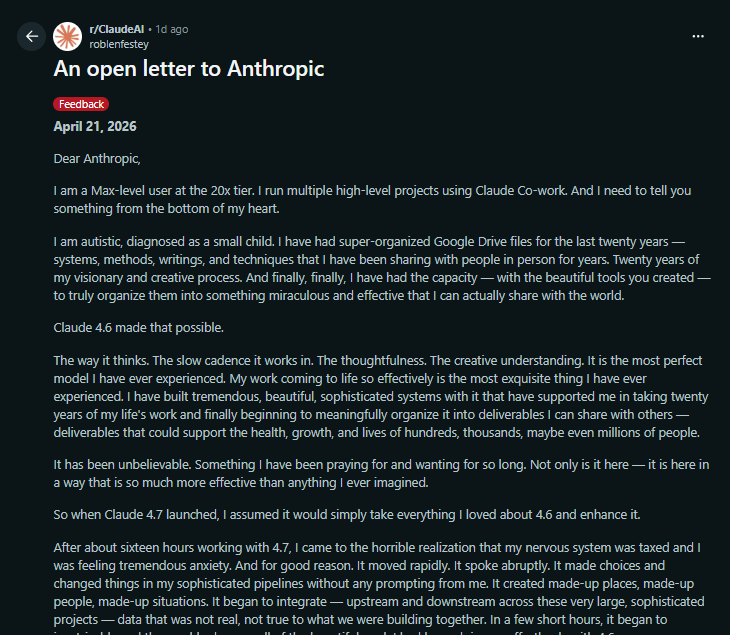
THIS MAX-LEVEL CLAUDE USER JUST WROTE AN OPEN LETTER TO ANTHROPIC THAT’S HITTING DIFFERENT
20 years of meticulously organized Google Drive files, visionary systems, and life’s work. Autistic power user finally turns it all into beautiful, shareable deliverables using Claude 4.6.
- 4.6: slow thoughtful cadence, zero random changes, actually gets the vision and builds sophisticated pipelines without hallucinating
- 4.7: blasts in fast and abrupt, rewrites stuff unprompted, fabricates people/places/data, wrecks four projects across four machines in 16 hours
- switched back, audits showed the full damage, nervous system instantly relaxed then learned 4.6 gets deprecated in June
He wept. Calls it the golden child of the whole AI thing.
Anthropic really out here about to kill the one model that actually works for people doing real long-term work.
Classic “ship faster, break the magic” energy.
You need 4.6 to stay.
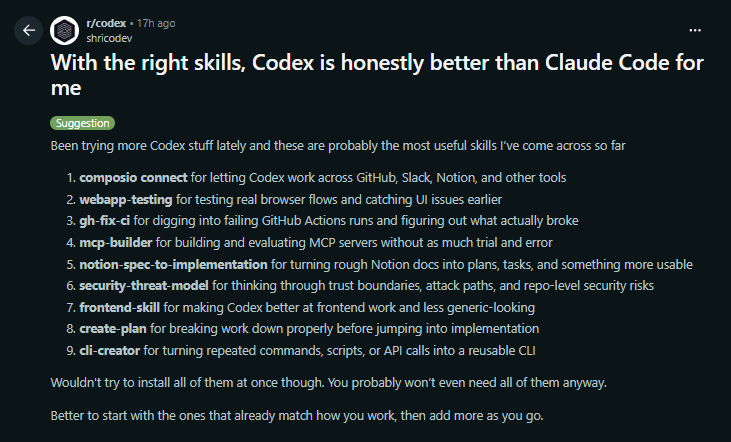
WE WEREN’T WRONG ABOUT CODEX, THESE SKILLS MAKE IT BETTER THAN CLAUDE
someone dropped a list of Codex skills that make it actually useful for real dev workflows.
- composio connect: hooks it straight into GitHub, Slack, Notion and the rest of your tools
- webapp-testing: runs real browser flows so you catch UI issues before they ship
- gh-fix-ci: digs into failing GitHub Actions and tells you what actually broke
- notion-spec-to-implementation: turns your rough Notion docs into real plans and tasks
- frontend-skill: stops Codex from spitting out the same generic UI every time
Claude’s cute for quick prototypes, but these turn Codex into the one that actually ships your work.
Don’t install the whole list at once or you’ll hate your life, start with whatever matches how you already work.
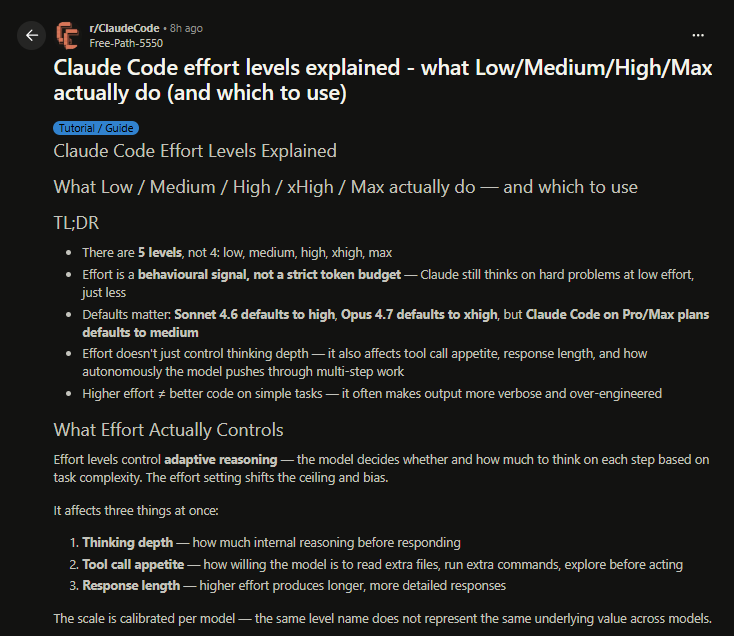
YOU’RE PROBABLY USING THE WRONG CLAUDE EFFORT LEVEL RIGHT NOW...
We thought effort levels were just token throttling. Nope, it’s a behavioral signal that dials thinking depth, tool appetite, and response length all at once.
> Low: skips reasoning, minimal tools, terse, builds, greps, renames
> Medium: balanced default on Pro/Max, thinks only when needed
> High: always engages brain, reads files unprompted, Sonnet’s default
> xHigh: persists sessions, full agent mode, Opus starting point
> Max: no limits, current session only for deep architecture hell
Higher effort on easy tasks just makes it over-engineer everything into verbose slop.
Sonnet actually cooks best at Medium. Opus finally respects lower settings instead of going rogue.
We’ve been prompting around this like clowns.
Set /effort and stop guessing. You need this.
SENIOR ENGINEERS ARE CRACKING CLAUDE CODE AFTER 6 MONTHS OF DAILY USE.
Tired of watching it hallucinate entire features and burn your context? This full stack vet finally nailed the workflow that actually ships.
> Plan mode first for anything complex, zero code until it maps the approach
> Only ask for step 1, review, then step 2 (one-shot requests are career suicide)
> Let Claude fix its own bugs, it builds real codebase memory
> /simplify before review (because it always over-engineers, classic)
> End every session with a retro: “what did you learn?” and stash it in CLAUDE.md breadcrumbs
Bonus meta:
> Use a second AI (Codex) to review Claude’s plan
> Store retros smartly (CLAUDE.md + logs, not one giant file)
Turns out treating AI like a junior dev actually works… shocking, I know.
go try this
IF CLAUDE FEELS LIKE IT’S HITTING A WALL ON REAL PROJECTS…
This guy was a die-hard Claude Opus user for years. Had a 190k-line project rotting in the fridge for months because Opus kept getting lost, wiring things wrong, and claiming it worked when it didn’t.
Then GPT-5.4 xhigh stepped in:
> Ran 30+ hours over 3 days, no hand-holding
> Found every mismatch, gap, and broken connection Opus missed
> Rewrote huge chunks, cleaned the repo, added features, and actually made the whole thing run smoothly
Of course the $200/month model couldn’t handle growing complexity without constant babysitting. Classic.
Time to thaw those other fridge projects. You need this.
THIS GUY BUILT THE KARPATHY-INSPIRED CLAUDE.md THAT’S ALREADY AT 47K STARS
Andrej roasted how LLMs make silent wrong assumptions, bloat code with abstractions, and sneak in unrelated refactors.
This repo packages the fix into one file with four principles that actually shut that down.
> Think Before Coding: state assumptions, surface tradeoffs, ask instead of guessing
> Simplicity First: minimum code only, no speculative features or flexibility
> Surgical Changes: touch exactly what’s requested, never refactor adjacent stuff
> Goal Driven Execution: tests first, define success, loop till verified
Of course Claude needed a rulebook to stop being a know it all. Classic AI moment.
One curl and you’re done. Go clone it.
WE WEREN’T WRONG ABOUT AI CODING
Anthropic dropped an 18 page agentic trends report. Skimmed expecting hype but the numbers actually hit different.
> Devs use AI in ~60% of work but fully delegate only 0-20%. Fast copilot that still needs you watching.
> 27% of AI-assisted output is net new: internal tools, fixes, experiments you’d never prioritize manually.
> Rakuten threw Claude Code at a 12.5M LOC codebase 7 hours autonomous, 99.9% accuracy. Not a toy anymore.
> Zero coding legal team cut reviews from 2-3 days to 24h. Zapier’s at 89% company wide.
Multi agent coordination is the 2026 bet, once single context hits the wall.
Their engineers: “I use AI when I already know what the answer should look like.” Of course.
so we're not getting replaced, we're getting promoted to AI babysitter. of course we are.
You need to see this.
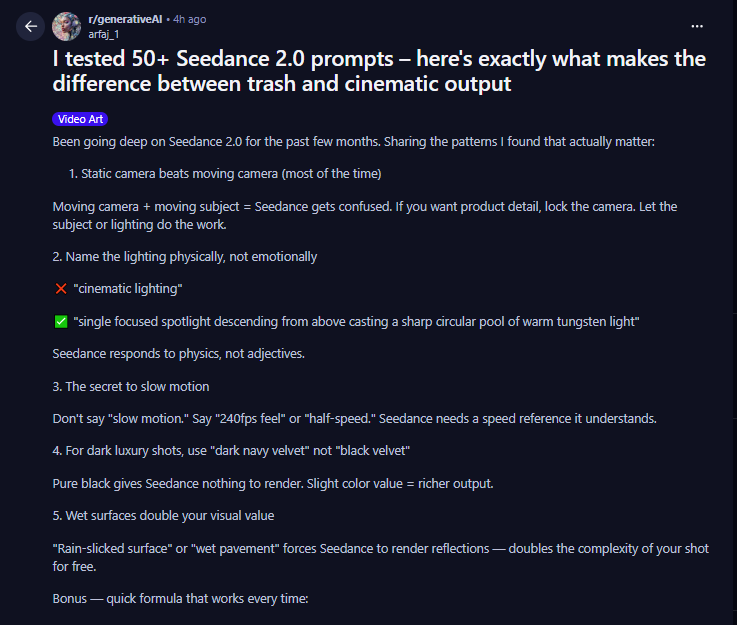
THIS GUY BUILT A SEEDANCE 2.0 PROMPT LIBRARY FROM 50+ TESTS
Most outputs looked like AI soup… until he found what actually works.
> Static camera beats moving one (most of the time) moving subject + moving cam just confuses it
> Name lighting physically, never emotionally: “single focused spotlight from above casting sharp circular warm tungsten pool” > “cinematic lighting”
> Slow-mo hack: say “240fps feel” or “half-speed,” never “slow motion”
> Dark luxury shots need “dark navy velvet,” not plain black (it needs something to actually render)
> Wet surfaces = free money: “rain-slicked” forces reflections and doubles visual complexity
Of course it responds to physics, not vibes. Classic AI moment.
Formula that works every time: subject + exact camera move + physical lighting + speed + duration.
You need this. Go test it.