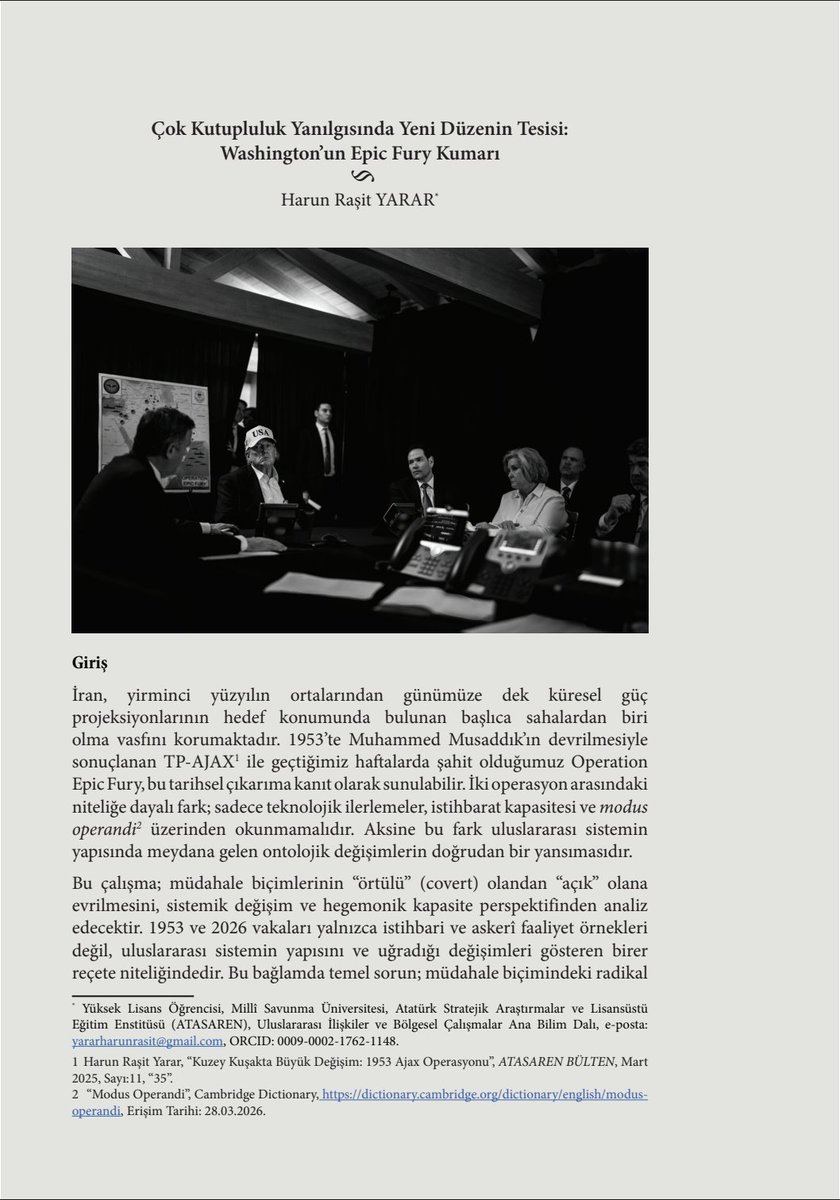
Milli Savunma Üniversitesi ATASAREN bünyesinde hazırlanan ATASAREN Bülten’in ABD-İran Savaşı Özel Sayısı'nda, Savaş'ın başlarında kaleme aldığım "Çok Kutupluluk Yanılgısında Yeni Düzenin Tesisi: Washington’un Epic Fury Kumarı" başlıklı çalışmamla yer aldım.
Bu çalışmada ABD'nin İran müdahalesinin sebeplerini ve yol açacağı sonuçları uluslararası sistemin değişimi ve hegomonik kapasite perspektifinden ele aldım.
Keyifli okumalar!
Bültene erişmek için: https://t.co/C6OWhA5jhF
Barrack is failing to de-escalate Turkish-Israeli relations because the obstacles to de-escalation are rooted in many different factors, and he will have a difficult time if he genuinely wants to address them. Let’s analyze the problems from scratch.
1. Political Leaders Increasingly Receive Distorted Information
The presidents in both countries are strong leaders with long governing experience. However, like everyone else, they rely on reports, documents, briefings, assessments and analyses provided to them by different state mechanisms. In both countries, reports coming from lower and mid-level bureaucracy do not necessarily reach the upper level directly. They are frequently “revised” by gatekeepers. As information travels upward, reports can become marginalized, acquire a sharper tone, become more politically convenient, and move further away from the reality on the ground to satisfy the leaders. Demagogic vocabulary gradually replaces proper analysis.
Instead of analyzing both countries, evaluating their strategic interests, conducting deep analyses, identifying possible areas of cooperation, identifying genuine threats and distinguishing between capabilities and intentions, analyses become filled with accusations.
Politicians are free to use such discourse among the public. They also have every right to use foreign policy as an instrument of domestic politics, practically every government does this to some extent. However, behind the curtains, foreign policy cannot be conducted effectively through campaign slogans. When political rhetoric contaminates internal analysis, decision-makers lose the distinction between what is useful to say publicly and what is necessary to know privately. The problem, therefore, is not simply misinformation. It is institutionalized confirmation bias.
If every level of bureaucracy gradually learns which conclusions are politically desirable, decision-makers may eventually receive increasingly sophisticated versions of what they already believe. Information that challenges the dominant narrative becomes filtered out. In such an environment, leaders may still receive enormous amounts of information while becoming less informed about the actual society they are dealing with.
2. Expertise Has Increasingly Been Replaced by Populist Narratives
In Israel, although there are excellent experts on Turkey, many have been sidelined for some years, while the public discussion has increasingly been hijacked by populist “experts” who adore talking big, making dramatic predictions and producing sensational arguments rather than describing realities. “Turkey is becoming the next Iran” is a perfect example, it is a powerful television sentence and also so a very poor analytical framework.
The problem is not that Israel lacks expertise; the problem is which expertise reaches the public, which expertise reaches politicians, which voices are rewarded by television programs, and which interpretations ultimately become dominant. Many of the “experts” who shape public discourse do not fully understand the sociological complexity of contemporary Turkey. Their perspectives are often shaped by overwhelmingly metropolitan environments, particularly Istanbul and İzmir and by relatively urban and elite social circles. Many have spent little significant time in smaller Turkish cities or rural areas and may therefore have limited exposure to the different social and political segments of the Turkish electorate.
There is a genuine selection-effect problem here. If most information about Turkey is filtered through metropolitan, secular, elite, security-oriented or expatriate perspectives, Israeli decision-makers may receive a detailed picture of one Turkey while remaining poorly informed about provincial Turkey, nationalist voters, conservative voters, Kurdish-majority regions, Black Sea politics, Central Anatolia, different generations of AKP voters, opposition constituencies, and the complex ideological combinations that characterize Turkish society. The issue, therefore, is not ethnicity. It is epistemic closure.
The Kurdish Issue
The second problem is that Israeli analysis is too heavily based on the “Kurdish issue against the Palestinian issue” argument. Since the Gaza flotilla incident, Israeli media and academia have increasingly pushed the Kurdish issue forward. Much of the discussion implicitly presents Kurdish politics through the prism of Israel's relationship with the Palestinians: if Turkey criticizes Israel over Palestinians, Israel should retaliate by emphasizing Kurdish issues.
But the majority of the time, some of these ideas become so radical that ordinary Israelis may be left believing that all Kurds in the world love Israel, support Israel and are ready to rebel against the countries in which they currently live. This is simply not a serious understanding of Kurdish politics. Kurdish populations are fragmented by state borders, class, religion, political ideology, tribal networks, party affiliation, linguistic differences, historical experiences, and competing nationalist projects. The “experts expectations” on Kurds of Syria and Iran failed dramatically and caused problems for Israeli politics in the region due to reports based on wishful thinking.
Moreover, some of the strongest anti-Israeli positions in Turkey, Iraq and Iran can probably be found in Kurdish-majority cities. Yet Israeli “experts” still occasionally push the fantasy of “Kurdish boots on the ground.” Relying on nationalist discourses of ethnic groups for information about realities on the ground has never worked particularly well for Israel. No matter how many times this approach fails highly ideological arguments continue to receive attention and continue poisoning Israel's near-abroad policy. Same applies to Turkey; majority of the Israeli Arabs are perfectly integrated to Israeli society and not all Gazans are Hamas supporters, but on the contrary against Hamas and protest from time to time.
There is a difference between recognizing that Kurdish actors may occasionally have overlapping tactical interests with Israel and imagining a homogeneous transnational Kurdish bloc permanently aligned with Israel. Countering the Palestinian centered discourse with Kurdish centered discourse does not work at all but many times backfire.
Israel's Image of Turkish Society
Turkish society is not really known by either the Israeli government or the Israeli public. After years of this type of discourse in Israeli media by supposed “Turkey experts”, Israelis increasingly tend to see the majority of Turks as people culturally or politically resembling Iran, Syria, Afghanistan or somewhere between. That is an astonishing misunderstanding of Turkey's sociology. The perception of a “Turk” among Israelis over approximately 35 years old is often relatively normal because Turkey used to be an extremely popular holiday destination. Huge numbers of Israelis visited Turkey. Human familiarity creates cognitive friction against demonization. Younger Israelis increasingly lack that experience. Their perception of Turks is therefore much more likely to be constructed through media, war, social media, Erdoğan speeches, Gaza, Syria, and hostile political discourse.
Turkey contains deeply conservative constituencies, secular constituencies, ultranationalists, Kurdish nationalists, Turkish nationalists, Islamists, social democrats, liberals, Alevis, religious Sunnis, urban professionals, provincial entrepreneurs, young apolitical voters, old ideological voters, and numerous groups that cannot be placed neatly on a Western left-right spectrum. Reducing all of that to “Islamist Turkey” and “the next Iran” is analytically useless.
Turkey Does Exactly the Same Thing to Israel
The other side of the coin is almost identical. The Turkish public has little to no knowledge about the different segments of the Israeli political spectrum and tends to see all Jews as religious Zionists or Haredim. The categories collapse into each other with huge overgeneralization follows as:
Israeli → Jew → Zionist → religious Zionist → Netanyahu supporter.
Many Turks have no idea about the political stance of Gaza Envelope kibbutzniks, many of whom were historically very cordial toward Gazans and strongly supportive of a two-state solution. Some maintained personal friendships with Gazans for many years and helped them in every possible sense (Yet these communities were nevertheless attacked on 7 October, which is another reason that Turkish analysts fail to grab the radical shift in Israeli politics center and leftist voting patterns). The same is true on the Turkish side. The Turkish public has almost no understanding of everyday Israeli life. Nearly none of the Turks have no idea how Israeli Arabs live, despite Arab citizens constituting roughly one fifth of Israel's population. They know almost nothing about Israeli Bedouins, Circassians, Druze, or the internal differences among these communities. Even among Turks with a clearly anti-Israeli stance, Israeli policies are frequently reduced purely to Gaza. Consequently, they miss much of what is happening in the West Bank and Lebanon and also avoid examining Egypt's part in creating or maintaining some of the conditions surrounding Gaza today.
That fact is profoundly difficult for much of Turkish discourse to process because it does not fit the simplistic binary categories through which Israeli society is understood. Israeli society is every bit as complicated as Turkish society. Israel contains secular liberals, traditionalists, Haredim, religious Zionists, Mizrahim, Ashkenazim, Russian-speaking communities, Palestinian/Arab citizens, Druze, Bedouins, Circassians, kibbutz movements, development towns, settlers, metropolitan elites, peripheral communities, and radically different political cultures. Yet in Turkey, all of this is overgeneralized.
Anybody who attempts to analyze Israel, explain these different groups, discuss the reasons behind Israeli grand strategies, or simply describe why Israel behaves as it does is often expected to begin by cursing Israel or at least to curse Israel somewhere in the argument, otherwise, that individual is immediately labeled suspicious. Cursing, swearing, denunciation, and demagogy are expected when evaluating Israel. Consequently, explaining Israel becomes confused with defending Israel. This destroys analytical depth. It becomes difficult to ask –why- Israel behaves in a particular way because asking the question itself is interpreted as legitimizing the behavior.
The result is a mirror-image epistemic problem:: Israelis increasingly understand Turkey through politically useful caricatures, while Turks increasingly understand Israel through politically useful caricatures. Both societies therefore become experts on imaginary versions of each other.
3. The “Hotline” Does Not Really Work Because Human Connection is Lost, NGOs and Civil Society Are Completely Disconnected
The “hotline” does not work effectively between the two countries because, to make a hotline work, both sides need actually to want it to work. If there is no meaningful connection between two countries, no technical instrument can magically produce political trust. Only “very technically” there is a contact, started in Azerbaijan last year to establish unwanted military incidents and misunderstandings in Syria but it seems not to work at all.
Today there is almost no regular contact between the two countries' NGOs, experts, government officials, opposition figures, military communities, and civil society groups. Leaving all those aside, there is increasingly little meaningful contact even between ordinary people.
NGOs are almost completely disconnected, as are civil-society forums and dialogue mechanisms. De-escalation rarely begins with presidents suddenly waking up and deciding to love each other. It often begins below that level, someone knows someone, a businessman calls another businessman, an academic speaks to another academic, a retired diplomat communicates with a former colleague, a journalist tests an idea, an NGO arranges a meeting, a backchannel develops then an unofficial proposal moves upward. Eventually, political leadership has options.
Today there is almost nothing comparable between Israel and Turkey from which de-escalation can begin at the most basic level. The ties have been cut in practically every aspect.Civil society is not the fundamental cause of the geopolitical conflict, however. This distinction matters analytically.
The collapse of civil society should be understood primarily as an amplifier and the destruction of a safety mechanism, rather than the original source of the conflict. When political relations deteriorate between countries with dense societal relationships, thousands of small connections continue pulling the countries back toward normality. When those connections disappear, there is nothing underneath the governments to absorb the shock.
5. Public Diplomacy Is Fueling the Hostility Rather Than Repairing It
Public diplomacy is also working not to repair the wounds created by tense relations between the two countries, but increasingly to fuel them. The IDF's Turkish-language public diplomacy (@TurkishIDF) is horrible. I have analyzed in detail how low-quality much of it is and how frequently it backfires, causing even ordinary and relatively neutral Turks to become seriously irritated because of the quality of the Turkish speaker person of the account and horribly incorrect cultural details. IDF Turkish spokesperson, Arye Sharuz Shalicar, is probably an important factor that detoriates relations with his background and lack of professionalism. In IDF Turkish account videos, Arabic tunes are used as background music for material supposedly aimed at Turks, Turkish coffee is presented in plastic cups, cultural references are badly chosen, language is ear-bleeding. These details communicate something unintentionally: “We do not really know who you are.” That is disastrous public diplomacy. On the contrary IDF Arabic is legendary in sense of public diplomacy and @captainella1 as well as @avichayadraee are realy textbook PR examples.
TRT Hebrew is no better. Some of the “news” they have provided has been so strange and has contained completely incorrect information. When you try to correct them, they simply block you. Their producers are in fact the only people who have ever blocked me on X.
Public diplomacy may no longer genuinely be intended to persuade the other society, it increasingly functions as domestic-performance diplomacy. Institutions produce foreign-language material because they are institutionally expected to produce it, while the actual ideological audience remains at home.
The IDF's Turkish-language communication may therefore satisfy Israeli institutional assumptions about Turkey without persuading Turks. TRT Hebrew may satisfy Turkish assumptions about Israel without persuading Israelis. Once that happens, public diplomacy becomes part of the echo chamber rather than an instrument for escaping it, does not allow communication across societies.
6. The Weakness of American Diplomacy Is Another Problem
The incompetence of US diplomats is another factor. Tom Barrack is a figure with enormous authority given to him by Trump but I do not see him as capable of lowering this type of escalation. He is simply not a “tough guy” in the Trump style, nor is he a Kissinger-type strategic diplomat capable of maintaining several contradictory relationships in careful balance. After Israel's 18 August 2026 strike on Abu al-Duhur airbase, he publicly criticized the attack as an unnecessary escalation and stated that Washington was working on a Turkey-Israel-Syria deconfliction mechanism but nobody is happy anymore about only words and condemnations. Therefore, the larger analytical question is not: Is Tom Barrack personally a good diplomat?Or does Washington possess sufficient leverage, credibility, institutional capacity, and political willingness to impose or incentivize meaningful deconfliction among Israel, Turkey and Syria?
The United States is one of the very few actors capable of talking seriously to both Ankara and Jerusalem. If Washington cannot produce a functioning mechanism, there is presently no obvious alternative external power capable of doing so.
7. The Structural Problem: Gaza Has Societalized the Conflict, While Syria Has Securitized It
The factors above are important, but none of them by itself explains the current crisis. NGOs, media, experts, bad public diplomacy, stereotypes and political rhetoric are mostly amplifiers. The structural problem is deeper as Gaza made the relations normatively loaded. A possible future cooperation now generates a normative question: After Gaza, why are you cooperating with Israel? The same question is asked by Israelis, after the massacre of 7 October, why to trust Turkey?
That dramatically increases the domestic political cost of rapprochement. Consequently, Gaza has not merely produced hostility but it has societalized foreign policy. Political leaders are no longer simply producing anti-Israeli public opinion from above, public opinion itself increasingly constrains what leaders can do from below.
At the same time, Syria is transforming Turkish-Israeli rivalry from an ideological confrontation into a genuine interstate security problem. Turkey increasingly regards post-Assad Syria as a strategic environment in which it has legitimate military, political, security, economic, and historical interests. Ankara believes that instability in Syria directly affects Turkish security through refugees, Kurdish armed groups, jihadist organizations, border security, trade, and regional power competition.
Israel increasingly sees Turkish influence in Syria through a different lens. From the Israeli perspective, Turkish military infrastructure, aircraft, drones, air-defense systems, or permanent bases in Syria could eventually restrict Israeli freedom of military action and create a powerful military presence close to Israel's operational environment. This is a textbook security dilemma.
Both governments can therefore interpret their own behavior as defensive while interpreting the other's behavior as offensive. That is much more dangerous than governments insulting one another.
8. Regional Alignments Are Making the Problem Larger Than Gaza
The relations will probably not significantly improve as long as Gaza remains unresolved or at least stabilized because Turkey has established a very thick red line and does not appear likely to become flexible in the near future. At the same time, the confrontation increasingly extends beyond Gaza.
Turkey is building or strengthening a network of regional relationships that it regards as balancing competing regional structures, while Israel's partnerships and strategic relations involving the UAE, Greece, Cyprus, and increasingly Somaliland are viewed from Ankara through a competitive geopolitical lens, countered by Mecca Agreement, bilateral alliance with Somalia and strengtehning presence in Balkans as well as Iraq.. From Turkey's perspective, these alignments can look like a network designed partly to constrain Turkish influence. From Israel's perspective, Turkish regional activism can look like an effort to construct an alternative regional bloc that limits Israeli freedom of maneuver.
Thus, Gaza may provide the emotional center of the confrontation, while Syria, the Eastern Mediterranean and Horn of Africa provide its geopolitical architecture. This combination is particularly dangerous because conflicts based purely on material interests can often be bargained over. Conflicts based purely on identity can sometimes be symbolically managed, but when identity conflict and security competition reinforce one another, compromise becomes much more difficult.
9. What Happens If Israel Diretly Attacks Turkish Armed Forces?
The most dangerous scenario is therefore not another speech, diplomatic insult, television argument, or social-media campaign but military casualties. If the present escalation leads to the deaths of Turkish soldiers such an incident could cause massive anger throughout Turkish society, regardless of whether people are pro-government or anti-government. A CHP voter, an AKP voter, a nationalist, a secularist, a conservative, or someone who strongly dislikes Erdoğan can still react almost identically to images of Turkish soldiers killed by Israel. This is precisely where the current level of societal hostility matters.
Turkey and Israel themselves repaired relations after the Mavi Marmara crisis and restored full diplomatic relations again in 2022, but Turkish military fatalities caused by Israeli action could transform the rivalry from a primarily political and strategic confrontation into a direct interstate security conflict, dramatically increasing the domestic cost of any future normalization. Civilian casualties in Mavi Marmara were ignored by parts of the Turkish society, but any Turkish soldier’s casualty will massively cause a united public anger from all parts of Turkish society towards Israel. There is probably an awareness of this risk on the Israeli side as well. The fact that Abu al-Duhur was struck at around 03:00, when the likelihood of Turkish personnel being present may have been lower (if there were any, of course), could indicate an attempt to avoid Turkish casualties, although the timing alone is obviously not enough to establish such an intention. What matters is that both sides now appear to understand that there is a line which, once crossed, would make the political management of the crisis way more difficult.
10. What next?
The real danger is therefore not that Turkey and Israel dislike each other. States can dislike each other for decades and still manage their relations. The danger is that the two countries are increasingly operating in the same military and geopolitical space while having fewer and fewer channels capable of preventing a crisis from getting out of control.
De-escalation is still possible but normalization is something else. A military hotline can prevent an aircraft from being shot down but it cannot repair public opinion, rebuild civil-society ties, correct years of bad analysis or create trust between two societies that increasingly see each other through caricatures.
For that reason, if American diplomacy really wants a stable Syria, the first objective should probably not even be “normalization.” between Israel and Turkey. That is too ambitious under the present conditions. The immediate objective should be much more basic as preventing direct military confrontation, rebuilding professional communication, bringing serious expertise back into decision-making and creating some human contact below the level of governments.
Otherwise, Turkey and Israel may eventually discover that the most dangerous part of their rivalry was not any deliberate decision to confront one another, but the gradual disappearance of everything that once prevented them from doing so.
Israeli government complains about status-quo broken, but latest attack changes the "status quo" that Israel had already, in some form agreed to, as shown on the map. Israel is naturally unhappy because, for many years, it had complete freedom to fly over Syrian territory and carry out raids withiut any intervention. It will not give up this freedom easily, especially before Turkey upgrades its air force with F-35s and domestically produced fighter jets.
Israel's earlier raid on Palmyra Air Base drew a kind of status quo line, since the reaction time of the IAF would be problematic if there were a hot conflict. North of this line, however, the IAF would have enough time to respond. That was essentially the "status quo," which Israel violated yesterday by striking a base far beyond that line.
The second point is that Syria will not remain without an army forever. Ultimately, it is a state and will have to rebuild its military. For now, this process is still in its babysteps and Turkey will probably be the main country helping to rebuild it from scratch. This latest attack is a sign that Israel does not want Syria to possess any meaningful military capability. Rather, Israel seems to prefer something comparable to what the Palestinian Authority has, or at most something resembling the military capabilities of the Iraqi Kurdish autonomous region, no real air force apart from basic aircraft and perhaps some light helicopters, no heavy armored formations or tanks and a military capable primarily of maintaining internal security.
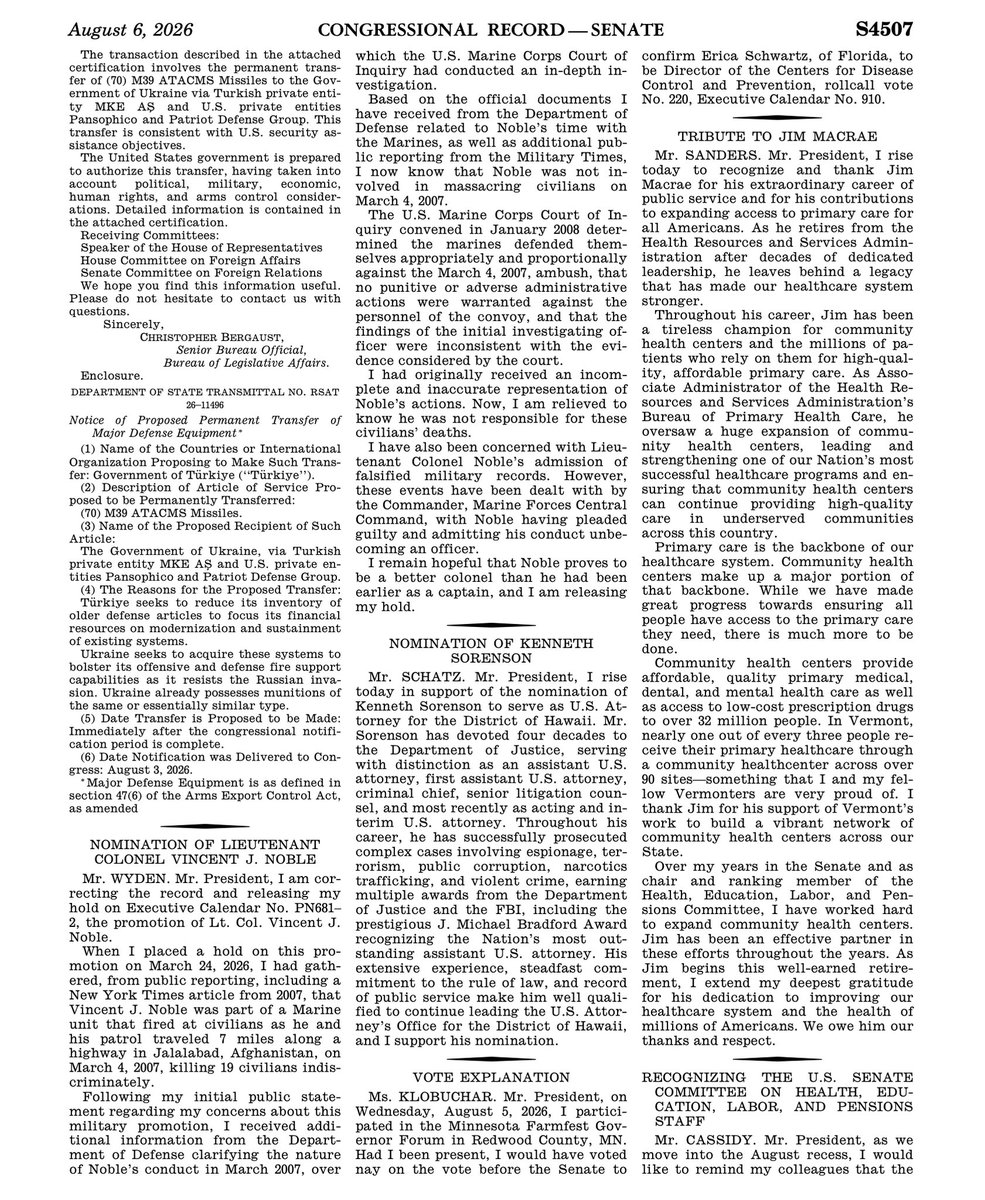
Alakalı bir gelişme. Türkiye Ukrayna'ya taarruzi bir silah sistemini, hele hele ATACMS gibi bir taktik balistik füzeyi vermeye hazırlanıyorsa "bir şeyler" epey değişmiş demektir.
https://t.co/WKS99AnUhZ
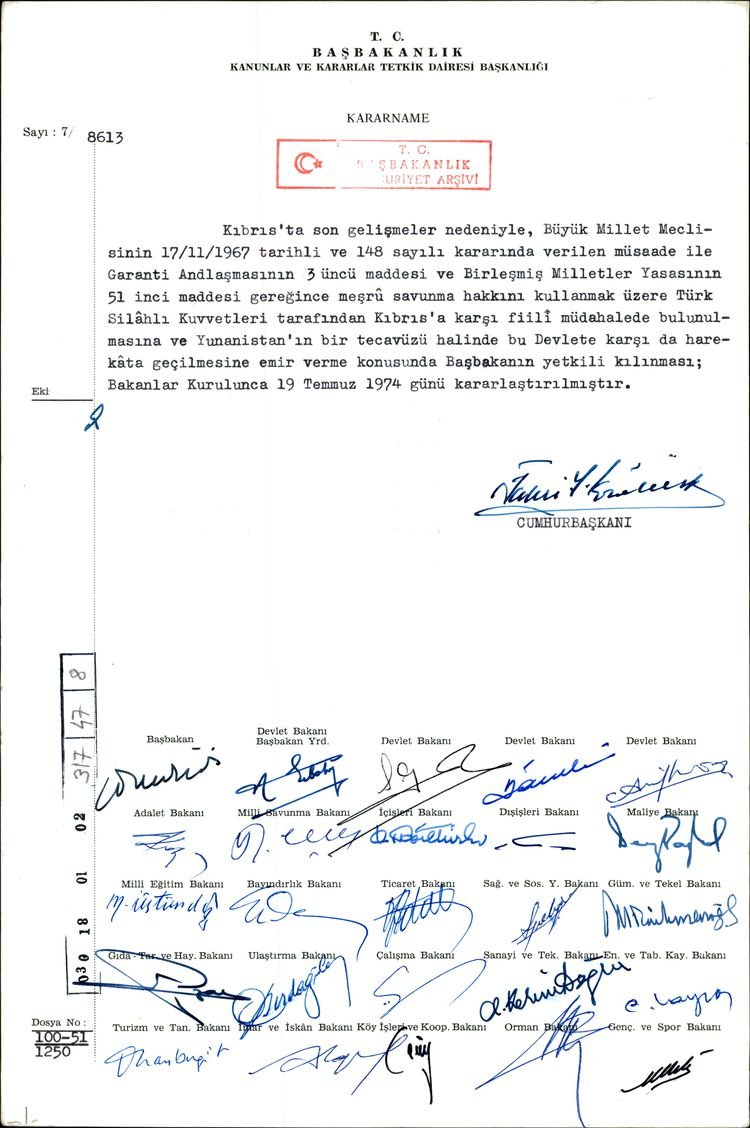
Meşru savunma gereğince TSK tarafından Kıbrıs'a karşı fiili müdahale bulunulmasına ve Yunanistan'ın olası bir saldırı girişiminde, Yunanistan'a askeri harekat icra edilmesine dair emir verme konusunda Başbakanın yetkili kılınması, 19 temmuz 1974.
I met with the Minister of Foreign Affairs of Türkiye, Hakan Fidan, and awarded him the Order of Merit, II class. I am grateful to Türkiye and to the Minister personally for the efforts to bring peace closer. Today, we discussed the diplomatic situation and the steps that could reinvigorate efforts to achieve peace.
I also briefed the Minister on the situation on the battlefield, while he spoke about his diplomatic contacts at various levels. Of course, we also discussed bilateral relations and the implementation of the Free Trade Agreement between Ukraine and Türkiye. We expect trade between our countries to keep growing. Thank you for the visit and for your readiness to cooperate and advance peace.
Milli Savunma Üniversitesi Atatürk Stratejik Araştırmalar ve Lisansüstü Eğitim Enstitüsü tarafından hazırlanan "ATASAREN Bülten" ABD-İran Savaşı Özel Sayısı yayımlandı.
➡️ https://t.co/pw5GCnXalU
🇹🇷 MİT Başkanı İbrahim Kalın:
▪️İhtiyacınız olduğunda Türkiye'ye yönelip, rahatınız yerindeyken ondan uzaklaşamazsınız.
▪️Biz kimseden iyilik istemiyoruz. Birlikte yapalım diyoruz, ama adil bir şekilde, Paylaşarak yapalım.
▪️Sonuçta dans için iki kişi gerekir.
Gece 3’te tek başına nöbet tutup SVO,MI gibi major şeyleri ekarte etmeye çalışırken bi yandan hasta yakınlarının endişesinin sözlü-sözsüz ağırlığını taşıyıp dava edilir miyim korkusunu her daim ensesinde hisseden dostlarıma 180k azdır demeyi borç bilirim