It’s a waste of time looking for alpha in crypto.
While I brace for the incoming rotten eggs and tomatoes on this one, let me make it clear that you don’t need alpha to make money—as long as some preconditions are met.
But first let’s straighten out some vocabularies. What is alpha anyway?
If we hang our thoughts on the good old CAPM (capital asset pricing model) for a sec, the expected return on an asset consists of several parts:
Asset return = Risk free return + alpha + beta x ( Market return - Risk free return )
Risk-free-return is what you can be guaranteed to earn with eyes closed, e.g. interest on 10-year US Treasury bonds. Market-return is the expected return from the whole asset class— in this case, the crypto market.
Beta is the correlation of your bag of tokens to market movement. Since crypto isn’t an efficient market and all participants are here for the singular objective of watching numbers go up, you get extremely consensus price behaviors, i.e. everything goes up and down together (read: large and positive beta). Your sh*t coin holdings all have beta > 1. And almost no token has beta < 0.
Alpha is the portion of an asset’s return that’s uncorrelated to Market-return. A positive alpha is a rare breed in any market since it requires your holding to independently generate value regardless of what its industry, sector, or asset class is doing. It’s easy for anybody to name dozens if not hundreds of crypto tokens with negative alpha, i.e. they systematically destroy value in the long run. But I have yet to find anybody who can present a convincing case for a positive alpha for any of the myriad of tickers listed on any crypto exchange (hold your eggs and tomatoes for now, we’ll come back to this in a sec).
The closest thing I can think of akin to alpha generating in crypto are short-term pricing arbitrages, e.g. across exchanges and across a token and its derivatives. That would indeed shield you from much of the market directional risks. But two things here: 1) these aren’t an accessible game to most people and are by no means easy (with their own infrastructure, tech and execution risks), and 2) they become less profitable in bear market as liquidity goes down and risk of short-term extreme price dislocation goes up. So their returns are actually more correlated with market movement than you may think.
The bottomline is the crypto market I can see is characterized by very large positive beta and highly questionable, if any, alpha.
Influencers and gurus across social platforms and crypto chatrooms all claim to be discovering alpha, while in reality they are all just chasing higher beta.
And there’s nothing wrong with that.
Because if you know the characteristics of this market is as such, then your marching order is clearly laid out. Step 1, figure out if Market-return of the current period is positive. Step 2, if it is, then find a way to identify and buy the highest beta you can find. Step 3, do it over and over until Market-return turns negative.
Chasing beta is an easier and more profitable game in crypto than finding alpha because of how big and obvious the former is, as long as you do it thoughtfully.
That means developing two skills: #1, an ability to identify market cycle (not necessary to spot exact top and bottom, but in the ball park are we on the way up or down?). #2, a repeatable method to identify and execute on high beta plays.
Of the two, #1 is much more important than #2, because if you use a beta chasing method in an environment of negative Market-return, you’ll just perish faster.
In contrast, if you get #1 down, then #2 is the easier part. There are thousands of beta-seeking strategies out there across many different schools of investing, e.g. strategies of momentum and trend following, strategies of whale watching and order flow counting, strategies of pullback and dip-buy. All have their respective pros and cons. But as long as you pick something with a reasonable rationale and stick to it, you’ll be harnessing beta alright.
Of course the flip side is if you get too aggressive with surfing the beta highs without thinking through your downside scenarios, sooner or later the gods of risks will demand their tribute, that is, your head. And once Market-return turns negative, none of these strategies would be worth their subscription fees.
Now, let’s briefly return to the question of alpha. Again, a positive alpha is the portion of an asset’s return on top of the Risk-free-return that is uncorrelated with the underlining market. Where does it come from?
To answer that, it’s useful to look at where the so called Risk-free-return comes from. The 10-year US Treasury yield, a real world proxy for Risk-free-return, has a long-term average of close to 6% a year. Why 6%? Well, 3% average inflation + 3% average US real GDP growth = 6%.
In other words, the Risk-free-return is a proxy for the annual rate at which the economy as a whole is able to create additional real value-added.
So for an asset to have positive alpha, it needs to generate real value-added at a rate higher than the overall economy. And it needs to be able to do so for a longish stretch of time.
From this perspective you can easily see what kinds of assets will more likely to have higher alpha— leaders from high growth industries and sectors that will continue growing faster than overall economy for a long time— provided that you don’t buy them at too expensive a price.
I don’t want to argue with anybody on whether any crypto assets would fit this description. I have my views but I don’t have a crystal ball.
But there’s the thing. In considering capital allocation, one should not only consider the expected return on an asset, but also how it compares with alternatives, no?
We luckily are living in an age of many technology breakthroughs and demographic shifts that will change industries and economies profoundly in coming decades. If you want to find investments that will grow faster than overall economy for a long time, there is no shortage of likely places to look— artificial intelligence, renewable energies and transportation, healthcare, to name a few.
Even if one can make a case for why some crypto assets would have positive alpha in long run, whether that is a higher expected alpha than all these alternative—and arguably higher-likelihood— choices that you can sink money into, is an entirely different question. My answer to that is I don’t know. But given how strong a beta-driven market it is, I’m not sure that question is even worth answering.
Shorting is a dark art- suitable only for the most elite of trading wizards.
You pay ongoing borrow costs in a war of attrition, for limited upside, all whilst taking on risk of liquidation- no matter how big your bankroll is!
The game theory lens is particularly interesting 🧵
1/ Nomad was just hacked for $190M, making it the 5th largest DeFi hack of all time. How did this happen? We break down not just the exploit, but also HOW THE VULNERABILITY WAS INTRODUCED IN THE FIRST PLACE.
Understanding bugs isn't enough. We need to stop merging them.👇
The macro is falling into place...
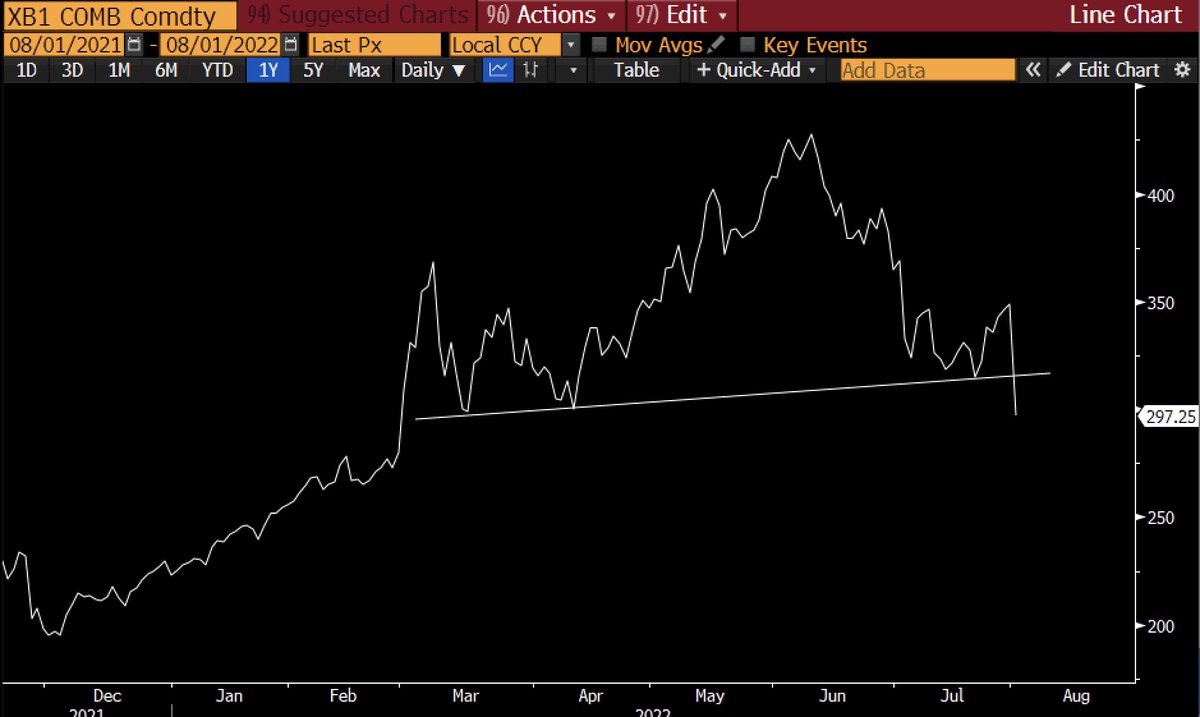
The last leg of the commodity demand destruction trade is kicking in...
Gasoline has now broken the big head and shoulders top...
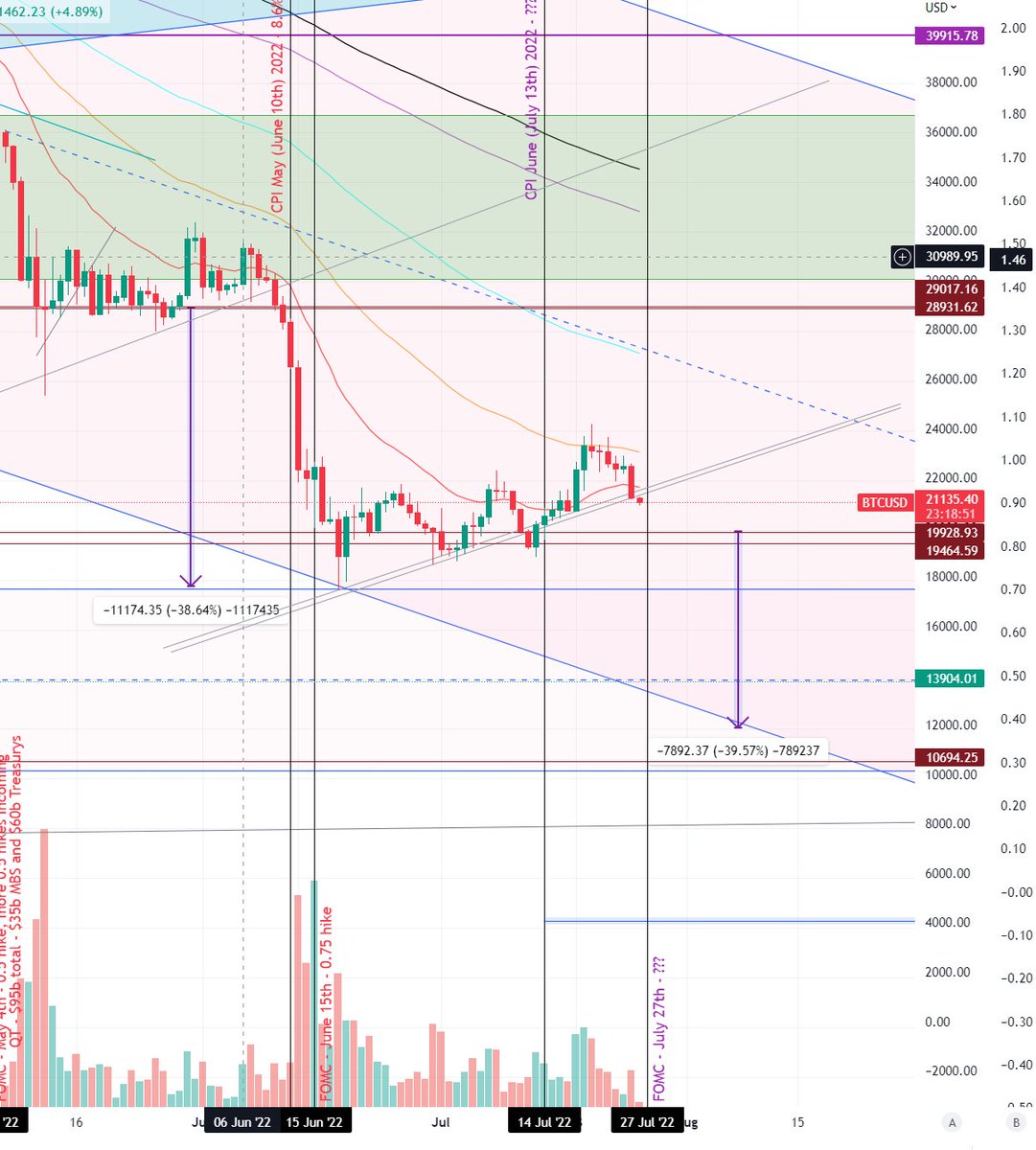
The Merge gave ETH a lot of strength last week, though most crypto assets are setup for a even a bigger fall. Unfavorable earnings will bring it down to horizontal support and very aggressive Fed rate hike would put the nail in the coffin for BTC 20k support. Popcorn time.
2/ ETHBTC Pair shows risk is ON, meanwhile BTC still mirroring SPX and NDX. You just don't bet against tech, decentralized computing with the ability to transfer value & assets with global liquidity.
1/ Despite challenging global backdrop & looming recession, the market is showing a high risk appetite with stocks holding up, money flow into high risk low liquidity then to low risk high liquidity crypto asset (ETH&BNB). This will be a bulltrap or generational bottom🐻🐂
Despite a hike of at least 0.75 by the Fed next week, the market seems to think problems/inflation will be behind us in 6 months time.
Meanwhile low cap projects/tokens are sky rocketing, followed by ETH, then BTC. SPX and NDX futures are resolving to the upside at the moment.
Market wasn't phased by high CPI print.
Chamath: "retail is driving the flows in the stock market, which is shaking off the high CPI print, institutions are sitting on the sideline".
Hayes's latest is out. YCC - "A Samurai, a Knight, and a Yankee"
https://t.co/HK1XNOX4uU
NDX and SPX consolidation coming to an end as tech earnings loom
Are we there yet?
- The White House said 'highly elevated' June CPI incoming - ETA 30 hrs
- BTC hanging on to its ascending triangle
- SPX bounce is losing momentum
- Earnings not looking good
- Russia 'could' slash crude production 3-5m barrels
Easier to puke ain't it.