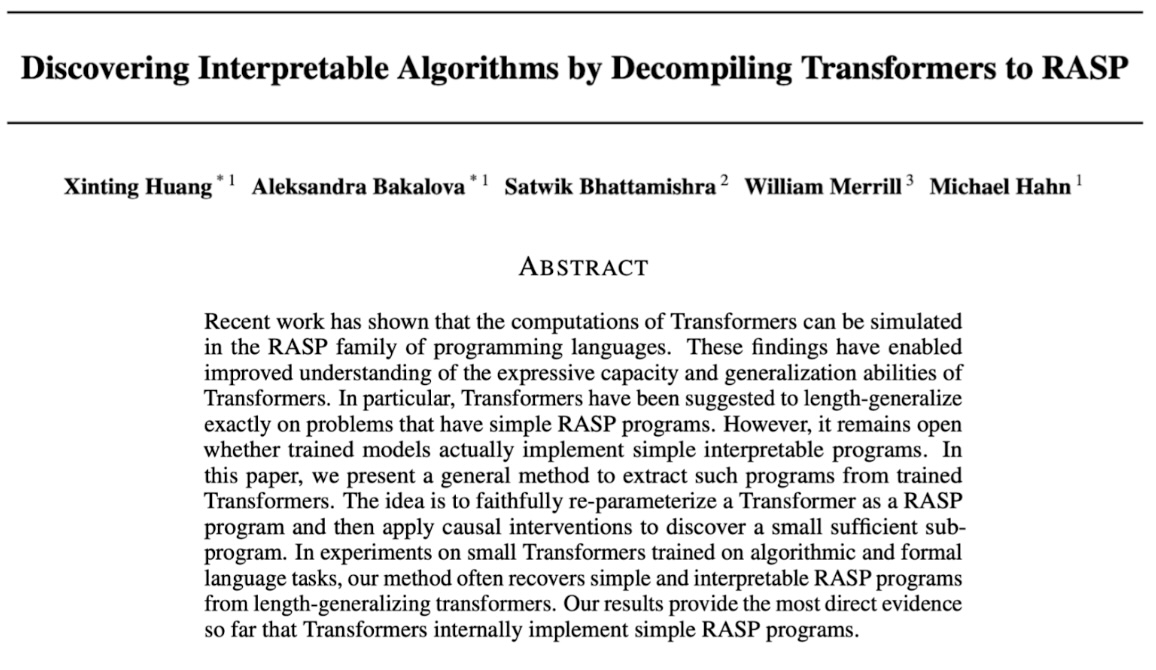
Can we rewrite Transformers as a human-readable code?
In this paper, we decompile Transformers trained on algorithmic and formal language tasks into D-RASP – a programming language that mirrors Transformer architecture. 🧵
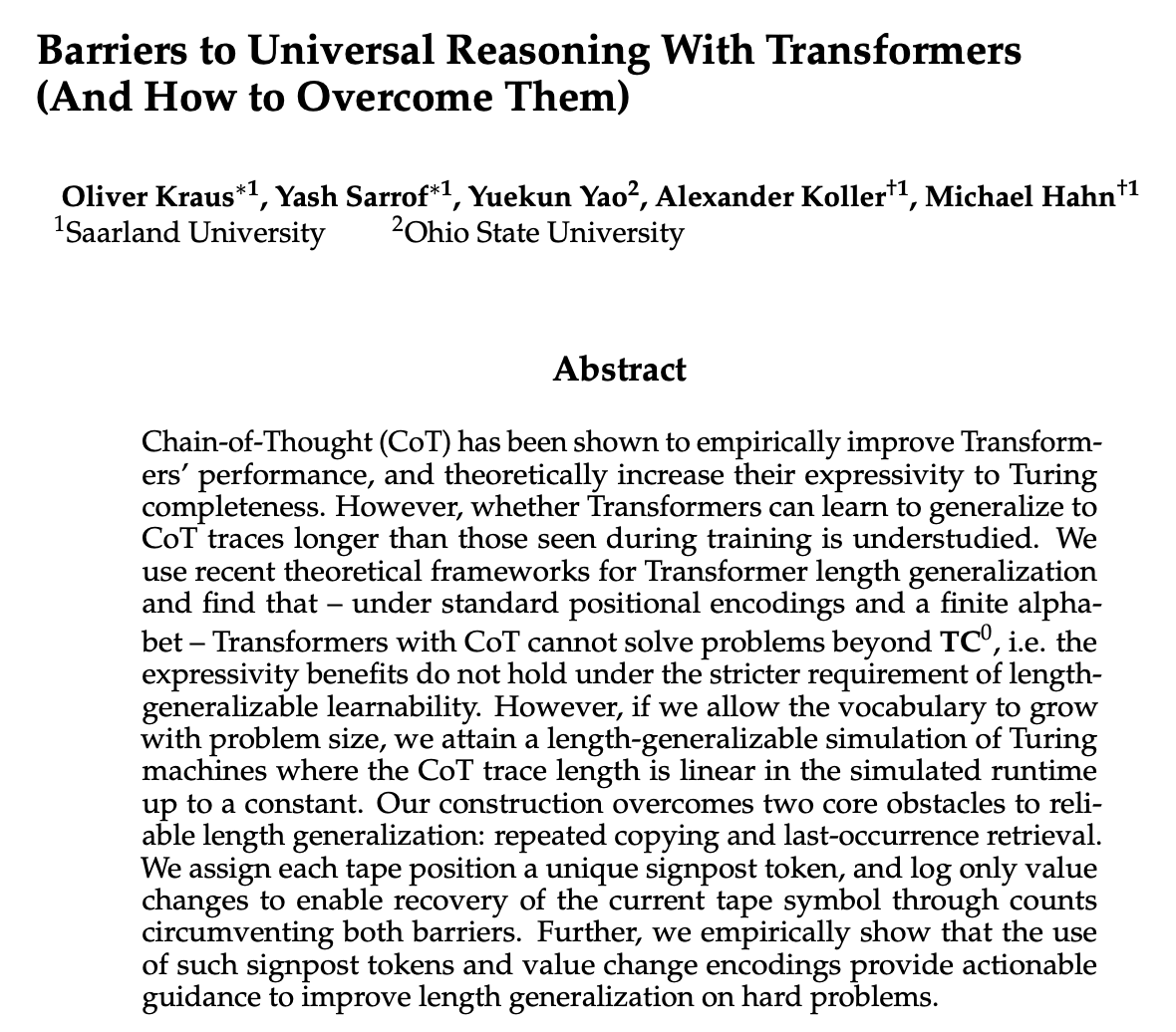
In principle, CoT makes Transformers Turing Complete, but empirically LLMs struggle at longer lengths. In our paper, we study Transformer+CoT length generalization and prove that with a finite vocab, models can't solve problems beyond the restricted class TC0. But there’s a fix🧵
Will be presenting this at the Latent & Implicit Thinking Workshop (https://t.co/8cytLakurb) at #ICLR2026 Come by our poster! Always happy to chat :)
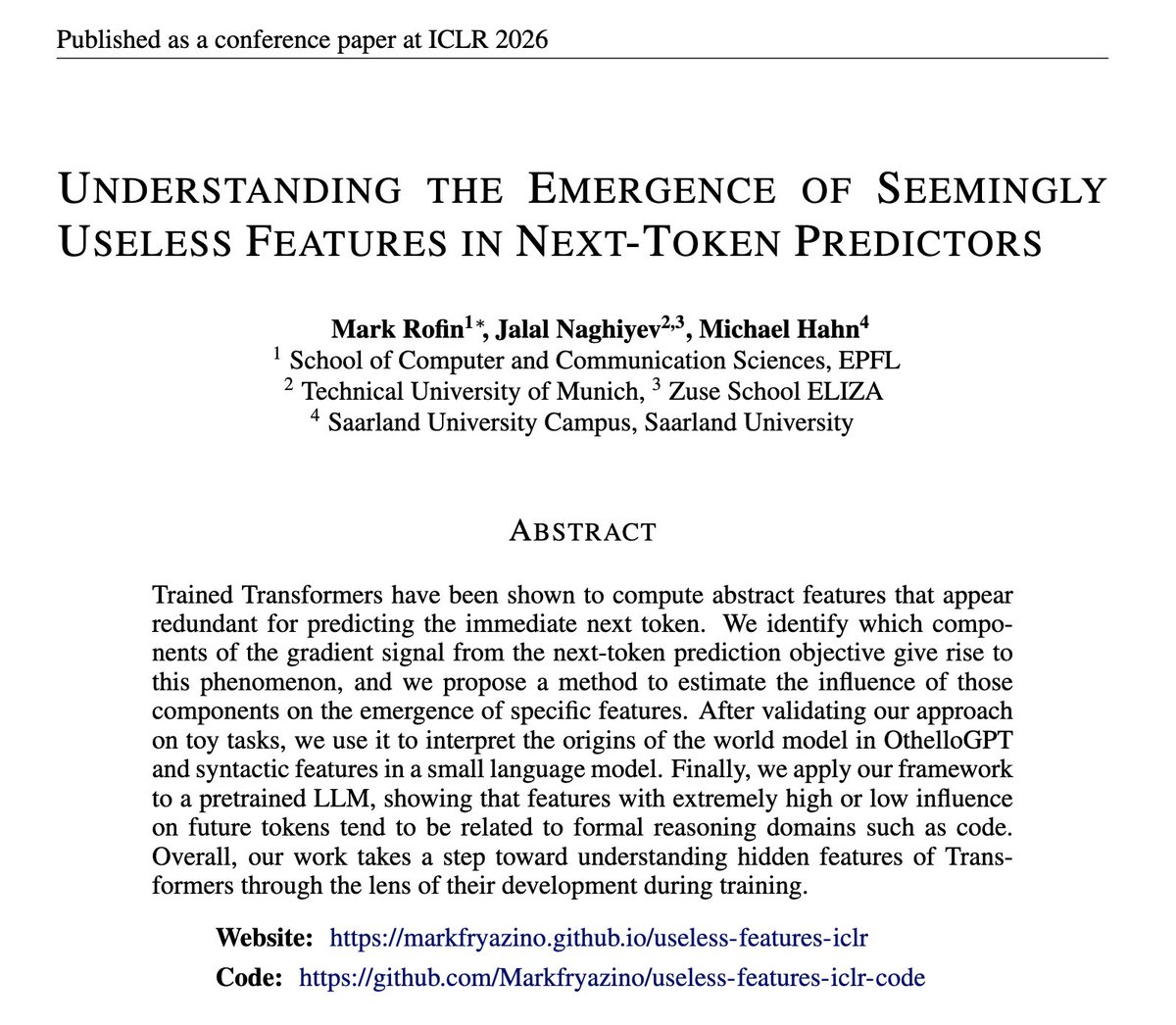
1/ Did you ever look at some feature represented by a Transformer and wonder: "Why would it even learn that? 🤔 "
We did! Announcing the ICLR'26 paper "Understanding the Emergence of Seemingly Useless Features in Next-Token Predictors"
Can we rewrite Transformers as a human-readable code?
In this paper, we decompile Transformers trained on algorithmic and formal language tasks into D-RASP – a programming language that mirrors Transformer architecture. 🧵
@mhahn29 will be presenting our work at Mechanistic Interpretability Workshop at NeurIPS, come and say Hi!
When? Today (Dec. 7) at 11:30am – 12:30pm
Where? Room 30A-E, San Diego
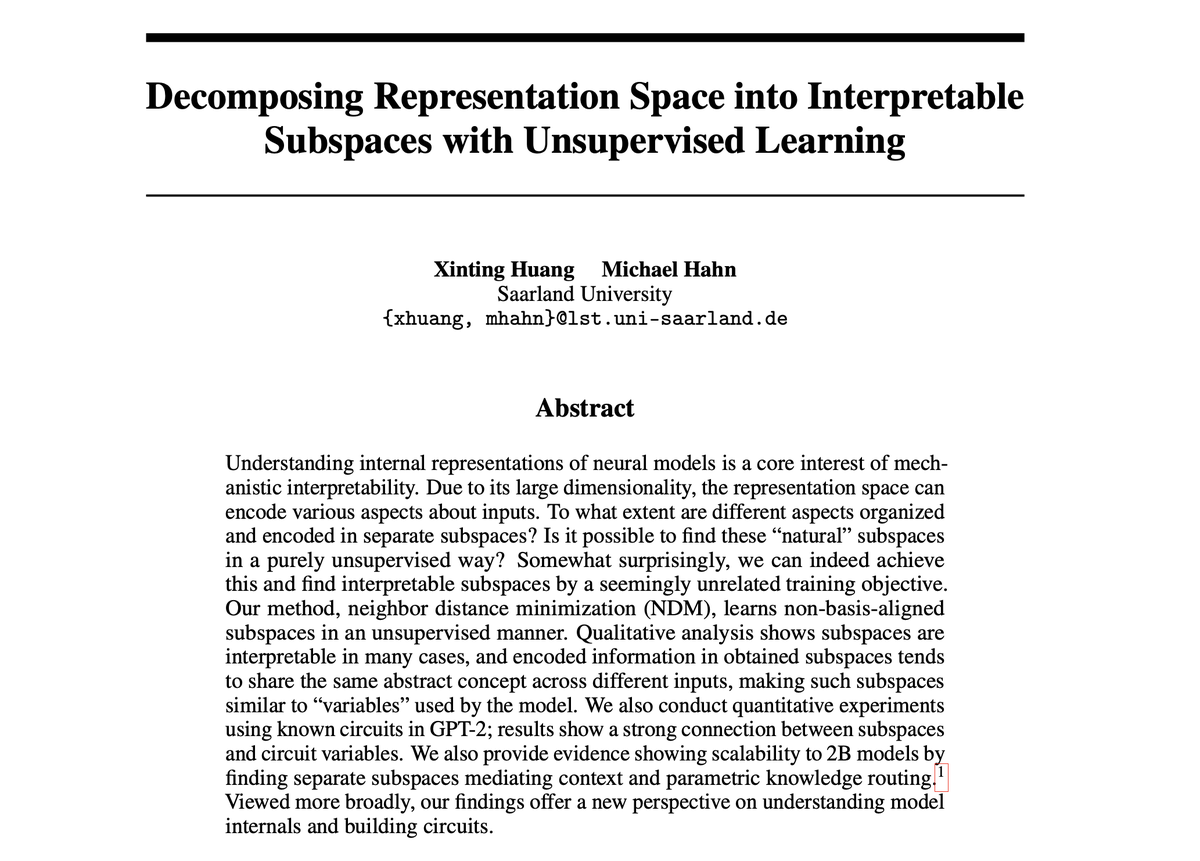
Do LLMs store information in interpretable subspaces -- similar to variables in a program?
In our new paper, we decompose representation space into smaller, interpretable, non-basis-aligned subspaces with unsupervised learning.
We’re hiring PhD students and postdocs on LLM theory and interpretability!
Topics:
1️⃣ abilities & limitations of transformers and other architectures;
2️⃣ LLM interpretability;
3️⃣ foundations of LLM reasoning;
4️⃣ foundations of AI safety.
Do LLMs store information in interpretable subspaces -- similar to variables in a program?
In our new paper, we decompose representation space into smaller, interpretable, non-basis-aligned subspaces with unsupervised learning.
(9/n) Besides our current findings, we are also excited about a potential future direction where these subspaces form the basic units in input-independent circuits. In sum, various decompositions have boosted Mech Interp, and we believe our decomposition will do so as well.
When do transformers length-generalize?
Generalizing to sequences longer than seen during training is a key challenge for transformers. Some tasks see success, others fail — but *why*? We introduce a theoretical framework to understand and predict length generalization.
How do LLMs perform in-context learning?
LLMs can infer tasks from just a few examples in prompts - but how? Our new preprint proposes a two-step mechanism: first contextualize, then aggregate. 🧵