A little update on my locomotion project: added `Slope-Warping` node featured on Paragon Anim techniques by @LDelayen#EpicGames , approach is based on floor normals and plevis/Ik-foot positions. Yet, footslides wont give up :V
#madewithunreal#indiedev#gamedev#UnrealEngine
I managed to do a lot today. I implemented a way to swap polymorphic nodes with a dropdown next to the node label. Changing type retains connections! I implemented most of the nodes of a reasonable math library (linear algebra still missing). Most math ops run component-wise on vector types.
I only had a few minutes today to play around with the stuff I did over the weekend. So, I made a designer vase the denoiser seems to really not appreciate 😅
Éste es el tipo de gente que México necesita y por el que me siento orgulloso de ser mexicano. @MarcoAGreen Mazda te va a reponer ese coche que te ayudó a llegar dónde estás. Escríbeme por DM por favor
Chills!
-Back to basics
-Gives the people what they want (Dom and Marcus)
-Plenty of room for set pieces/moments
See, they didn't need me, y'all.
(didja notice the little Mad World chords in it too?!)
Bravo!!!
https://t.co/CLyWK2stiP
Due to weather conditions, all schools in the District are CLOSED for instruction. This decision was made after careful consideration of all the circumstances. #BurnabySchools
@Rainmaker1973 A random fact about Whittier, is that it holds the title for the “City under one roof” in the Guinness World Records, thanks to its unique living arrangement in Begich Towers.
This is the Wittier’s tunnel
🛂 Casey Schmidt
My deep learning course @unige_en is available on-line. 1000+ slides, ~20h of screen-casts. Full of examples in @PyTorch.
https://t.co/6OVyjPdwrC
And my "Little Book of Deep Learning" is available as a phone-formatted pdf (400k downloads!)
https://t.co/qXni5GZOMT
Even technical people get this wrong:
Sample Standard Deviation (SD) vs Standard Err (SE)
You want an estimate m̂ of m=𝔼(x) from N independent samples xᵢ. Typical choice is the average or "sample" mean
How stable is this? The Standard Error (SE) tells how stable it is
1/6
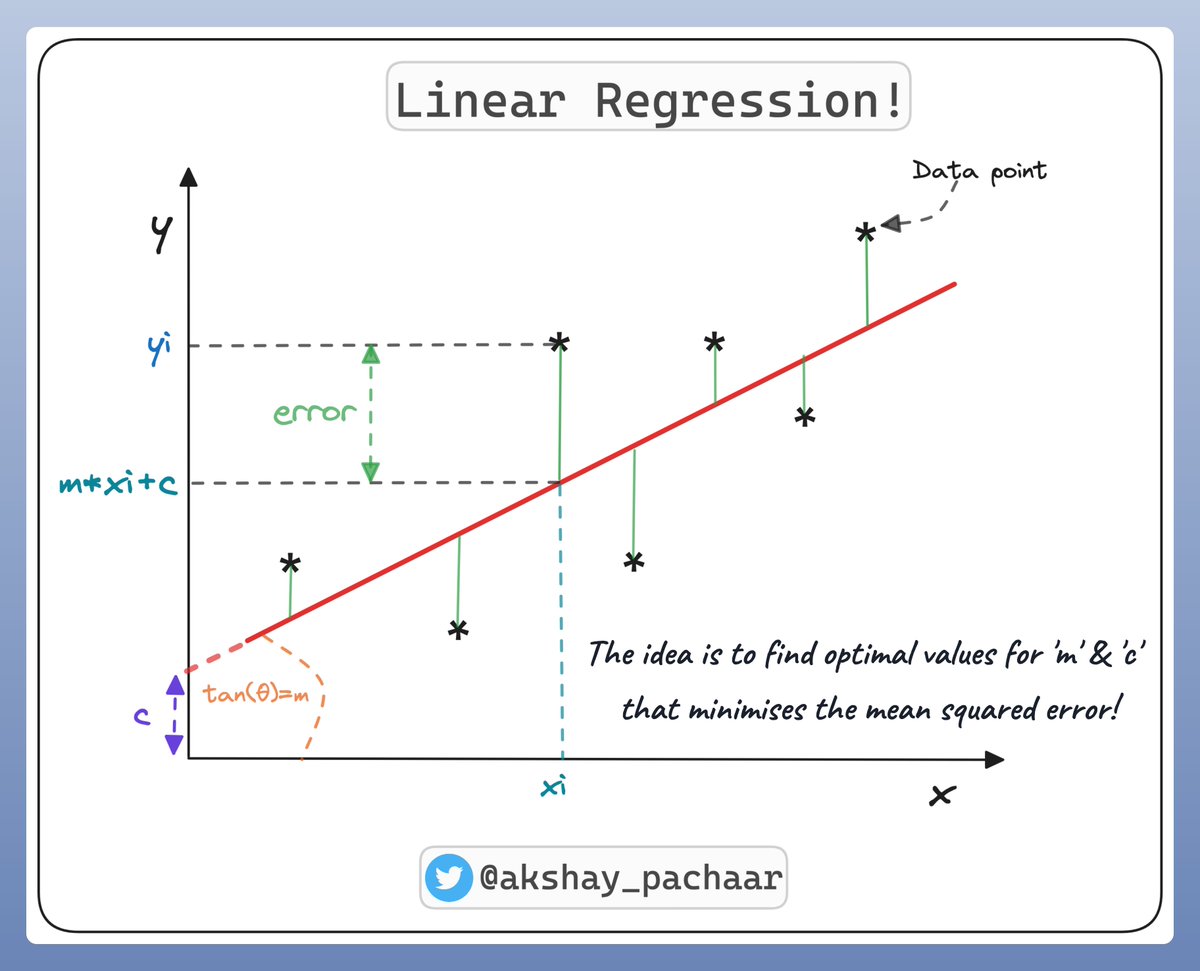
Linear Regression clearly Explained!🚀
Linear Regression models relationship between a dependant variable (y) & two or more independent variables (x1, x2 ...)
❗️For the sake of simplicity we discuss linear regression with a single independent variable.
Mathematical Representation:
y=mx+c
where:
- y is the dependent variable
- x is the independent variable
- m is the slope of the line
- c is the y intercept
Cost Function:
❗️The goal is to find the best values for m and c that minimize the error between the predicted values & the actual values for all data points.
This is how the cost function looks, a mean squared error:
MSE= 1/N∑(yi−(m*xi+c))**2
Where:
- N is the number of data points.
- yi is the actual value for the ith data point.
- mxi+c is the predicted value for the ith data point.
How it works (Optimisation)❓
To minimize the MSE, we can use gradient descent.
The basic idea is to:
- Start with some initial value of m & c
- Compute the gradient of the MSE w.r.t. both m & c.
- Update m & c in the direction of the negative gradient.
Implementation from Scratch:
Now that we understand how things work it's fairly simple to implement linear regression in Python!
Check this out👇
That's a wrap, If you interested in:
- Python 🐍
- Machine Learning 🤖
- Maths for ML 🧮
- MLOps 🛠
- CV/NLP 🗣
- LLMs 🧠
Find me → @akshay_pachaar ✔️
Everyday, I share tutorials on above topics!
Cheers!🥂
Backpropagation and Gradient Descent - The dynamic duo of deep learning
Ever wondered about the mathematics behind NN training? Here is a simplified way to understand the process.
1. Initialize the NN: Create a neural network and initialize it with random weights and biases.
2. Feedforward pass: NN predicts an outcome based on input. For example: does the input image have a cat?
3. Calculate Loss: At first the prediction is a random guess. The error between the prediction and reality is called loss. If the network predicts there is no cat in an image of a cat, loss is high and vice-versa
4. Backpropagation: This is where the magic happens. Fundamentally, you are calculating how much each parameter (weight or bias of each node) in the network contributed to the loss or error from step 2.
You move backwards from the last layer using the chain rule of calculus and compute "gradients". Basically, you are calculating the gradient of the loss function with respect to each weight or bias
5: Gradient Descent: We now adjust the weights and biases based on the gradients calculated in the last step. Typically this is done by multiplying the gradient by a small factor called learning rate. The basic idea is to reduce the error or loss.
6. Iteration: We repeat steps 2 to 6 for all the data points in your training set multiple times (epochs). Hence, your NN is likely to be a better fit, if you have more training data points.
7. Evaluation: You should always keep aside some data points from your original training set for testing. Here we evaluate how the NN predicts data points, it's never been trained on
If your error on the test set is low, fundamentally you have learnt the weights and biases of a model that predict the output given specific inputs and you can now use it to predict on unseen data
YT videos are a great way to learn more
Gradient descent: https://t.co/h30r4t7J1V
Back prop + Pic credit - https://t.co/vlhvZdf1eV