@blindma1den Quiero entrar al mun dev desde hace unos meses, he visto varias rutas he estado indagando , hice dos cursos de lógica de programación, pero he aprendido más de tus tweets que en todo lo que llevo buscando información jajajaja , aparte eres del @ManUtd como yo Glory Glory Manutd
La alianza entre los terroristas latinoamericanos y del Medio Oriente no es casual ni es ignorancia. Ambos son programas que fueron creados por la KGB durante la guerra fría para ganar zonas de influencia y desestabilizar al bloque capitalista.
Durante el verano estuve haciendo un documental en Israel. Entre otros entrevisté a radicales pro Hamas, quienes me recibían con abrazos porque era venezolano y ellos amaban a Chávez.
Ningún pueblo de Latinoamérica tiene mayor contexto para entender el conflicto del Medio Oriente.
Gaza es una población secuestrada por Hamas, así como Venezuela está secuestrada por el chavismo.
Culpar a los residentes de Gaza por las barbaries que cometen sus gobernantes es como culpar a los venezolanos por los crímenes de Maduro.
Culpar a Israel por las desgracias que se viven en Gaza es como culpar a EEUU de las desgracias que se viven en Venezuela.
Lamentablemente al final las víctimas más numerosas siempre son los inocentes, sometidos por dictadores.
Por eso nunca se puede ser cómplice de depravados.
Por eso hay que tomar muy en serio la influencia de Irán en el continente. Irán acabó con Venezuela y con Argentina y va por Colombia.
¿Viven contigo pensamientos rumiantes / intrusivos que no te aportan bienestar, se intensifican con el estrés, amplifican un problema, se centran en lo negativo y te generan ansiedad?
ABRO HILO🧵 y hablamos de ello.
#NeuroCosasNidea 👇
El Lado oscuro de la Empatía.
Extraigo de este artículo las 4 criticas principales que se hacen a la empatía:
1- El primer tipo de crítica es que la empatía no se aplica con suficiente amplitud. A menudo no empatizamos con las víctimas de la injusticia que están lejos y son muy diferentes de nosotros o cuando se las percibe como una amenaza. Además, incluso cuando empatizamos, no podemos hacerlo durante mucho tiempo porque nos resulta difícil soportar el sufrimiento vicario sostenido. En las profesiones asistenciales, los niveles más altos de empatía pueden conducir a una mejor atención a los pacientes, pero a un mayor agotamiento de los cuidadores, lo que a su vez se traduce en una peor atención a los pacientes a largo plazo y en una mayor rotación laboral. La empatía es una capacidad que se agota fácilmente
2- El segundo grupo de críticas a la empatía se centra en su fragilidad. Prinz sostiene que la empatía es fácilmente manipulable, en la medida en que podemos aumentar o disminuir fácilmente la relevancia de una situación o la similitud de un objetivo con un sujeto. Podemos ver esta manipulación de nuestras respuestas empáticas en muchas experiencias ordinarias. Por ejemplo, la recaudación de fondos para causas humanitarias emplea esta táctica de manipulación de la atención poniendo música emotiva, centrándose en los rostros de las personas necesitadas y contando sus historias en términos cargados de afecto.
3- El tercer tipo de crítica a la empatía es que exacerba el conflicto intergrupal en lugar de aliviarlo. La empatía es parcial en la medida en que tendemos a empatizar sólo con quienes nos caen bien y con quienes consideramos que se parecen a nosotros en algún aspecto relevante. A menudo no empatizamos con individuos que consideramos socialmente muy diferentes a nosotros, o con aquellos que parecen tener valores diferentes a los nuestros, incluso cuando esas personas sufren y están necesitadas. De hecho, a veces nos complacemos en su sufrimiento en lugar de empatizar con ellos. A menudo, racionalizamos el sufrimiento de estos miembros de grupos externos pensando que de alguna manera lo han causado o incluso que se lo merecen. Breithaupt sostiene que la empatía nos lleva a dicotomizar el mundo social con una mentalidad de nosotros contra ellos. Nos anima a tomar partido, y normalmente ese partido se alinea con nuestro grupo afín.3 Esta parcialidad nos lleva a tratar bien a algunos individuos (aquellos con los que empatizamos) y a descuidar a los demás. Esto puede conducir al nepotismo, la discriminación y los prejuicios. De hecho, esta parcialidad no hará sino exacerbar las desigualdades subyacentes, en la medida en que quienes disponen de más recursos tienen menos probabilidades de empatizar y ayudar a quienes se encuentran en peor situación en la sociedad porque los grupos son socialmente muy diferentes entre sí.
4- En cuarto y último lugar, la empatía se centra en los individuos. Nos resulta difícil empatizar con clases enteras de personas, por ejemplo, personas pobres, niños hambrientos, grupos que se enfrentan al genocidio o generaciones futuras que sufrirán los efectos del cambio climático. Cuando empatizamos, adoptamos la perspectiva de una persona individual (cuya situación nos llama la atención y que es socialmente similar a nosotros) y llegamos a sentir lo que esa persona siente.
https://t.co/26iIRejl0Z
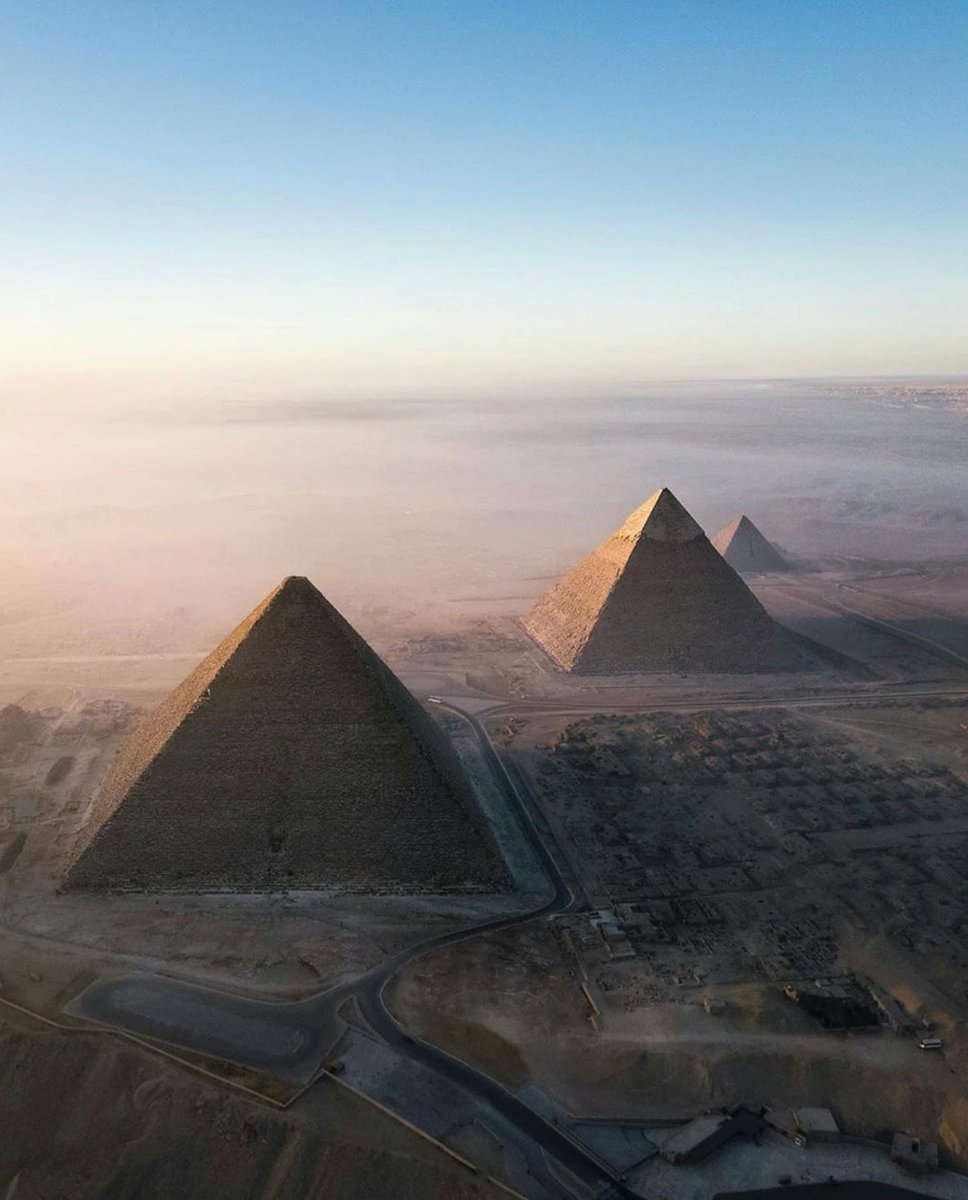
We're so used to seeing and hearing about the pyramids that it's easy to forget how strange and extraordinary they really are.
So, just to remind you:
When woolly mammoths went extinct the Pyramids of Giza were already more than 500 years old.
Cleopatra and Julius Caesar are closer in time to the present day — to the Burj Khalifa — than to the construction of the Pyramids of Giza.
Where are they and who built them?
There are three pyramids on the Giza Plateau, which is on the west bank of the River Nile, in northern Egypt. They aren't far from Memphis, which was the capital of Ancient Egypt when they were constructed.
The largest and oldest was built in less than thirty years around 2570 BC for the Pharaoh Khufu. The second was built for Khufu's son, Khafre, and is only a few metres shorter. The third and smallest was then built for Menkaure, Khafre's son. Three monumental tombs for three generations of the same family.
Nearby are many more tombs for various members of the royal court, the Sphinx, several more temples, and the remains of a sort of workers' town including houses, workshops, bakeries, kitchens, breweries, a hospital, and a necropolis.
Khufu's Pyramid, known as the Great Pyramid, was the tallest building in the world for over 3,800 years — that is, until the spire of Lincoln Cathedral in England was constructed in 1311.
And at more than 6 million tonnes it was the heaviest manmade structure ever built, and is still third behind only the Great Wall of China and the Three Gorges Dam.
The mortar used in constructing the Great Pyramid alone weighs over half a million tons, which is more than the total weight of the Burj Khalifa.
See, the Great Pyramid is almost entirely solid — there are only a few narrow shafts and three small chambers inside. It was largely built from huge blocks of local Giza limestone, although its exterior was once covered in polished white limestone transported there from nearby Tura, and its interior includes blocks of granite weighing up to 80 tonnes transported from Aswan, over 500 miles away.
The *precision* of the pyramids is also remarkable. On a technical level their masonry is astonishingly accurate, but even more amazing is that the four sides of the Great Pyramid are all almost exactly the same length — they have a variation of no more than 60 millimetres.
Not to forget that all three pyramids are aligned according to the points of the compass — within one tenth of a degree of perfect geographical accuracy.
And if these facts weren't impressive enough, the actual construction of the pyramids — the specifics of how the blocks were quarried, transported, and lifted into place — remains a marvel we have yet to fully understand.
But those are merely the facts of the Pyramids of Giza; perhaps more interesting is what they really mean.
After all, you can learn a lot about any society from its architecture. What we say about ourselves can rarely be trusted — but what we do and what we leave behind is always truthful. In other words, that which we build expresses our priorities, how our society works, and who has the most power.
Think of it this way: what are the biggest buildings in the modern world?
By volume it is factories (the Boeing Everett Factory is number one right now) and distribution centres.
By total floor space it is airports and malls.
By height it is mixed-used skyscrapers, though they are usually dominated by offices, especially relating to finance. The Pentagon was the world's largest office building until this year; it has been overtaken by the Surat Diamond Bourse in India.
By capacity? Well, there are sports stadiums, the biggest of which is the Narendra Modi Stadium in India, with an official capacity of 132,000. That being said, no single complex can hold a greater number of people than the Masjid al-Haram in Mecca, which has a capacity of 4 million.
So the largest buildings in the 21st century are almost all related to industry, finance, retail, transport, and leisure — with religious worship something of an outlier. This is a technologically advanced, industrial, highly consumerist society in which businesses hold a great deal of power, and in which the wants and demands of the public are very important.
For comparison, during the Middle Ages nothing came remotely close to cathedrals in size or complexity, though castles and fortresses were also far bigger than everything else. We can draw the basic conclusion that religion was of immense and central importance, that the church as an institution was very wealthy, and that power was actually spread out among the hereditary nobility rather than being entirely concentrated in the monarch alone, not to mention the political and spiritual power also held by the church.
So, what about the Pyramids?
The Ancient Greek historian Herodotus remarked that the Pyramids of Giza were proof of how tyrannical a ruler Khufu — or Cheops, as the Greeks called him — must have been. In his native Greece the largest buildings were temples for public worship; the Great Pyramid was a monument to but one man alone, and this shocked Herodotus.
The biggest buildings of the 21st century are all useful. They have a clear and immediate purpose, and usually one which benefits — in some sense — lots of people. A factory produces things we all use, a distribution centre organises our online shopping, an office is a place of work, and a stadium is where we go for entertainment. Our largest buildings are intimately and inseparably related to employment and consumption.
What about the Pyramids? They were tombs for the Pharaohs and they were supposed to last forever. In other words, they had no immediate use or purpose, at least for the living. They served only one person: the Pharaoh — plus his family and closest supporters, though they were buried nearby rather than inside — in his journey through the Afterlife.
So this is not the same as a large and lavish royal or presidential palace; such buildings are designed to be used as a seat of power and administration — by several succeeding generations or leaders.
Meanwhile, all the resources and labour that went into building the Pyramids, which were literally manmade mountains, were for the benefit of one Pharaoh alone, after his life had ended — and, to a lesser extent, those lucky enough to have been buried nearby at the time.
Does that mean Khufu and his descendants were tyrants? In some sense, yes. But there is evidence that those who built the Pyramids were not, as Herodotus thought, slaves, and were instead closer to conscripted workers and freely employed craftsmen who were fairly remunerated for their labour.
See, it wasn't just that Khufu held total political power; he was also the spiritual leader of his subjects, such that their work was fundamentally religious in nature — it might have even helped them achieve a better afterlife.
There was nobody who could refuse Khufu's desire to build the largest tomb in human history, because he was a divinely appointed intermediary between gods and humans; no regulation to stop him, because his will was the law; no limits to his expenditure, because he collected the taxes and owned all the land in the kingdom.
However powerful the world's richest and most influential people might now seem, none of it compares to the power wielded by Pharaohs like Khufu; a power that was political, financial, legal, military, and spiritual — absolute.
And so the Pyramids are a glimpse into a society fundamentally and almost irreconcilably different from that in which we now live, to the earliest epochs of human civilisation, long before democracy and the rule of law, when one man could rule as a god and have mountains built to serve as his personal, eternal monument on earth.
This thread is for people who are curious about some film basics.
This is a low, Dutch angle two-shot.
That probably doesn’t mean much.
But, here’s why this image feels like it does.
Hace unas horas, tres militares han testificado bajo juramento ante el Congreso de los Estados Unidos. Si lo que han contado es cierto, el mundo tal y como lo conocemos está a punto de cambiar.
No estoy bien. No sé si esto sirve de algo pero quiero decirlo. Estoy triste y cansado. Por si alguien más cree que hay que ser siempre una brisa de mar o un fuego artificial en una noche de verano. Estoy trabajando para que se me pase… llegaré a los escenarios y algo dentro me dirá que hacer. Pero a veces no quiero ni estar. Literalmente. Sólo por ser sincero. Por no entrar al ruido inútil. Sé que hay gente que se siente así. Si te sirve, yo me siento igual.