Orthopedic Truths: #6
Bone spurs in the shoulder
Disclaimer: I am firmly in the Save the Acromion club :-)
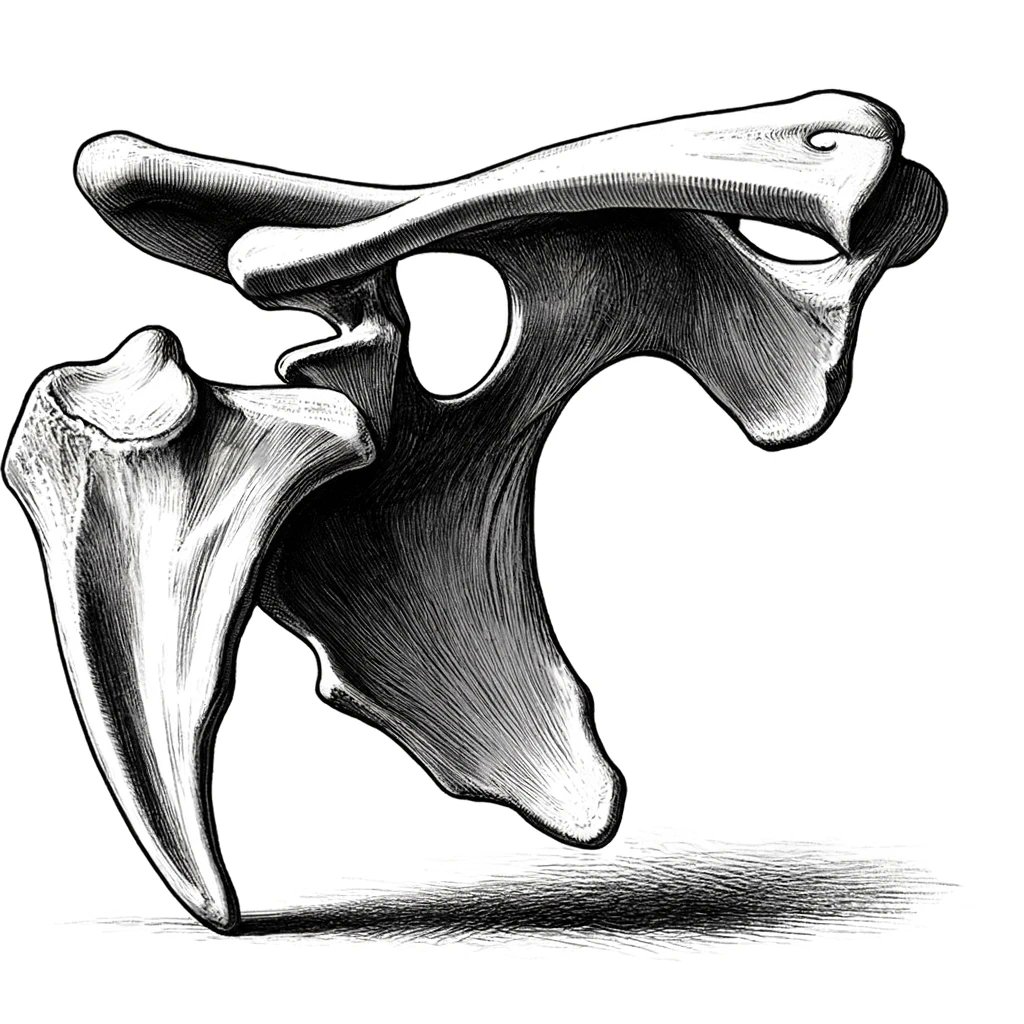
Many decades ago (1972), a famous shoulder surgeon proposed that an anterior spur on the acromion caused rotator cuff disease.
Somehow, that morphed into the cause of much shoulder pain for a short while.
Back in the day, we took the anterior portion of the acromion from many people, young and old alike.
Interestingly... the 1972 paper that spurred all the interest wasn't peer-reviewed.
But that didn't matter.
Hundreds of thousands of acromion have been harmed due to this paper 🤣
In this culture, the acromion has been metaphorically aggrieved.
The acromial shape changes over time.
However, most papers show that it doesn't have a role in the etiology of cuff tears.
Back in the days of open surgery, if you ran your finger in the subacromial space (SubAc) you found it to be smooth.
You didn't feel a spur.
That's because the spur lies within the CA ligament.
Hence, it dives medially as it heads distally.
Thus, away from the tuberosity and cuff enthesis.
We have traction spurs within ligaments all over our bodies.
We blame tendinosis, tendinopathy, overload, overuse, etc. for pain in many tendons throughout our body...
Yet we have blamed the acromion for all that ails the subacromial space for decades.
Just bizarre.
It never made sense.
The space between the tuberosity and the acromion increases beyond 60-80 degrees of elevation.
Yep, increases.
So pushing an arm up 160 degrees and claiming the pain is due to a spur doesn't sit well.
In full forward elevation, the acromial-humeral distance is at its widest.
Attempts by Christian Gerber and others have shown that when you build up the acromial undersurface to reproduce cuff tears, it always led to bursal-sided fraying and tears... as one would expect.
But that's not what happens in real life...
Where do most "tears" initiate?
Are they even "tears" if there's no trauma?
Anyway, I digress.
We know that most tears begin on the articular surface of the anterior SST.
So... if you're rubbing the upper surface, how would you tear the deep surface?
You don't
These cuff lesions occur for many reasons...
That's for another session.
There was a recent paper that showed that the recurrence rate of cuff tears was a little lower in the acromioplasty group.
But we can't assume it's due to a mechanical effect.
Many other papers...
Many, many, many other papers have shown that acromioplasty has a limited role in the etiology, progression, or recurrence rate of cuff tears.
Why is an acromioplasty still done?
idk
Do I do them?
Honestly, no.
If you do it for visualization, you should work on the scope position and portal placement.
You can't look at the subacromial space in an anesthetized patient and claim it's narrow!
Aside from cuff tear arthropathy patients... 😳
The distance of the SubAc space is dynamic.
It's not static.
Thus, if the cuff is paralyzed... well, you know.
Cuff weakness leads to narrowing dynamically.
If we want to improve the space, we should improve that.
If we whack the acromion---within a year...
If the cuff is still weak...
The head could simply elevate further into the defect.
We have all had patients with subacromial-based pain proven by injections, etc.
Yet they don't have tears.
Many improve with time, injections, and physio
But some don't.
It took a long time to adjust to not touching the acromion...
But these folks improve by just dealing with the bursa...
Or perhaps one day, we'll find out it was a placebo effect.
Over the last decade, a few sacred ortho procedures have not held up well against sham surgery studies.
But either way, these folks feel better despite keeping their acromion intact.
Besides, taking out the CA ligament could have serious implications.
If you've ever seen someone with anterior superior escape...
You will never forget the role of the CA lig.
I can't believe it's been 52 years, and we still argue about this :-)
Honestly... in writing these posts, it's unfortunate how little we have progressed in much of our understanding and practice.
Yes... we have progressed... Don't @ me.
Maybe my expectations were too high...
Safe to say... SubAc pain is more commonly an intrinsic problem than any extrinsic compression.
But wait!!
The lateral acromion overhang does have a role.
But we're not taking it out because of that role.
The acromial index seems to be important... we can counsel patients about the risk of recurrence and similarly quiet our exuberance about fixing certain tears.
But... we still should preserve this structure.
Given the increasing prevalence of rTSAs and the incidence of acromial fractures, we should preserve that bone stock as much as possible.
It's been 52 years, and we're still discussing whether the acromion has a role ;-).
I just love that.
Any of #pttwitter want to attend a con-ed in San Diego? Feb 24-25. @GregLehman is teaching his Reconciling Biomechanics with Pain Science course! I’m going, you should go too! #pittPT#CAphysicaltherapists
@MikeMakher Boston College.... they don’t know where they are (Chesnut Hill, MA really) and they don’t know what they are (It’s really a university)... #goBU#whatdoyousayTerriers
One of the biggest myths of marathon running is that muscle cramping mid race is due to dehydration and/or electrolyte loss. The reality is that it is far more likely to result from fatigue and muscle damage. https://t.co/9BvEG69GjP