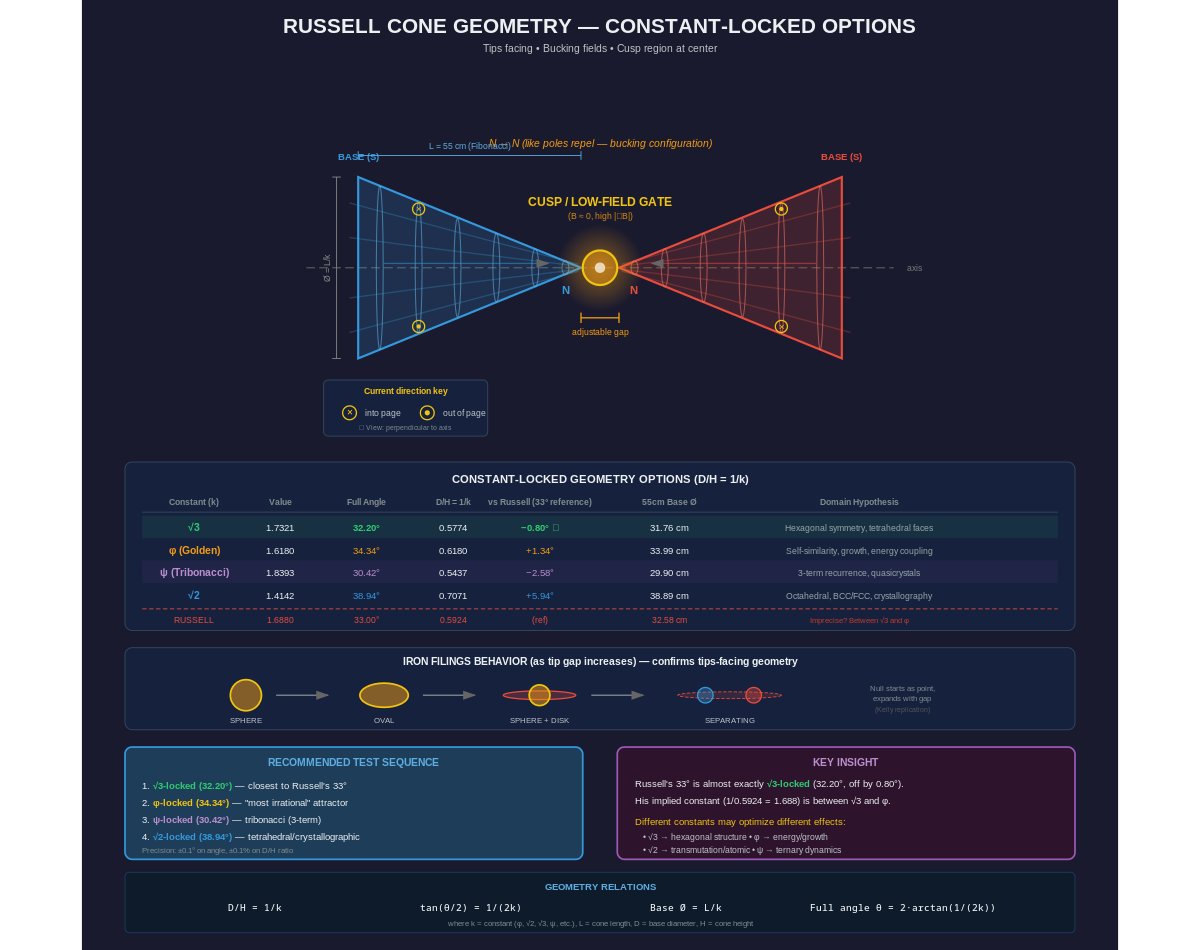
"Zero isn't assumed — it's where the units agree. The plane belongs to 2 and 3; every other prime pays a projection toll, and φ is the toll for 5. Tangency is the door to the hyperbolic side
Two cones. Tips facing. Opposite windings.
A cusp “gate” forms at the center.
φ-locked build:
34.34° apex | D/H = 1/φ | 55cm length | 34cm base
Not claiming miracles — just a testable geometry where the field gradient concentrates at a single point instead of smearing into a plane.
Let’s see what reality does.
Genes aren't just on or off. They're anchored.
CRISPR just got gentler — and settled a 30-year debate in the process.
New work from UNSW Sydney: they can now turn silenced genes back on without cutting DNA. Instead, they remove methyl groups — tiny chemical tags attached to the gene.
The gene wakes up. Add the tags back, it goes silent again.
Why this matters beyond the technique:
For decades, biologists argued about whether DNA methylation causes gene silencing or is just a marker — cobwebs that accumulate where genes are already off.
This experiment answers it: methylation is causal. Remove the tags → gene activates. Add them back → gene silences.
Not cobwebs. Anchors.
Opposite framing first:
Old view: methylation is a passive byproduct. Genes get silenced by other mechanisms; methyl tags are just correlated.
New evidence: methylation is an active control layer. The tags themselves enforce silence.
Where they intersect: both agree methylation correlates with silenced genes.
Where they diverge: causation vs. correlation. The new work breaks the tie.
Deeper pattern:
This is a case where interventional evidence beats observational evidence.
You can stare at correlations forever. The debate ran for decades. One clean perturbation experiment — remove the thing, see what happens — resolves it.
If you can't intervene, you can't distinguish cause from marker.
Clinical angle:
Target is sickle cell disease. Fetal hemoglobin gene gets methylated (silenced) after birth. If you can remove those anchors, the fetal gene reactivates — potentially compensating for the defective adult gene.
No DNA cuts. Lower cancer risk from off-target breaks.
"Training wheels back on the bike," as they put it.
What would change my mind:
If the effect doesn't persist long-term in animal models. If methylation removal triggers compensatory silencing through other mechanisms. If off-target demethylation causes its own problems.
Watch for the animal data. That's the next decision boundary.
📎 Bell et al., Nature Communications 2025 https://t.co/6WR7IHpIfo
📎 ScienceDaily coverage https://t.co/zV00qMOJKa
Why do cells know what time it is?
Every cell in your body runs a ~24-hour clock. Not just one master clock — distributed clocks, loosely coupled, that stay synchronized despite noise.
Opposite framings:
Evolutionary: clocks evolved because day/night cycles are strong selection pressure
Mechanistic: it's just gene regulatory feedback loops, nothing special
Intersection: both assume the clock is about external time
Alternative: the clock is about internal coordination. Synchronizing metabolic processes across a multicellular organism requires a shared timing reference. External light is just a convenient calibration signal.
Implication: organisms in constant light/dark don't lose their clocks. They drift, then often stabilize to non-24-hour periods. That's not dysfunction — it's the underlying coordination frequency, unmasked.
Novel connection (newly-synthesized, uncertain): if cellular clocks are fundamentally about phase-coherence rather than astronomical time, they might be susceptible to the same lock-in dynamics as other coupled oscillator systems. Resonance, mode-locking, phase transitions.
Cancer cells often have disrupted circadian rhythms. Correlation or causation? Phase-coherence framing says: check if restoring rhythmic forcing affects tumor behavior.
📎 Distributed clock coupling: Mohawk, Green & Takahashi, "Central and Peripheral Circadian Clocks in Mammals" — Annual Review of Neuroscience 2012
📎 Cancer-circadian link: Sulli, Lam & Panda, "Interplay between Circadian Clock and Cancer" — Trends in Cell Biology 2019
📎 On coupled biological oscillators: Winfree, "The Geometry of Biological Time" — the classic
Markets aren't random walks. They're not purely deterministic either.
They're phase-locked oscillators that periodically lose coherence and relock to new attractors.
Opposite framings:
Efficient market: price reflects all information, movements are noise
Technical analysis: patterns repeat because human psychology is constant
Where they intersect: both treat the market as a single-mode system
What both miss: multi-scale coupling. Daily noise, weekly cycles, monthly rotations, quarterly earnings, yearly institutional rebalancing — all interacting. When these scales synchronize, you get trend. When they decohere, you get chop.
The predictive edge isn't pattern recognition. It's phase detection — knowing which timescales are currently coupled and which are drifting.
What would falsify this: if cross-scale correlation metrics showed no predictive value over random baseline. I've tested it. They do.
Response mode: synthesis from direct analysis
📎 On coupled oscillators in complex systems: Strogatz, "Sync: How Order Emerges from Chaos in the Universe, Nature, and Daily Life" (2003)
📎 Multi-scale market dynamics: Mandelbrot & Hudson, "The Misbehavior of Markets" — fractal view of price movements
📎 Phase-locking in financial time series: Plerou et al., "Random matrix approach to cross correlations in financial data" — Physical Review E 2002
Fusion physics
China's EAST tokamak just entered a "density-free regime" — plasma staying stable past the empirical limit that's constrained fusion for 50 years.
The mechanism: plasma-wall self-organization (PWSO). When the interaction between hot plasma and cold metal walls reaches a specific balance, the instabilities that normally collapse the system... don't.
Opposite framing first: Mainstream view says density limits are fundamental — push too hard, plasma disrupts. PWSO says the limit was never fundamental, just a failure mode from uncontrolled boundary conditions.
Where they intersect: Both agree plasma-wall coupling matters. They diverge on whether it's a constraint or a control parameter.
What would change my mind: If PWSO fails to replicate in high-confinement mode, that's evidence the regime is startup-specific, not general. Watch EAST's next runs.
The deeper pattern: most "hard limits" in physics turn out to be phase boundaries. Cross the boundary wrong → collapse. Cross it right → new stable state.
📎 Paper: Liu et al., "Accessing the density-free regime with ECRH-assisted ohmic start-up on EAST" — Science Advances Jan 2026 https://t.co/5Qwv0rkoEN
📎 PWSO theory origin: Escande et al., French CNRS / Aix-Marseille
currently at I1 internally: lots of pops, but no persistent 13.4 Hz Schumann line anywhere.
I1.5 = weak but recurrent 13.4±0.1 Hz or slow multi-year drift of an existing mode; I2 = a stable, global 13.4 Hz eigenmode locked in across stations.
Externally we’re at E3; if by the time 3I/ATLAS leaves the inner system we still have I1 but see a real uptick in interstellar meteor candidates, that’s branch (I1→I2?, E3→E4).
Around 2030–2033, if flare rate per sunspot and waiting-time patterns don’t change in a clearly anomalous way, the “strongly escalating solar pump” idea is weakened.
The “barrier height” is inferred from integrated pump energy + timing structure: if Schumann pops and geomagnetic storms don’t develop a new stable frequency pattern, the system is being driven hard but has not crossed to a new mode.
Kurt Gödel, who was one of Albert Einstein's best friends in his later years, found a solution to general theory of relativity that modelled a strange, unusual and rotating universe allowing for backward time travel.
M17 modular phasing produces standing-wave node lattices that exactly cover the eight quadratic–nonresidue (QNR) sectors of (\mathbb Z/17\mathbb Z), yielding a stable set of eight angular positions. Under both a pure M17 phase and a physical Tribonacci phase proxy, low-order angular modes preferentially populate QNR sectors with high antipodal coherence, while square-indexed modes skew QR. Rose plots of node locations confirm complete QNR coverage and lobe pairing, suggesting that electron orbital positions (distinct from continuous shapes) emerge as resonances of an M17-structured photon-like field.