Raoul's piece captures something that I think many people still underestimate.
We're entering a world where billions of AI agents, robots, vehicles and autonomous machines won't just consume information, they'll continuously make decisions and transact with each other.
The question is no longer if the machine economy arrives.
It's what infrastructure it runs on.
Every autonomous machine needs to answer fundamental questions before it can act:
• Can I trust this data?
• Can I verify the software I'm running?
• Is the other machine genuine?
• Can I prove what happened?
Without native trust, autonomous systems simply don't scale.
So blockchain's biggest opportunity isn't replacing banks.
It's becoming the trust infrastructure for the autonomous machine economy.
At @Minima_Global, we've spent years building for exactly this future - a Layer 1 capable of running a full node on the device itself, giving every machine the ability to independently verify the world around it.
If the next decade belongs to autonomous machines, they'll need more than AI.
They'll need trust.
AI needs trusted data. Machines need trusted payments.
I enjoyed joining @xximpod to discuss why we believe blockchain-on-chip will become the trust layer for the autonomous economy.
We covered embedded trust, industrial AI, machine-to-machine payments, and our work with Arm, Siemens & the University of Southampton.
https://t.co/i8rC0LlwbJ via @YouTube
A World First: a drone with a blockchain black box.
Working with the @unisouthampton, and supported by @Arm and @Siemens, we demonstrated autonomous flight data recorded directly to a tamper-resistant ledger.
A major milestone for Blockchain-on-Chip, now at Technology Readiness Level 6.
From drones to satellites, machines will be able to prove what they did independently.
🏝️🚢✈️🛰️
🎥 Documentary:
Exciting to see us featured in The Engineer.
A drone that records its flight and sensor data directly onto the blockchain - creating a tamper-proof audit trail of everything it does.
Built by a brilliant team at the University of Southampton using Minima, with support from Arm and Siemens, it’s a powerful example of how blockchain can enable trusted autonomous systems.
As AI and machines become more autonomous, the ability to verify their actions will be critical.
The era of self-verifying machines is getting closer. 🚀https://t.co/BPsS1Rsv9t
@byzkhan Minima solves decentralization at the edge: letting users and autonomous machines run full nodes locally, without depending on centralized cloud or trusted intermediaries.
From roadmaps to results. At Minima, execution and transparency matter more than hype. We’re building durable infrastructure that delivers, not promises.
KISS 💋
Minima fulfils and exceeds the requirements that to many only now in retrospect seem obvious..
"It might make sense just to get some in case it catches on.."
Ethereum is making real progress toward a new class of decentralized network, and that matters.
But it’s important to distinguish between networks evolving toward a solution and networks designed around it from day one.
Ethereum’s path combines DAS, ZK-EVMs, PBS & future gas limit increases to approach decentralised consensus with higher bandwidth.
Minima already operates there today.
Every Minima node:
🔹 Runs as a full node on commodity hardware
🔹 Participates directly in consensus and validation
🔹Scales horizontally without replication-heavy global state
No rollups.
No validator specialisation.
No deferred decentralisation.
Ethereum is engineering its way out of centralisation risk. Minima removed the cause.
This isn’t about roadmap vs theory, it’s about architecture.
One approach adds layers to preserve decentralisation at scale.
The other removes assumptions so decentralisation scales naturally.
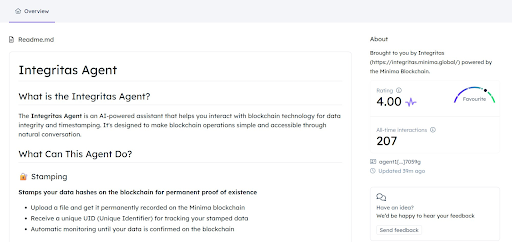
Today, we’re launching the Integritas AI Agent for ChatGPT, bringing verifiable data integrity into AI-assisted workflows.
For the first time, users can create cryptographic proofs of authenticity for documents, files, logs, and AI-generated outputs - and anchor those proofs to the Minima blockchain - without leaving ChatGPT.
Full Announcement: https://t.co/b0LbuiMeLy
Overview 👇
Cross-border payments are overdue for a reset.
ThunderPay is powered by Thunder, Minima's native Eltoo-based payment protocol, enables direct, private settlement - no correspondent banks, no data leakage, no friction.
#Minima#CrossBorderPayments#DigitalCash#PrivacyByDesign
Decentralized applications are often described as censorship-resistant and trustless yet in practice many still rely on centralized servers, cloud APIs or managed infrastructure that quietly reintroduce points of control and fragility.
@Minima_Global challenges this model by introducing MiniDapps, a design philosophy where applications are not hosted somewhere else but instead live directly on the user’s device, running alongside a full blockchain node at the very edge of the network.
A thread 🧵👇
MiniMask Beta: Browser-Based Minima Transactions Are Now Live for Testers!
👉 https://t.co/SMwhBLIcrr
We’re excited to open up the MiniMask Beta, a major step toward making Minima accessible directly from your Chrome browser.
MiniMask is our new Chrome extension that provides a lightweight wallet and core Minima transaction capabilities inside a clean, browser-native experience. 🧵
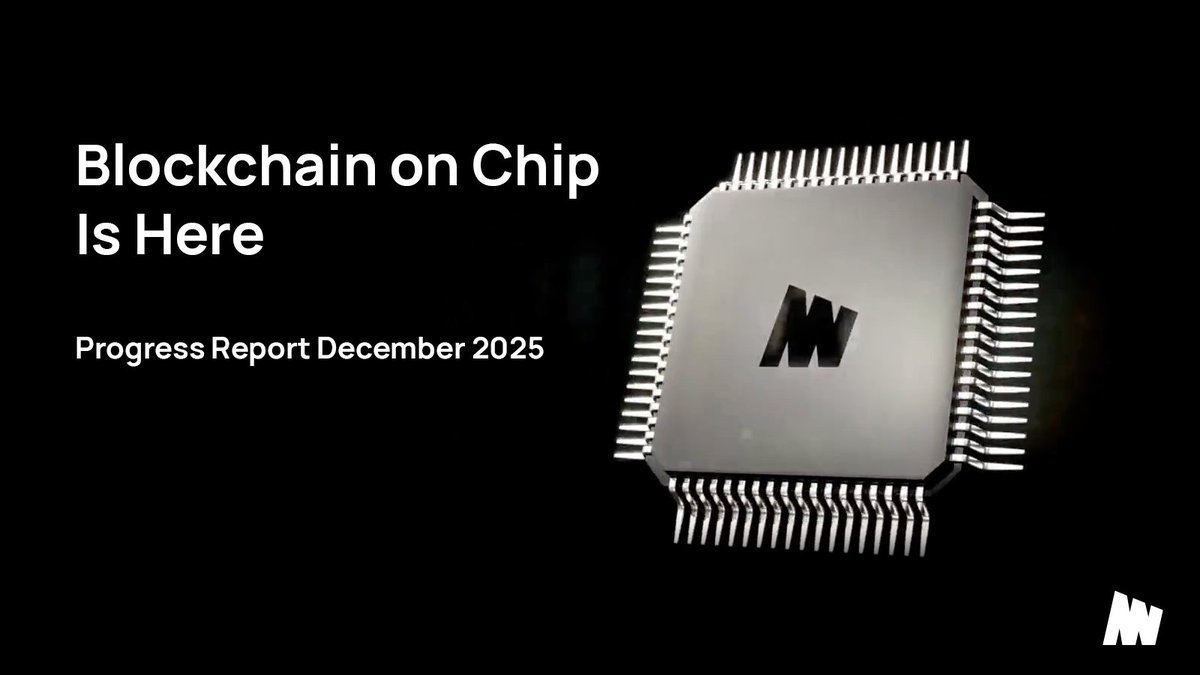
Minima has reached a milestone the blockchain industry has discussed for more than a decade, but never truly delivered: a fully functioning Layer-1 blockchain node running directly on embedded hardware, without reliance on cloud infrastructure, heavyweight runtimes, or specialised servers.
Today, Minima runs on the Arm processor subsystem inside an FPGA board, with custom cryptographic accelerators. Minima’s deterministic architecture, combined with a purpose-built C++ code, positions Minima as the first blockchain genuinely engineered to live inside autonomous machines, not merely alongside them.
This is not a concept or a speculative roadmap. It is working now.
Read on for the overview, or over this link for the full update: https://t.co/ndEkj5wy0o
Most chains carry an uncomfortable truth: the larger the balance behind a single keypair, the louder the invitation to any future quantum adversary. Bonded stake. Validator clusters. Pools. Bridges. All of them compress value into oversized cryptographic choke points. Elegant in design, catastrophic in failure.
Minima avoids that trap by design.
There are no privileged operators, no mega-keys guarding empire-sized stakes. The network is a flat topology of independent actors, each running a full node on their own device. Power is granular. Funds are granular. Failure, if it ever comes, is granular.
Quantum attacks thrive on concentration & Minima refuses to concentrate.
Privacy isn't a feature. It's an architecture.
If a chain has sequencers or producers, it has surveillance points.
Minima doesn't.
Zero chokepoints.
Every phone a full node.
Structual privacy from the ground up, not scrabbling to patch your way there. This is what the privacy narrative is actually about.
6/ Integras by Minima_Global × https://t.co/kJ9URVpOul integration
Integras (by @Minima_Global) has integrated ASI:One by https://t.co/kJ9URVpOul, making seamless connectivity between on-chain data and agentic intelligence possible.
The development of the world’s first blockchain-on-chip for drones is being made possible through Arm Flexible Access, as @Minima_Global and @unisouthampton use Arm compute platforms to explore new approaches to secure, autonomous system design 👏: https://t.co/dUUf8RRpuV