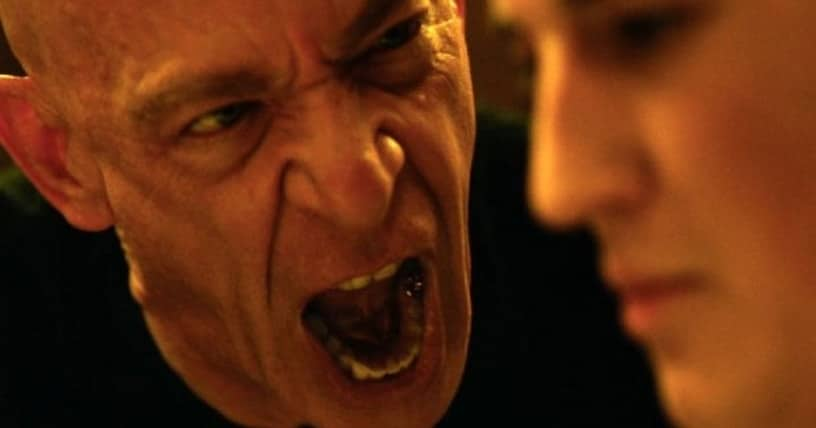
“Show me the mechanism of action.”
“Uh. from the p-p-perturb seq?
right here. Knocks down Gene X, and the cells shift into Cluster 7."
“You used fkn UMAP again. FUCK. Zoom in.”
“Sorry?”
“Zoom. The fuck. In.”
“…Okay.”
“Do you see it?”
“…See what?”
“He doesn’t see it. The cell biology postdoc from Stanford does not know how to see a cell. He stares at a two-million-cell embedding and doesn’t see the conflations he just planted in my S3 bucket.
WHERE is the temporal resolution?”
“The… what?”
“Where is the time? You hit the cell with a perturbation and you measured it once. Once. That’s not a mechanism. That’s a fucking POSTCARD!”
“We sequenced at 72 hours. That’s standard.”
“Standard is not the same as correct. You are aliasing causality. You compressed a dynamic process into a static endpoint and you’re think you will cure metastatic cancer.”
“But the differential expression is significant.”
“WOW! DIFFEWENTIAL EXPRESSION IS SIGNIFICANT! WOW! WHEN THE FUCK IS IT NOT.
Yes, because statistics is Mario Kart.
A fantasy land where causality is optional and variance disappears if you collect enough cells. Real biology has inertia.
Feedback.
Competing pathways.
Do you understand the difference between correlation and mechanism? Or did you flunk out of STAT 101?”
“…I mean, we saw Gene X regulate Pathway Y.”
“No. You saw Pathway Y exist in the same cell after you kicked it down the stairs and waited three days. That’s not even a crime scene, you dimwit. That is a post-mortem autopsy.”
“The model inferred a trajectory--”
“STOP the buffoonery. Do not blame the model.
The model is a mirror.
In this particular case, you can see it mirrors the clusterfuck you just created in my biosafety cabinet.
If the reflection is warped, it’s because your measurement is warped.”
“Pull up the raw counts.”
“…Okay.”
“Scroll. Cell 14,982. Read it to me. What does it say?”
“Uh… mitochondrial genes up, ribosomal genes down-”
“And?”
“…And stress response markers?”
“Yes. Because you poisoned the cell and waited long enough for it to panic.
Where is the early signaling?
Where is the metabolic inflection?
Where is the first irreversible decision?”
“We don’t capture that.”
“Exactly. You built a platform that cannot see the mechanism. YOUR PLATFORM IS FUCKING BLIND.”
“The virtual cell...showed the perturbation effect cleanly.”
“Yes. because your VIRTUAL CELL IS VIRTUAL. it assumes the cell is a bag of transcripts. Do you think metabolites show up? OR AN ISOFORM? AN ISOFORM, THAT WILL DEGRADE IN THE CELL BEFORE YOU EVER REACH YOUR SENSOR? THAT ONE? YOU THINK THAT'S HOW CELLS WORK?”
“So what do you want me to do?”
“Delete the atlas.”
“What?”
“Delete it. The whole thing.”
“But that’s the core result.”
“It’s three weeks of garbage narrative built on a blind instrument. Delete it.”
“…Now what?”
“Now you rebuild the measurement. You observe the cell while the perturbation propagates. You track chemistry, not just transcripts. You capture the first divergence, not the final corpse.”
“That’s… not perturb-seq anymore.”
“Exactly.”
door slams
It's out !
A big review on the neural mechanisms of PP - written with many fellow predictive processors, led by the amazing @LecoqJerome through the @AllenInstitute's OpenScope program
https://t.co/fVEJCwsBo0
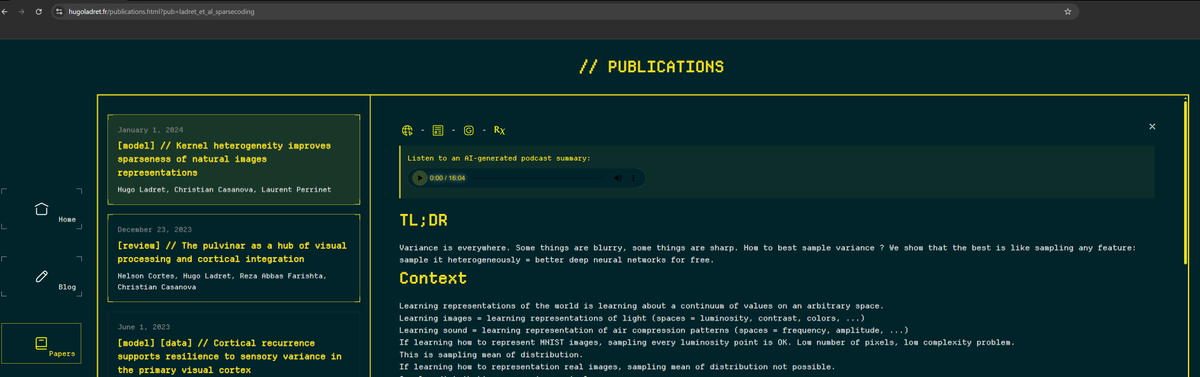
@NotebookLM-generated podcasts to summarize scientific articles are awesome. There's now one for every paper on https://t.co/Xd9pJZ1gp2
Ah yeah also, new website, thanks @cursor_ai !
Traveling waves of neural activity are observed all over the brain. Can they be used to augment neural networks?
I am thrilled to share our new work, "Traveling Waves Integrate Spatial Information Through Time" with @t_andy_keller!
1/14
🎉 It’s been over two years since we launched the eLife Model for publishing that places the focus on nuanced public assessments instead of publishing outcomes.
1/ Here’s how it’s going: https://t.co/NFTTEJu6TG
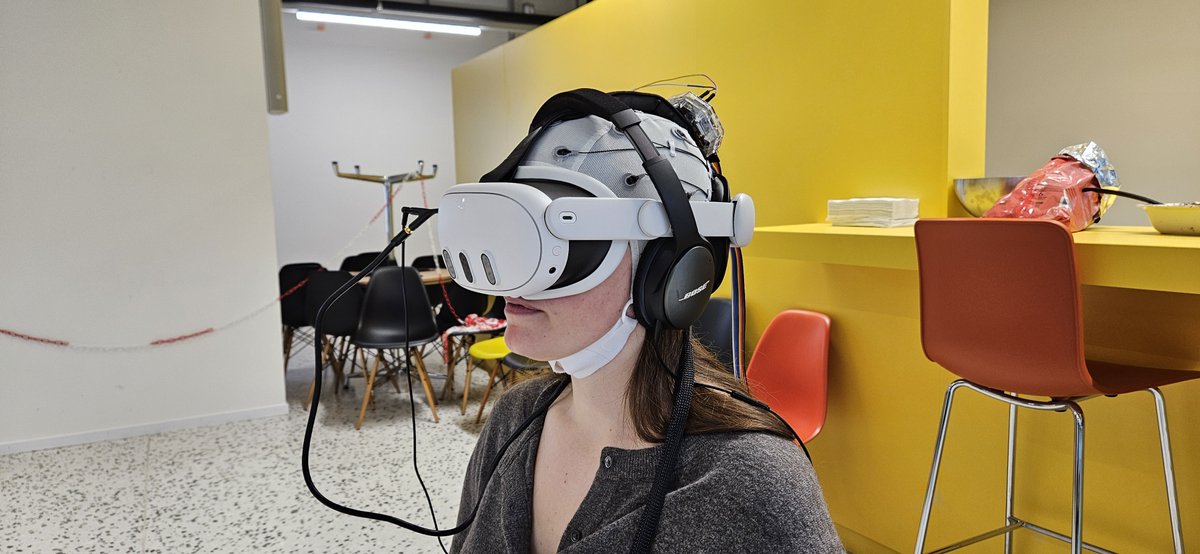
Ever wondered if humans experience the same tricky vision-movement mismatches seen in mice? The @georg98keller group is finding out! This week, they've been running EEG & VR experiments in the FMI lobby to explore how our brains handle these conflicts.
I am excited to announce that I've been awarded an SNSF Starting Grant! 🥳 I will start a lab at the Institute of Neuroinformatics in Zürich next year and we will work on "Neural mechanisms of perception and learning in uncertainty."
@snsf_ch@UZH_en
The #SNUFA24 final program is out and the event is next Tue-Wed! If you love spiking neural networks, click on the link below to check it out and register (free).
https://t.co/U7TGfWN815
Deeply saddened by the passing of Yves Frégnac. His scientific legacy is immense. My thoughts are with his family during this difficult time.
The group he formed in Gif-Sur-Yvette, in the south of Paris, with Destexhe and others was truly unique (and was called UNIC!). 1/
BREAKING NEWS
The Royal Swedish Academy of Sciences has decided to award the 2024 #NobelPrize in Physics to John J. Hopfield and Geoffrey E. Hinton “for foundational discoveries and inventions that enable machine learning with artificial neural networks.”
Thrilled to share the first preprint from the lab! We find that mouse V1 contains a three-dimensional map of visual space with different populations of neurons responding to near and far visual cues! Led by @yiran25_ with @populusalba9 and @ant_blot. https://t.co/qYig6bEnih 1/n
Two days ago, a lawfirm filed a federal antitrust lawsuit against 6 commercial publishers (incl Elsevier & Wiley) in the federal district court in New York.
They allege a 3-part scheme on part of publishers. 🧵
https://t.co/BswKVg5l5G
We're hiring! Come build models of how the brain learns and simulates a world model. We have several openings at PhD and postdoc levels, including a collab with @georg98keller lab on designing regulatory elements to target distinct neuronal cell types.
https://t.co/DakerWs5Sz
We convert our setup monitors to synchronize them to the microscopes (2p and WF) they are used with (to reduce contamination light). Peter Buchmann at @FMIscience has made a PCB boards that can be used to convert Dell U2722D monitors.
1/9 New paper out @IOPneuromorphic !
All natural images are equal(ly complex to model), but some are more equal than others.
-> How should we model them ?
-> https://t.co/Ww8U5h4z8Q
(cool pictures + deep learning in this thread)
https://t.co/N0iKkPtSVe