we're making @blocks smaller today. here's my note to the company.
####
today we're making one of the hardest decisions in the history of our company: we're reducing our organization by nearly half, from over 10,000 people to just under 6,000. that means over 4,000 of you are being asked to leave or entering into consultation. i'll be straight about what's happening, why, and what it means for everyone.
first off, if you're one of the people affected, you'll receive your salary for 20 weeks + 1 week per year of tenure, equity vested through the end of may, 6 months of health care, your corporate devices, and $5,000 to put toward whatever you need to help you in this transition (if you’re outside the U.S. you’ll receive similar support but exact details are going to vary based on local requirements). i want you to know that before anything else. everyone will be notified today, whether you're being asked to leave, entering consultation, or asked to stay.
we're not making this decision because we're in trouble. our business is strong. gross profit continues to grow, we continue to serve more and more customers, and profitability is improving. but something has changed. we're already seeing that the intelligence tools we’re creating and using, paired with smaller and flatter teams, are enabling a new way of working which fundamentally changes what it means to build and run a company. and that's accelerating rapidly.
i had two options: cut gradually over months or years as this shift plays out, or be honest about where we are and act on it now. i chose the latter. repeated rounds of cuts are destructive to morale, to focus, and to the trust that customers and shareholders place in our ability to lead. i'd rather take a hard, clear action now and build from a position we believe in than manage a slow reduction of people toward the same outcome. a smaller company also gives us the space to grow our business the right way, on our own terms, instead of constantly reacting to market pressures.
a decision at this scale carries risk. but so does standing still. we've done a full review to determine the roles and people we require to reliably grow the business from here, and we've pressure-tested those decisions from multiple angles. i accept that we may have gotten some of them wrong, and we've built in flexibility to account for that, and do the right thing for our customers.
we're not going to just disappear people from slack and email and pretend they were never here. communication channels will stay open through thursday evening (pacific) so everyone can say goodbye properly, and share whatever you wish. i'll also be hosting a live video session to thank everyone at 3:35pm pacific. i know doing it this way might feel awkward. i'd rather it feel awkward and human than efficient and cold.
to those of you leaving…i’m grateful for you, and i’m sorry to put you through this. you built what this company is today. that's a fact that i'll honor forever. this decision is not a reflection of what you contributed. you will be a great contributor to any organization going forward.
to those staying…i made this decision, and i'll own it. what i'm asking of you is to build with me. we're going to build this company with intelligence at the core of everything we do. how we work, how we create, how we serve our customers. our customers will feel this shift too, and we're going to help them navigate it: towards a future where they can build their own features directly, composed of our capabilities and served through our interfaces. that's what i'm focused on now. expect a note from me tomorrow.
jack
You don't need a storyteller
According to friend of the show @DollyDeighton at WSJ, companies are desperate to hire storytellers.
Hiring “storytellers” is not a new phenomenon (the title began to appear in the early 2000s) but it makes sense that companies feel the need to hire them right now.
Why? Because it’s never been more obvious that the best storytellers in the world create billions of dollars of value for their companies and create massive advantages using only their words. Their words are so powerful that no matter where they appear on the internet they draw millions of views and create a vortex of talent, capital, and customers. The reality distortion field that emerges often results in 100x+ P/E ratios.
Of course every company in the world wants this. The problem is that it’s impossible to “hire” the most elite storytellers because they are founders. Think Elon, Karp, Palmer. I call these types “Joe Rogan CEOs.”
The internet is noisier than ever with thousands of startups competing for mindshare (when every startup has a great launch video, no one does) and yet these storytellers consistently break through and dominate the timeline. Even though generative AI allows marketing teams big and small to massively increase their output, it is often not even 1% as effective as one of these founders going on a podcast or even just posting stream of consciousness on 𝕏.
The white pill for savvy marketing teams is that even as we’re seeing an exponential increase in content production, I’m not sure we’re seeing an exponential increase in great ideas. That means companies large and small (that don’t have the luxury of having an elite storyteller like Elon, Karp, or Palmer on the payroll) still have a chance to break through the noise and be remembered.
As I reflect on 2025, there were only a handful of corporate “storytelling” moments that I really remember. And each worked for a different reason.
@anduriltech – Don’t work at Anduril
Their “chief storyteller” makes a cameo, but the campaign stands on its own.
@astronomerio - Thank you for your interest in Astronomer (featuring @GwynethPaltrow)
No notes. Will be studied.
@tryramp – Expenses should do themselves (with @saquon)
Executed in just a couple weeks, with a low budget, and benefited from a little luck sprinkled in (Eagles got it done).
@AnthropicAI – Keep Thinking
Human-centric, empowering, cool.
Friend (@AviSchiffmann) - Buy every billboard
Friend did something absurd, which we can call the “buy every billboard” strategy. Many people have criticized the campaign and the product, but the results from an awareness standpoint are undeniable. Avi spent $1-2M and became a household name (at least on the coasts). Many brands have spent 10x that amount this year and you still don’t know their names. This campaign showed me that billboards can have increasing returns to scale.
Hiring a storyteller to “craft narratives” and “tell your story internally and externally” is fine. But if the goal is to be remembered (and you lack a “Joe Rogan CEO”), remember that one great campaign is worth 100,000 posts.
BEST NEW BLOGS OF 2025 !!!
- Music blog: https://t.co/AZR9a4d5MF by @vmaxmc2
- Steps to Phaeacia: https://t.co/uNbvbCycmm by @BennyChugg
- Human Invariant: https://t.co/od2hen18yu by @humaninvariant
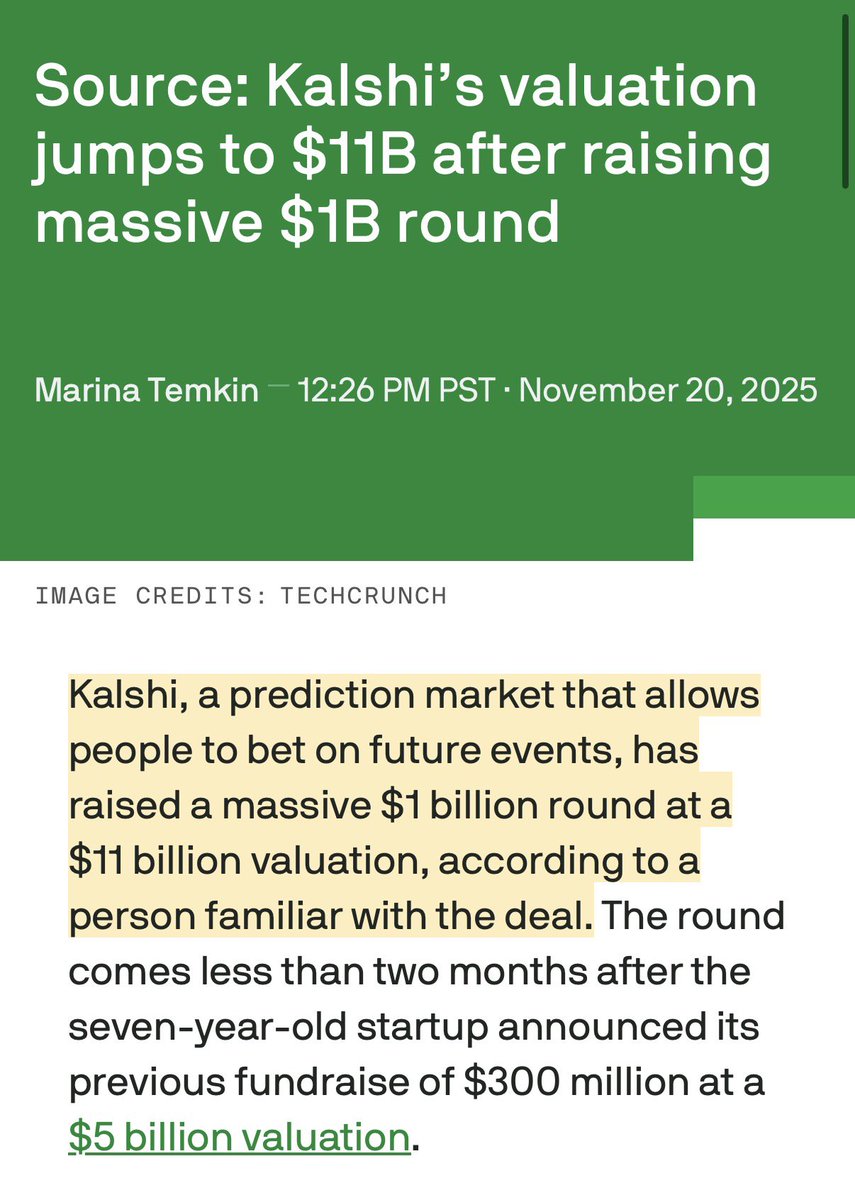
Kalshi reportedly raised $1B at an $11B valuation from Sequoia and CapitalG.
Polymarket reportedly raising at $12-15B.
They created a new market out of thin air, major props to everyone who invested in these companies before the 2024 election. I did not think they would work.