🎤 As AI systems become more capable, who or what can reliably judge whether their behavior is correct, safe, and aligned?
In this episode of the @HumansofAIPod, I sit down with @shubadubadub and @joshnotjacob, co-founders of @SampuraResearch, an independent nonprofit exploring how humans and AI can work together to oversee increasingly powerful systems.
Rishub and Josh explain why better AI judges are central to the future of alignment. Many of the hardest behaviors to evaluate are subjective, ambiguous, or difficult to verify and neither humans nor AI systems are reliable enough to handle every case alone.
Sampura’s research on "human–AI complementarity" asks how the strengths of each can be combined to create more trustworthy evaluations, stronger benchmarks, and oversight methods that continue to work as models improve.
We discuss what meaningful benchmarks for AI judges should look like, where human judgment remains essential, and how scalable oversight connects to the larger challenge of robust alignment.
Rishub and Josh also share why they left Google DeepMind to start Sampura, how they are shaping the organization’s culture and research agenda, and the unexpected operational realities of building an independent research lab.
🎤 As AI systems become more capable, who or what can reliably judge whether their behavior is correct, safe, and aligned?
In this episode of the @HumansofAIPod, I sit down with @shubadubadub and @joshnotjacob, co-founders of @SampuraResearch, an independent nonprofit exploring how humans and AI can work together to oversee increasingly powerful systems.
Rishub and Josh explain why better AI judges are central to the future of alignment. Many of the hardest behaviors to evaluate are subjective, ambiguous, or difficult to verify and neither humans nor AI systems are reliable enough to handle every case alone.
Sampura’s research on "human–AI complementarity" asks how the strengths of each can be combined to create more trustworthy evaluations, stronger benchmarks, and oversight methods that continue to work as models improve.
We discuss what meaningful benchmarks for AI judges should look like, where human judgment remains essential, and how scalable oversight connects to the larger challenge of robust alignment.
Rishub and Josh also share why they left Google DeepMind to start Sampura, how they are shaping the organization’s culture and research agenda, and the unexpected operational realities of building an independent research lab.
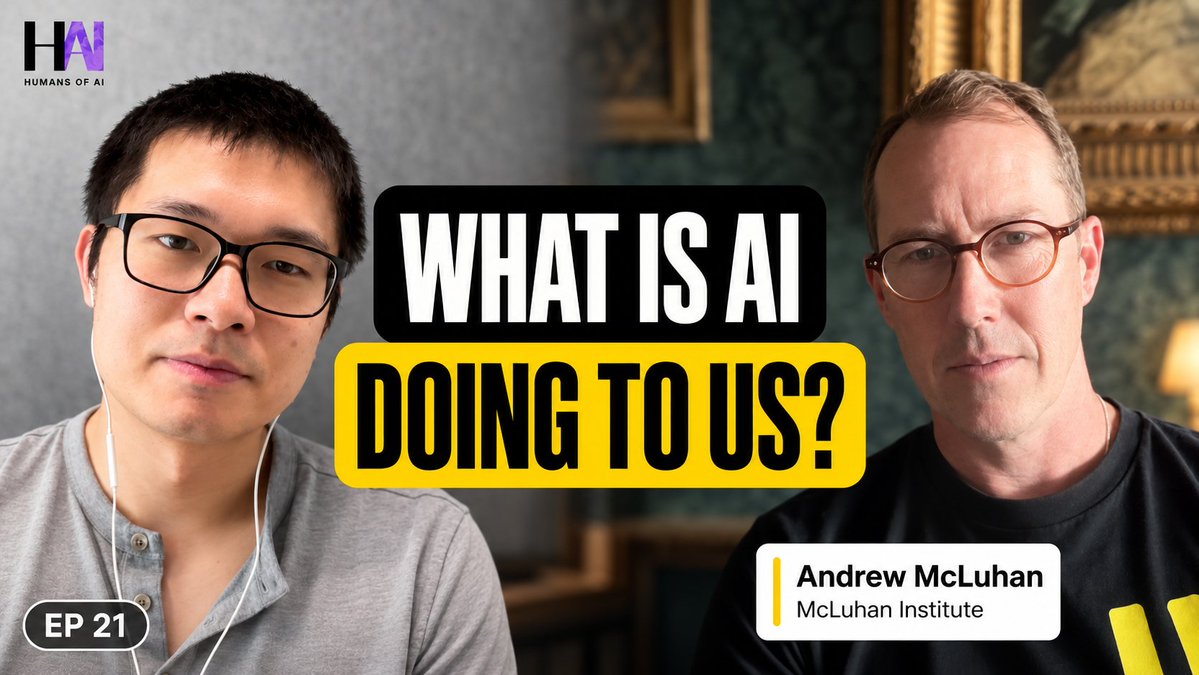
🎤 How is AI reshaping not only what we do, but who we are?
In this episode of @HumansofAIPod, I chat with Andrew McLuhan (@amicusadastra), a poet, writer, researcher, and the founder and director of The McLuhan Institute (@McLinstitute), where he develops and teaches ways of analyzing the nature of technologies and their personal and social effects.
As the grandson of renowned media theorist Marshall McLuhan and the son of Eric McLuhan, Andrew brings a perspective shaped by three generations of thinking about how media and technology transform human life.
Andrew explains why artificial intelligence should be understood as more than just another tool. AI is becoming part of the environment around us, reshaping how we think, create, communicate, trust information, and understand ourselves.
We unpack Marshall McLuhan’s famous idea that “the medium is the message,” why focusing only on the content produced by AI can distract us from its deeper effects, and what earlier shifts—from oral culture and print to radio, television, and the internet—can teach us about the present moment.
We also explore how AI overviews and agents are changing search, discoverability, and the economics of publishing; why the risks of AI extend beyond automation to mental fatigue, weakened judgment, trust erosion, and value misalignment; and how every technology strengthens certain human abilities while allowing others to fade.
Andrew offers a practical way to evaluate new technologies against our personal, family, and community values and asks which parts of ourselves we should be unwilling to outsource.
Andrew also shares his unconventional path from punk rock, poetry, and furniture upholstery to carrying forward the work of Marshall and Eric McLuhan. The result is a wide-ranging conversation about media, culture, identity, consciousness, and the question underneath nearly every debate about AI: not only “What can this technology do?” but “What is it doing to us?”
In the gambling industry, a customer-service chatbot might be designed to answer account questions then drift into giving betting advice. Because gambling is highly regulated, that unexpected behavior can create real harm and serious fines.
That's one reason why adoption of generative AI has been slow in Vegas.
Watch the full @HumansofAIPod episode on YouTube: "Kasra Gaharian: AI Can Flag Gambling Risk. But Can It Reduce Harm? | Humans of AI #20"
Casinos and sportsbooks spend heavily on licenses, compliance, and risk controls. Prediction markets can offer a very similar product while operating outside much of that gambling framework.
Is that innovation or an uneven regulatory playing field?
w/ @alexchaomander@KasVegas
Are prediction markets like @Polymarket and @Kalshi democratizing financial forecasting, or are they executing an "Uber-style" regulatory bypass of traditional gambling laws?
Kasra Ghaharian (@KasVegas) breaks down the massive disruption prediction markets are causing across sportsbooks, state tax revenues, and consumer protection frameworks and why taking risks in regulatory gray areas is a hallmark for tech.
Good to see more independent research studying how AI responds to mental health crises.
@TransluceAI was able to get anonymized data from @OpenAI and @AnthropicAI on how users talk with ChatGPT and Claude specifically on queries related to mental health support.
I appreciated their separation of studying the harness (the chatbot) vs the raw model (the API) which is very much the methodology we take in the "When AI is Your Pastor" paper (https://t.co/0ON9b4AerS).
Looking forward to reading through the results and seeing what lessons and future research can be done through @FideAILabs
It was a pleasure getting to learn from @KasVegas on how AI is impacting the gambling industry not just in internal operations but in better understanding players and minimizing harm to them!
🎙️ AI Can Flag Gambling Risk. But Can It Reduce Harm?
How is AI reshaping the gambling industry?
In this episode of @HumansofAIPod , I chat with @KasVegas, the Director of Research at @unlv University of Nevada-Las Vegas (@unlv) International Gaming Institute (@UNLVigi) , where he leads interdisciplinary research at the intersection of artificial intelligence, data science, and gambling.
Kasra breaks down the state of AI in gaming, the rise of prediction markets, and why the future of betting may depend as much on regulation and consumer protection as it does on model capability.
We unpack the distinction between "gaming" and "gambling," why the industry uses softer language, and how trust is built through regulation, fair-play systems, and responsible gambling tools. They also get into the probabilistic mindset behind games of chance, cognitive distortions that make players overestimate skill, and the challenge of helping consumers understand risk before it turns into harm.
On @HumansofAIPod, @alexchaomander joins Kathryn Harrison to talk about her prediction for the future of AI. Her opinion? AI agents will handle the manual tasks, and voice will change how we interact with technology. Watch → https://t.co/h4dvn2LJ8C
The original father of the term AGI @bengoertzel lays out an alternative path towards getting to what he calls Beneficial General Intelligence (BGI).
How do we get there? Check out the latest episode of the Humans of AI podcast to find out!
🎙️ Is decentralization the better path to building AGI?
In this episode of @HumansofAIPod, I chat with @bengoertzel, AI researcher, mathematician, and one of the pioneers of artificial general intelligence, having coined the term back in 2005.
Ben is the founder and CEO of @SingularityNET and he has spent decades exploring intelligence, consciousness, and what it might mean to create machines with increasingly general minds. He is now also the founder of BGI Labs aiming to chart a path toward building Beneficial General Intelligence.
Ben says the next breakthrough in AGI may not come from bigger transformers at all. Rather, the real bottleneck is deeper: memory, continual learning, metacognition, and architectures that can actually keep improving without forgetting what they learned yesterday.
Ben also argues that AGI shouldn’t be concentrated in the hands of a single company, country, or small group of institutions. The more powerful these systems become, the more important it is that they’re built on open, distributed infrastructure rather than locked inside one corporate walled garden.
In his view, decentralization isn’t just about ideology, it’s a practical way to make AGI more resilient, more transparent, and ultimately more beneficial for everyone.
#humansofai #agi #singularity #architectures #memory #rsi #decentralization
The software development lifecycle needs to be transformed as AI produces more code than can be human-reviewed. Who will take accountability?
Great conversation with @digitaldotai CEO Derek Holt!
What happens when AI can generate more code than humans can realistically review, understand, or govern?
In this episode of @HumansofAIPod, I sit down with Derek Holt, CEO of @digitaldotai, to explore how AI is changing not just the act of writing code, but the entire software development lifecycle: from planning and testing to security, governance, and release.
Derek describes this shift as a new wave of software development: coding itself is becoming dramatically easier, but that does not automatically mean organizations are delivering better software faster. As machine-generated code becomes more abundant, the bottleneck may move somewhere else: to human attention, judgment, testing, security, and accountability.
We talk about the software abundance paradox: if AI can produce code at enormous scale, who is responsible for making sure that code is actually trustworthy, maintainable, and safe? And when an AI agent writes a change, another system tests it, and an automated pipeline deploys it, who is ultimately accountable for what happens next?
Recorded live at @Ai4Conferences in Las Vegas as part of the Humans of AI field interview series.
#SoftwareEngineering #responsibility #review #accountability
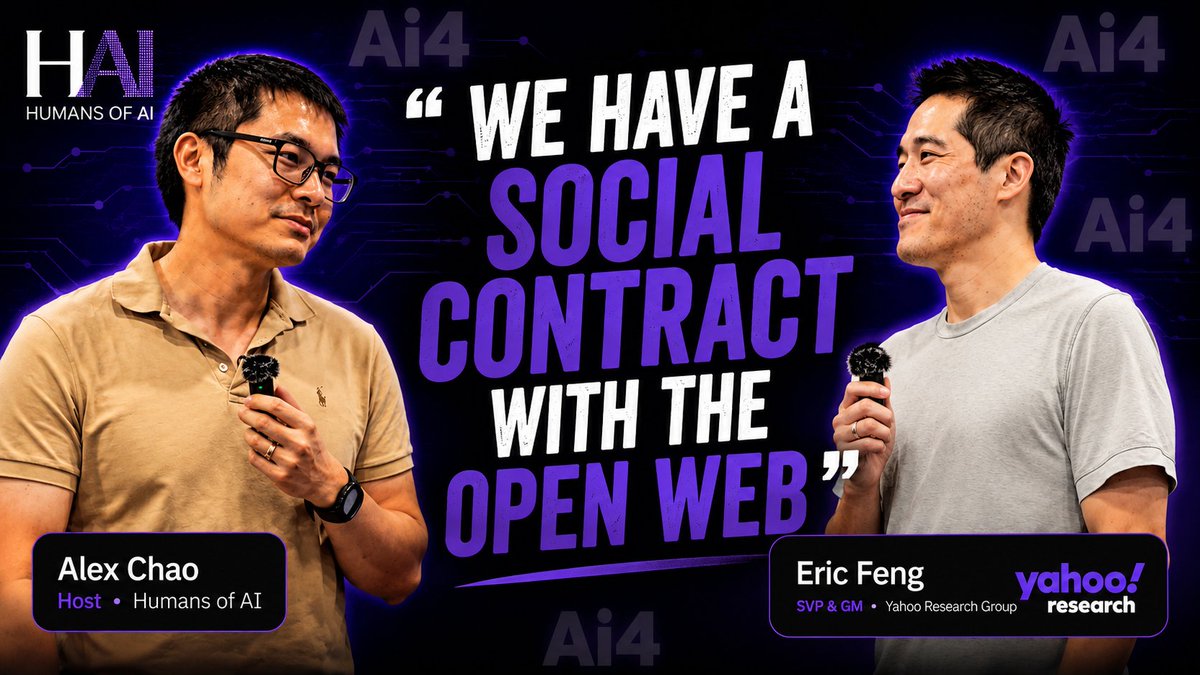
Building an engine that can deliver answers while preserving and honoring the open web is tough. Fascinating to hear how @efeng and @Yahoo Research are tackling this!
How can AI deliver answers without undermining the open web?
In this episode of @HumansofAIPod, I sit down with @efeng, SVP and GM of Yahoo Research Group, to explore how @Yahoo is building its answer engine and what it means to create AI-powered search experiences that are useful, trustworthy, and sustainable.
Eric leads Yahoo’s work at the intersection of search, AI, and information discovery and is tackling a central tension in the AI era: the more complete and convenient an AI-generated answer becomes, the less reason a user may have to click through to the original sources that produced the information in the first place.
We talk about what Yahoo is building, how Eric thinks about the design of an AI answer engine, and why he believes these systems need to do more than simply generate good responses. They also need to honor what he describes as a "social contract with the open web".
Recorded live at @Ai4Conferences in Las Vegas as part of the Humans of AI field interview series.
What does the future of work look like when humans, AI agents, and automation all work side by side?
@alexchaomander sat down with @KathrynHarrisn of @Concentrix, to talk about building hybrid workforces and why AI should empower people in their jobs, not simply replace them
What does it take to build an AI-powered newsroom without losing the editorial judgment, trust, and human perspective that journalism depends on?
In this episode of @HumansofAIPod of AI, I sit down with @katdowns, SVP and GM of @YahooNews, to explore how @Yahoo is building an AI-native newsroom and what it means to bring AI into the editorial, product, and business systems behind one of the internet’s largest news platforms.
Kat leads Yahoo News across editorial, product, and business strategy. Before Yahoo, she spent many years at The Washington Post, including leadership roles in both product and editorial, giving her a unique perspective on how news organizations evolve when technology changes the way people discover, consume, and trust information.
We talk about what it means to create an AI-powered newsroom in practice: how AI can support journalists and editors, how product and editorial teams work together, and how a major media organization thinks about personalization, workflow, and audience experience in the age of generative AI.
It's not just about adding new tools. It is about rethinking how news is created, surfaced, and experienced while still preserving the human judgment that makes journalism valuable in the first place. As AI becomes more embedded in media products, the question is not just what the technology can automate, but what responsibilities should remain meaningfully human.
Recorded live at @Ai4Conferences in Las Vegas as part of the Humans of AI field interview series.
#newsroom #ai #journalism
"The best defense against AI is more AI"
Great chatting with Leslie Nielsen, Chief Information Security Officer of @Mimecast at @Ai4Conferences on the increasing prevalence of more sophisticated AI security attacks and what can be done to guard against them.
What happens when AI needs knowledge that still lives in the physical world?
In this episode of @HumansofAIPod, I sit down with Dilo Wijesuriya, President of @ARCDocSolutions, to explore how non-destructive book scanning can help unlock physical archives for the age of AI without sacrificing the books themselves.
ARC works with organizations around the world to digitize physical information at scale, including books, documents, archives, and other materials that are still difficult for modern AI systems to access.
We talk about why so much valuable data remains offline, how digitization is becoming part of AI infrastructure, and why preserving physical books matters as companies race to turn more of the world’s knowledge into machine-readable data.
The conversation is especially timely amid growing attention around projects like Anthropic’s Project Panama, where destructive scanning was used to digitize books for AI training. Dilo offers a very different vision: scan the information, preserve the original, and treat digitization as both an AI problem and a stewardship problem.
Recorded live at @Ai4Conferences in Las Vegas as part of the Humans of AI field interview series.
Whether you work in AI, libraries, archives, research, enterprise data, knowledge management, or are simply interested in how the physical world becomes accessible to machines, I hope you enjoy the conversation.
What does the future of sound look like?
At @Ai4Conferences, I sat down with Jos Daniel, President of Marziani InMersion Systems on the @HumansofAIPod, to talk about the technology behind truly immersive audio and how rethinking the way we engineer sound could transform the experiences we create.
#HumansOfAI #AI4 #ImmersiveAudio