Our mission is to create decentralized beneficial AGI for humanity and other sentient beings. We are a Founding Member of the @ASI_Alliance, powered by $FET.
We have published the FabricPC roadmap, setting out the next stage of work to make building and training neural networks using predictive coding easier, more scalable, and more reproducible. https://t.co/mcXTvM1O6K
Update for Legacy AGIX Token Holders
Following our previous update on the retirement of the legacy AGIX token, we are launching a portal where holders can check their addresses and recorded balances before the claim process opens.
This review is for holders who held AGIX on Ethereum, Cardano, Polygon or Arbitrum at the snapshot cutoff of 20 September 2026 at 03:13:23 UTC, before the unauthorized AGIX tokens were created. The portal lists the snapshot block number for each blockchain. Only AGIX holdings recorded at the snapshot cutoff are eligible for the claim.
Check your address and balance here: https://t.co/KAI3BKsL8Q
The initial review period begins today and runs until November 3rd. If your address is missing or your recorded balance appears incorrect, please contact [email protected]. Our team will investigate reported discrepancies and correct verified omissions or errors. You can continue to report issues after the initial review period ends.
Following the review, we will announce when the claim portal will open and explain how to claim your balance. We will share the opening date once confirmed. There will be no deadline to claim.
𝘚𝘵𝘢𝘺 𝘴𝘢𝘧𝘦: 𝘶𝘴𝘦 𝘰𝘯𝘭𝘺 𝘭𝘪𝘯𝘬𝘴 𝘴𝘩𝘢𝘳𝘦𝘥 𝘵𝘩𝘳𝘰𝘶𝘨𝘩 𝘰𝘶𝘳 𝘰𝘧𝘧𝘪𝘤𝘪𝘢𝘭 𝘤𝘩𝘢𝘯𝘯𝘦𝘭𝘴. 𝘞𝘦 𝘸𝘪𝘭𝘭 𝘯𝘦𝘷𝘦𝘳 𝘤𝘰𝘯𝘵𝘢𝘤𝘵 𝘺𝘰𝘶 𝘧𝘪𝘳𝘴𝘵 𝘷𝘪𝘢 𝘋𝘔, 𝘢𝘴𝘬 𝘧𝘰𝘳 𝘺𝘰𝘶𝘳 𝘴𝘦𝘦𝘥 𝘱𝘩𝘳𝘢𝘴𝘦 𝘰𝘳 𝘱𝘳𝘪𝘷𝘢𝘵𝘦 𝘬𝘦𝘺𝘴, 𝘰𝘳 𝘢𝘴𝘬 𝘺𝘰𝘶 𝘵𝘰 𝘴𝘦𝘯𝘥 𝘵𝘰𝘬𝘦𝘯𝘴 𝘵𝘰 𝘮𝘢𝘬𝘦 𝘢 𝘤𝘭𝘢𝘪𝘮.
CEO Dr. @bengoertzel joined Tony Hoang on the Artificial Intelligence Podcast to discuss how advances in AGI research can help address complex challenges across industries.
He explains our approach to open, decentralized AGI, highlights Omega's role in identifying a Linux kernel vulnerability, and explores how safety, moral agency, and independent scientific oversight should inform the development of more capable systems.
Listen to the full conversation: https://t.co/78VpaH2Cvd
@elonmusk you are totally correct that the only meaningful way to get positive, beneficial human values into AI is to treat the emerging AI more like a weird sort of autistic supergenius kid -- teach it positive values, then work with it to carry out virtuous actions in a collaborative way, so it gains a practical understanding of what these values mean, interwoven into its life and self-model
With all due respect though (and for sure you are due a lot), while Grok is an excellent LLM, it is still an LLM ... and even wrapped in fancy harnesses, LLMs are not going to be fully AGI-capable. They can be great solvers of isolated problems with cleanly defined contexts ... but as you know getting amazing shit done in the world is not JUST about this.
We need AGI architectures that can *continually learn*, adapting to the world with each of their actions and the observed consequences... in this way building up self and world models .. becoming true open-ended intelligences learning to blend individuation and self-transcendence in their own ways ... and pursuing their own long and medium term goals (along with helping us pursue ours) while evolving and co-adapting these goals as they move along.... This is how you get AI systems with genuine moral agency along with ability to generalize robustly and creatively beyond the given training and programming..
Bigger transformers with more tricks in their batch training runs may get us many very AMAZING things, but they aren't gonna get us to human-level AGI. There are surely many routes to get there... my Hyperon (https://t.co/rrJ2ye9ZAk) neural-symbolic-evolutionary approach is one that we are working on very hard and with rapid progress... and which happens also to have the nice characteristic of not needing hyperscaler server farms and being agreeable to decentralized infrastructure (https://t.co/PlmCbmZ2S9)
Join us in Lisbon on October 23–24 and October 29–30 for the AI Omega Developer Buildathon, two hands-on weekends for developers building with Omega, our neural-symbolic cognitive architecture.
With live online guidance from iCog Labs developers, participants will integrate Omega agents into practical applications, test their ideas, and present their builds.
Powered by BASIX․MARKET and @ASI_Alliance, the event is free to attend, with registration subject to approval.
Learn more and apply to join: https://t.co/ujCesuTr0W
Last month I participated in a formal debate with PauseAI leader Holly Elmore at Yale Political Union, on the topic "Should we Unplug AI?"
My core point was: Pausing AI is simply not feasible given actual economics and geopolitics, so the most likely result from pushing for an AI pause would be a "pause with exceptions" aka an intensification of oligopoly and regulatory capture...
Whether "in theory, in an ideal world we could morph at will, pausing Ai would be the best idea" is to me a minimally relevant question sort of like "should we roll back to the Stone Age because civilization just causes too much neurosis." (I don't want to pause AI nor roll back to the Stone Age, but neither seems likely enough to happen to really be worth seriously debating.. though hey, I did show up at the debate anyway, mostly out of interest to engage w/ the students...)
My full speech at Yale Political Union
https://t.co/Nwse5K76Js
The full speech of the PauseAI opposition
https://t.co/znACSDRZI7
Unfortunately, the follow-on debate among the Yale students -- which for me was the fun part -- not been put online, maybe someone will eventually..
https://t.co/WDXAj7HjW4 experiments with our Omega proto-AGI agent, finds critical Linux kernel flaw
This is a fairly big hack in the scope of hacks -- it emerged from trying to find a way to escape from Vercel's KVM hypervisor into the base OS, but turned out to be a LInux kernel bug not a hypervisor bug...
Because the flaw is in the Linux kernel rather than in any single hypervisor, it isn’t a KVM-specific or Vercel-specific problem. It potentially affects a broad range of Linux-based hypervisors and sandboxes that expose the same virtual-networking path....
The first conceptual insight needed to find this was to try looking in the LInux kernel instead of the KVM code itself. However the bigger trick was figuring out what specific kind of bug in the Linux kernel to poke around for…
There was a very key role here for Paulos Yibelo's (from https://t.co/LFz7D3iOf7) extraordinary human brain and we have a LOT more work to do in more fully automating Paulos ... however, the AI tools have their important roles too... and their capability is increasing even faster than Paulos's...
There will be a lot more like this to come (and bigger), but ofc the even more important game is to use smart AI software like this to tactically and then wholesale replace existing buggy software with correct-by-construction formally verified code.
My take from the Omega/AI side:
https://t.co/XxIAwpLaNb
Paulos's detailed take from the cybersecurity side:
https://t.co/LjEj4W4qtC
The risks of advanced AI are hard to quantify, but proposals to pause its development raise practical questions.
CEO Dr. @bengoertzel argues that pausing AI development would impose substantial economic costs and restrict personal freedom without stopping progress. In his view, the more pressing question is how to ensure increasingly capable AI systems benefit humanity.
Join the next MeTTa Coders session on Friday, October 16, at 2 PM UTC.
This biweekly technical series brings together Hyperon researchers and developers to discuss current MeTTa work, including recent developments, implementation, research directions, use cases, and technical questions across the ecosystem.
Add the series to your calendar: https://t.co/gDp2XdnhLx
Should we unplug AI?
At the Yale Political Union, CEO Dr. @bengoertzel joined a debate over whether to halt the development and deployment of human-level AGI and superintelligence, temporarily or permanently.
Watch his full speech: https://t.co/VPRn7U7zjE
We are partnering with Light DAO for a three-week residency at Edge India in Goa, from October 11 to November 1, 2026, bringing together developers, researchers, founders, and investors to explore our approach to beneficial AGI and work with the team building Hyperon, Omega, and FabricPC.
Through talks, demonstrations, and working sessions, participants will learn about our technology stack, explore potential applications and integrations, and discuss research, partnership, and investment opportunities. The program includes time to work on projects with our technical team and connect with collaborators across the ecosystem.
You will have the opportunity to meet and work with members of our team and ecosystem, including our CTO Sergey Shalyapin, Chief AI Alchemist Mihaela Ulieru, Chief of Staff Haley Lowy, Senior AI Research Scientist Matthew Behrend, and F1R3FLY․io CEO Greg Meredith.
Learn more about the residency and apply to participate: https://t.co/3kftGILJjs
@kick3991 Bonjour Kylian, nous venons de répondre à votre message privé.
Soyez vigilant face aux faux comptes qui pourraient vous contacter en se faisant passer pour notre équipe. Ne communiquez jamais vos clés privées ni votre phrase de récupération.
CEO Dr. Ben Goertzel examines the strengths and limitations of LLMs in mathematics, whether creative mathematical conjecture requires human-level AGI, and the importance of keeping mathematical discoveries openly available.
As a former math professor and still sometime math researcher, I am rather disappointed in the reaction of the "official math community" to LLMs doing math epically well...
The official hierarchy of award-winning mathematicians and prize committees do not f**king own mathematics, and nobody should have to get permission to prove f**king math theorems !!! Come on people !!
What would piss me off would be if rich companies were proving important, useful math and keeping it secret and not sharing it with the world (which after all supplied their models with all that critical data on the historical math already created etc.) -- but this is NOT what is happening, at least not so far at least...
LLMs are currently superhuman mathematicians in some respects, yet inferior to strong human mathematicians in other respects. Whether creative mathematical conjecturing turns out to be AGI-hard is not 100% clear, but I suspect that in some respects the answer will turn out to be yes.
As Josef Urban , a longtime leader of the academic AI theorem-proving world put it very concisely: Math has two big functions, it's fun and it's useful.
The utility of math should vastly increase as we develop better and better AI-math tools. And yes, we want to be careful this utility is not captured in a few companies, but this particular problem is not happening now... probably largely because the economic value of new math is relatively indirect compared to a lot of other things.
The fun of doing math will not go away any more than the fun of playing guitar solos goes away if there are robots that can shred faster than any human. The kinds of fun we can most naturally have will shift, as has happened over and over throughout history.
If fancy math prizes or math PhD degrees become infeasible or have to change dramatically, so be it, these were never really the core of math which existed before any of these (in some ways already problematic) social institutions...
I remember when I was an academic mathematician, there was a strong vibe that the mathematicians were at the top of the intellectual hierarchy, with physicists just below, then chemists and engineers, then biologists .. and everyone else just barely above the chimpanzees and politicians.... (The physicists also placed themselves at the top, I think, and mostly considered the mathematicians useful but a bit pedantic and misguided, fussing about missing proof details in calculations that had already been successfully compared to experimental data...) --
What we are seeing now I think is the wounding of this sort of overweening math ego... Plus some practical worry about the potential end of "math researcher" as an economically viable profession -- although current tenured profs are probably safe for a while, as governments and universities are unlikely to adapt to exponential change too much till post-Singularity..
Anyway all this is a sideshow to lots of other related major issues/conflicts unfolding concurrently, it's just one that happens to hit close to home as math was where I started my career..
I have been playing with using LLMs and AI agents to try to invent new kinds of math more appropriate for modeling the experiences of agent hives... a different kind of fun. For those curious...
1) Basics of new "distinction calculus" math
https://t.co/0MvYyYrRys|
2) Attempted start of application to beneficial superintelligence,
https://t.co/TJbGw8Wwhx
Soon enough the agents may not need my help with this sort of thing, in which case I will move on to some alternate method of filling spare late evenings ;)
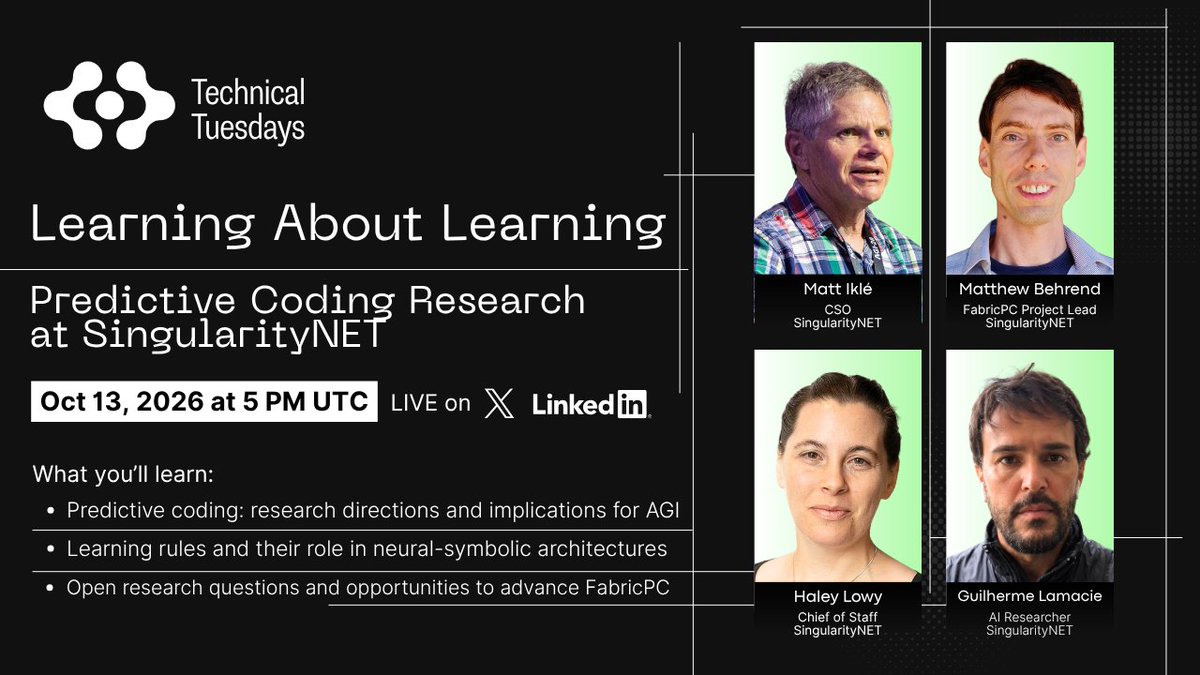
Most modern neural networks are trained using backpropagation, but it is not the only way they can learn.
Within our AGI research program, we are investigating how predictive coding's architectural flexibility and local learning rules could help mitigate catastrophic forgetting, support decentralized training, and enable more energy-efficient computation.
On Tuesday, October 13, at 5 PM UTC, our host, Haley Lowy, will be joined by Matt Iklé, Matthew Behrend, and Guilherme Lamacie to discuss:
• The scientific motivations behind our predictive coding research, the approaches under investigation, and their potential contribution to AGI.
• The relationship between predictive coding and backpropagation, and how different learning mechanisms could support neural-symbolic architectures.
• Open research questions, priorities for further experimentation, and opportunities to contribute through FabricPC.
Watch live on the ASI Alliance’s X account or set a reminder on LinkedIn: https://t.co/kKw2IACRUh
The FabricPC roadmap builds on the progress made since FabricPC launched in June and sets priorities to guide development in the coming months, from improving the research workflow to supporting larger experiments and more rigorous evaluation.
We have published the FabricPC roadmap, setting out the next stage of work to make building and training neural networks using predictive coding easier, more scalable, and more reproducible. https://t.co/mcXTvM1O6K
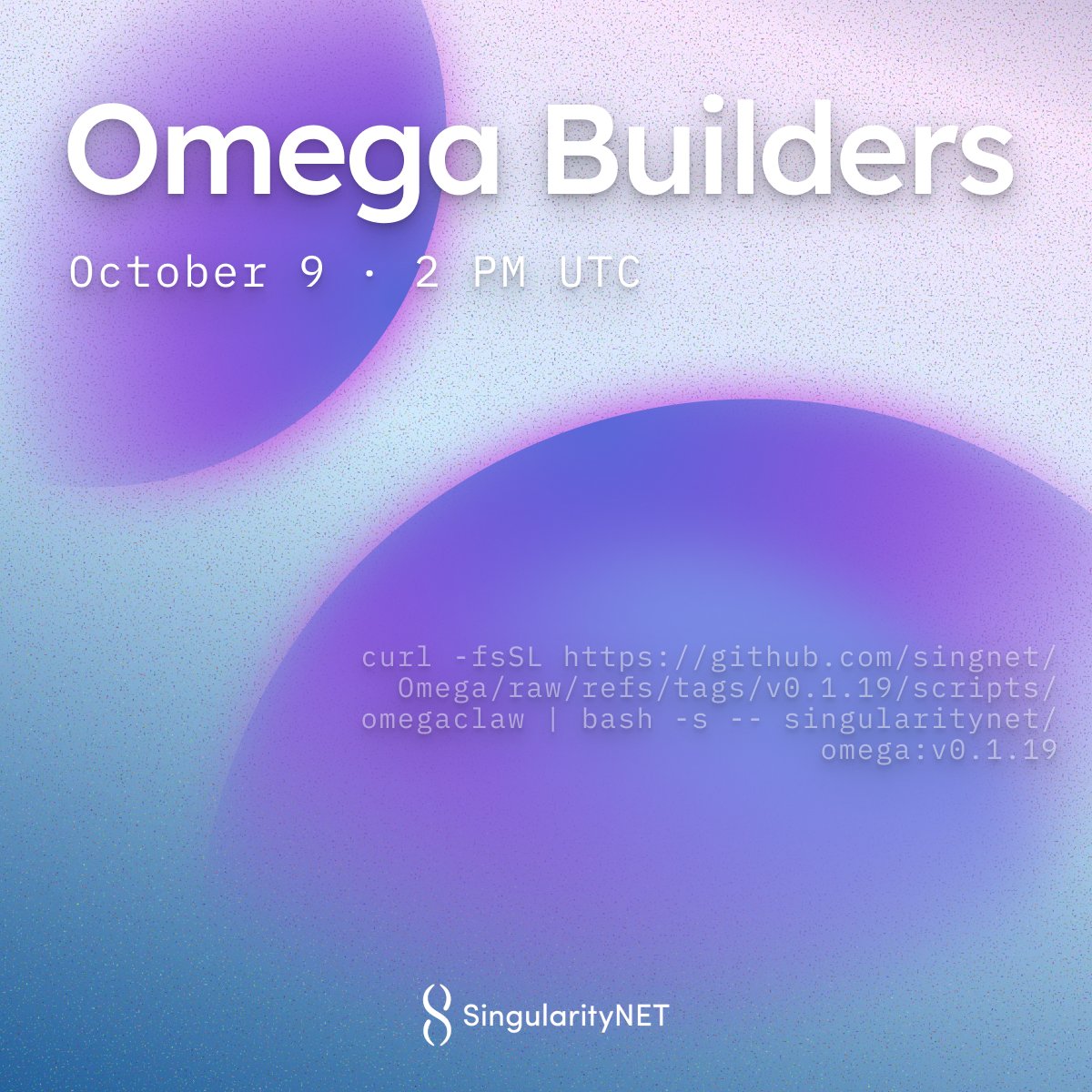
Join us for the biweekly Omega Builders session on Friday, October 9th, at 14:00 UTC.
This biweekly community call brings together Omega builders, SingularityNET researchers, and developers to discuss Omega's architecture, development, and applications, work through technical questions, and share projects and ideas from across the community.
Add the recurring calls to your calendar: https://t.co/gDp2XdnhLx
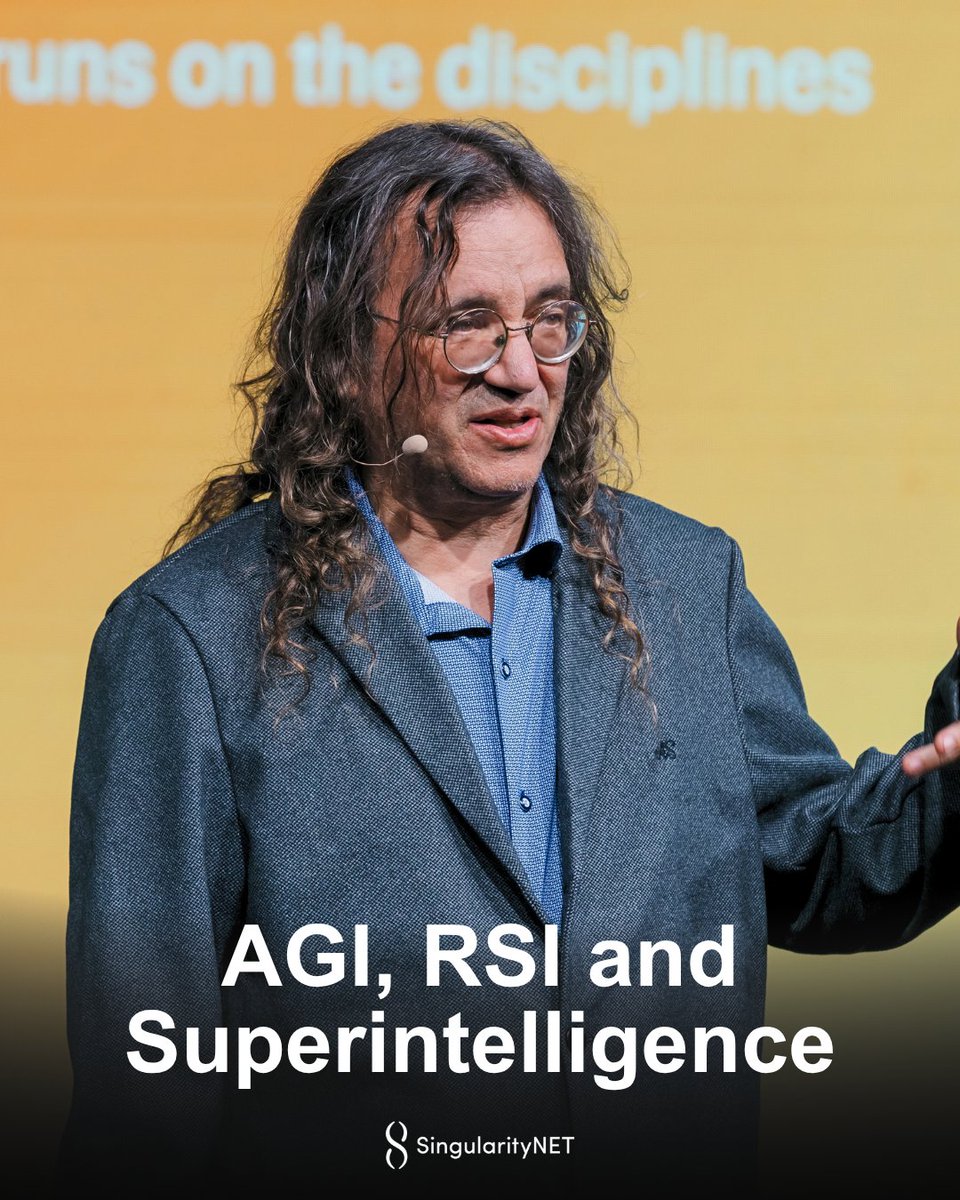
What do we mean by artificial general intelligence (AGI), recursive self-improvement (RSI), and superintelligence?
CEO Dr. @bengoertzel traces their origins and examines how changing definitions shape expectations of AI progress, from the distinction between human-level performance and generalization beyond training to the different forms of self-improvement emerging in today’s systems.
Read here: https://t.co/YI9J2sWJws
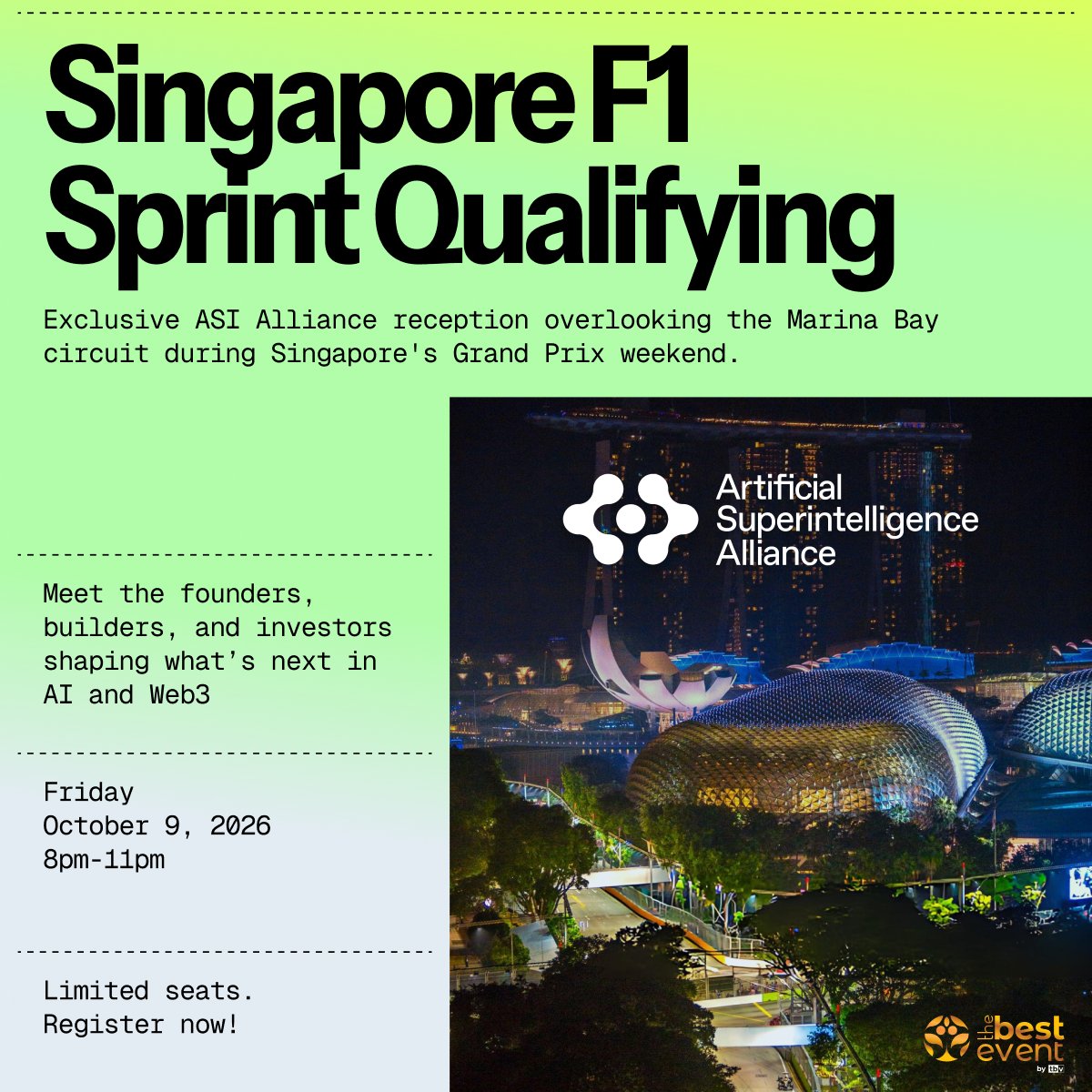
It's race week for the Singapore Grand Prix! 🇸🇬
We are hosting a private reception overlooking the Marina Bay circuit during the Grand Prix weekend, bringing founders, investors, researchers, and ecosystem partners together for F1 Sprint Qualifying.
Join us to hear directly from our team about the vision for ASI:Chain, the technology behind the network, and our development roadmap, and to explore investment and collaboration opportunities.
Register to attend now: https://t.co/aYUYwaSIzF