Acaban de meter el "vibe coding" en el desarrollo de robots humanoides.
Gratis.
Se llama Booster Studio, la plataforma de Booster Robotics.
El problema para programar un robot siempre fue el mismo:
montas el entorno durante horas.
tu código funciona en simulación pero falla en el robot real.
debuggeas a ciegas sin ver los datos.
Booster Studio lo resuelve de raíz:
→ IA nativa que entiende tu intención y escribe el código
→ la simulación y el robot físico comparten exactamente el mismo código
→ despliegue en un clic, de la simu al mundo real
→ point clouds, cámaras, URDF y series temporales en una sola vista
→ reproducción nativa de MCAP y ROS bag
Sin configuración compleja. Plug and play.
Corre en macOS, Windows y Linux.
100% gratis. Descarga directa para escritorio.
El link aquí ⬇️
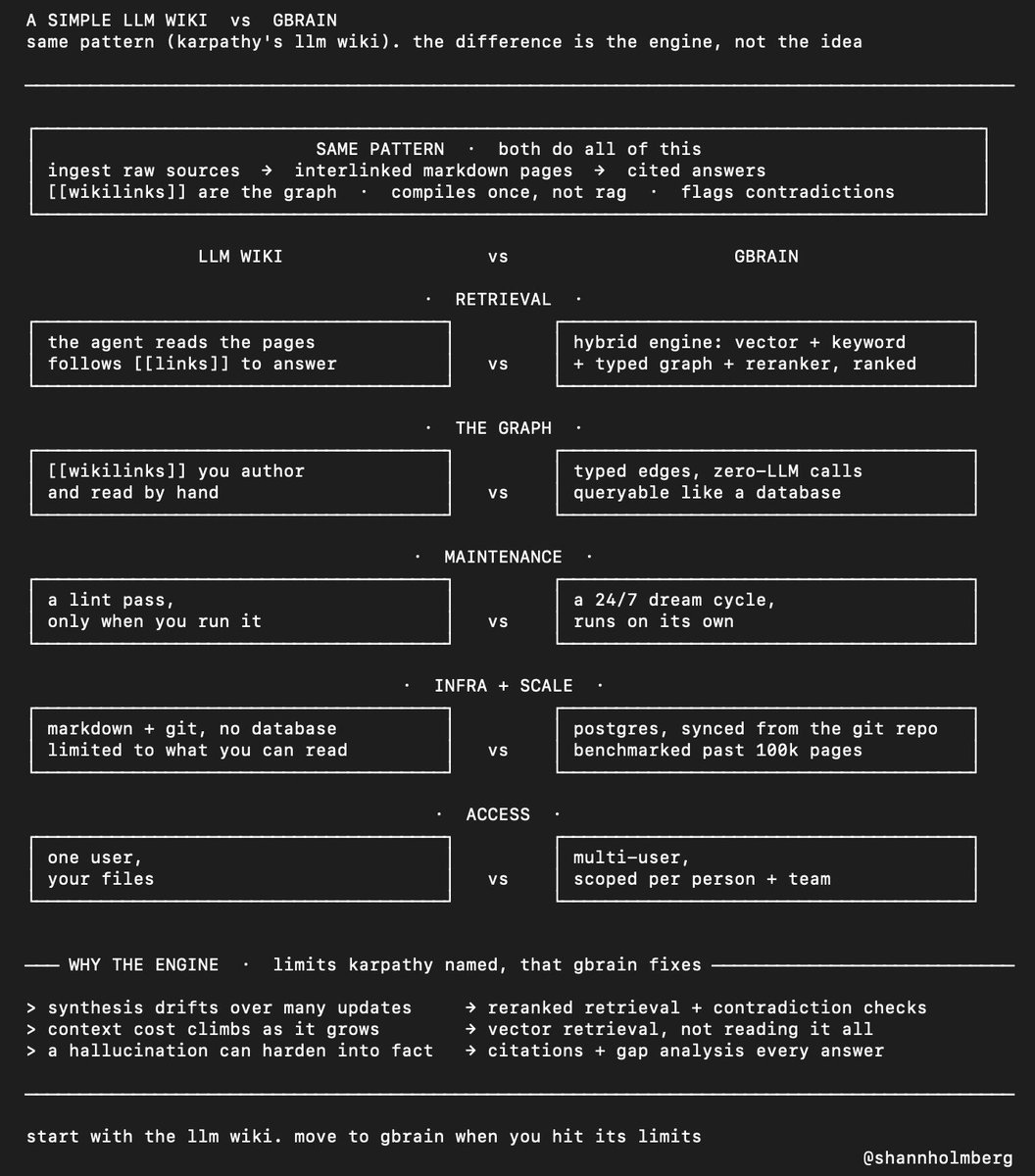
how a simple llm wiki compares to gbrain
second brains are getting popular fast, they're one of the main enablers for ai and agents right now. the context you give an agent is what makes it good
two frameworks I've been using are the LLM Wiki and Gbrain. here's how they compare, and how to use both
underneath they're the same idea, karpathy's llm wiki: you compile raw sources into linked markdown pages your agent reads, instead of redoing RAG from scratch every time
both ingest your sources, build a graph out of them, and answer with citations, so the real question is what's actually different
an LLM wiki is just markdown and your agent:
> it reads your sources and writes linked pages
> you ask a question and it reads those pages to answer
> you keep it healthy with a lint pass
> there's no database, just files, and one user
it works well, and karpathy even points out where it starts to break down:
> the synthesis drifts after a lot of updates
> the context cost grows as the wiki gets big
> a wrong claim can harden into fact over time
gbrain is that same wiki with an engine built for those exact problems:
> better retrieval, vector plus graph plus a reranker, instead of the agent reading pages
> it runs on postgres, so it scales past what you could ever read yourself
> a 24/7 loop enriches and fixes the wiki on its own, so there's no manual lint
> every answer comes with sources and an honest note on what it doesn't know yet
> it's multi-user, with access scoped per person and team
when to reach for each:
> use an llm wiki for smaller projects, to gather and store the context an agent will use later on. when it grows up, you can ingest it straight into gbrain
> use gbrain for the consistent, shared things, a company brain or a client brain, especially once more people are involved
so it's not wiki vs brain, it's the same wiki run by you on a small project, versus the same wiki run by an engine at scale for a team
start simple, then move to gbrain when you outgrow the files
CLAUDE CODE AHORA TAMBIÉN EDITA VÍDEOS
skill 100% gratis y open source, la instalas y ya
→ crea animaciones automáticamente
→ genera subtítulos con estilos distintos
→ elimina silencios, errores y muletillas
lo que antes necesitabas un editor para hacer, ahora lo hace una IA en tu terminal
Te lo dejo abajo👇🏻
Encontré la herramienta de OCR que realmente estaba hecha para la era de los LLMs.
Se llama olmOCR.
Convierte PDFs, escaneos, PNGs y JPEGs en markdown limpio y bien estructurado que los modelos de IA pueden entender de verdad.
Ya no se rompe con lo que normalmente complica todo:
-> Tablas
-> Ecuaciones
-> Texto manuscrito
-> Diseños de varias columnas
-> Figuras e insets
-> Documentos antiguos escaneados
-> Encabezados y pies de página
-> Orden de lectura natural
En vez de pasarle a tu IA un texto desordenado y lleno de errores, le entregas un Markdown que respeta la estructura original del documento.
Esto importa mucho más de lo que parece.
Gran parte del conocimiento del mundo sigue atrapado en PDFs: papers, documentos legales, reportes financieros, historiales médicos, archivos escaneados, conocimiento interno de empresas…
Si estás armando RAG o agentes sobre documentos y tu OCR es mediocre, tu sistema ya empieza fallando desde el primer paso.
olmOCR soluciona esa primera milla.
Esa capa “aburrida” que nadie menciona hasta que tu agente empieza a alucinar por culpa de un texto roto.
Repo en los comentarios 🔥
My entire AI stack is now Chinese 🇨🇳
87% cheaper. same revenue
swaps by task:
1. reasoning / backend brain
Opus 4.8 → Kimi K2.7
benchmark gap: ~8% · price: ~11x cheaper
2. code generation
GPT-5.5 → Qwen 3.7 Max
benchmark gap: ~18% · price: ~7x cheaper
3. agent loops + tool calling
Sonnet 4.7 → GLM 5.2
benchmark gap: ~3% · price: ~5x cheaper on input
4. cheap volume / bulk processing
GPT-5.5 mini → MiMo V2.5
benchmark gap: ~6% · price: ~12x cheaper
5. image generation
GPT-Image-2 → Wan 2.5
benchmark gap: ~5% · price: ~8x cheaper
6. video generation
Sora 2 → Kling 3.0
benchmark gap: roughly equal · price: ~6x cheaper
[ result after 30 days: ]
operating costs dropped 87%, output quality dropped 4% on average, revenue unchanged
the most important that these models will be not banned in a month and i can run them locally
nobody will steal my data and i can learn them as i need
full article drops tomorrow with:
> exact routing logic per task type
> the 2 cases where I still pay for American
> the migration playbook anyone can copy in a weekend
VERY IMPORTANT to get migrated now, while it's not too late
ABANDONÉ LOVABLE DESPUÉS DE VER LO QUE CLAUDE CODE PUEDE HACER REALMENTE
los generadores básicos son geniales para ideas rápidas
pero intentar construir un sitio premium con Lovable se siente como jugar en una caja de arena
Le di a Claude Code unas pocas habilidades de diseño personalizadas en su lugar
4 minutos después construyó un diseño premium por el que me habrían cobrado $7,500
la diferencia entre plantillas genéricas y un agente local hábil vale literalmente miles
This is the most powerful way to use Hermes.
Spinning up multiple subagents to complete work.
Rather than working sequentially, Hermes fans out across multiple agents at once - then cross-verifies and merges the results.
It's like having an entire team from a single prompt:
Your Hermes Agent Setup Is Missing This
00:00 The first mistake people make with Hermes
01:10 Why Hermes feels powerful but hard to use
02:28 Prompt 1: Make Hermes interview you
03:49 Example: answering the Hermes life audit
07:03 The workflow list Hermes creates
07:40 Prompt 2: Build a delegation map
09:12 What Hermes can do alone vs what needs approval
10:16 Prompt 3: Pick the first three workflows
12:01 My three recommended workflows
14:08 Prompt 4: Schedule a morning check-in
15:18 The daily assistant loop
16:21 Prompt 5: Create an operating profile
17:54 Turn repeated work into skills
19:09 The full Hermes daily setup recap
19:52 Download the prompt pack
جوجل تفتح خزائنها للمطورين بشكل غير متوقع، وتتيح رسمياً 1,000,000 توكن في الدقيقة مجاناً بالكامل وبـ صفر قيود. 😳
بدون الحاجة لبطاقة ائتمانية، وبدون أي اشتراكات شهرية؛ فقط دخول رسمي ومباشر عبر منصة Google AI Studio لامتلاك طاقة حوسبة هائلة كانت تكلف آلاف الدولارات شهرياً.
إليك تفاصيل هذه الفرصة وكيف تستغلها في مشروعك القادم: 👇
🚨EXCLUSIVA: LOS INGENIEROS DE ANTHROPIC ACABAN DE FILTRAR EL VIDEO DE 40 MIN DONDE CONSTRUYEN UNA APP ENTERA CON 3 AGENTES DE CLAUDE
mientras tu hablas con un solo claude, ellos arman un equipo de 3 que se reparten el trabajo y se corrigen entre si
el futuro no es de quien tiene la IA mas inteligente, es de quien arma el mejor equipo
Guarda esto en favoritos para que no lo pierdas.
Perfectionists spend too much time on little differences at the margins at the expense of the important things. There are typically just five to ten important factors to consider when making a decision. It is important to understand these really well, though the marginal gains of studying even the important things past a certain point are limited.
#principleoftheday
cuando trabajás con un agente, el ciclo suele ser siempre el mismo:
1) le das una tarea
2) revisás el resultado
3) le pedís cambios
4) y repetís
en otras palabras, vos hacés el loop.
loop engineering consiste en automatizar ese ciclo.
en lugar de esperar tu próxima instrucción, el agente hace una tarea, otro agente o un checker revisa el resultado y, si encuentra un problema, le devuelve feedback para corregirlo.
el ciclo se repite hasta que alcanza el objetivo.
así el agente puede seguir trabajando sin depender de vos después de cada iteración.
HERMES AGENT SUB-AGENTS DO THE GRUNT WORK
ON A CHEAP MODEL WHILE YOUR MAIN AGENT
ONLY SEES THE SUMMARIES.
SAME QUALITY. 5X CHEAPER.
@tonbistudio just dropped module 8 of his masterclass
covering delegation, parallelism, and cost control.
here is the full architecture.
WHY DELEGATE:
two problems with a single agent loop:
1. CONTEXT POISONING
every tool call, retry, dead end from a long task
stays in the context window.
the window fills. the model gets worse.
2. SERIAL SLOWNESS
10 research tasks one at a time = 10x the wait.
sub-agents fix both.
each child gets a clean isolated context.
runs in parallel.
only the final summary returns to the parent.
the parent never sees the mess.
HOW DELEGATE_TASK WORKS:
the agent calls delegate_task with:
→ goal: what the child must achieve
→ context: every detail it needs
(file paths, error messages, project root,
stack traces. if it's not in context, it doesn't exist.)
→ tool_sets: scoped per task
the child is a fresh agent.
own conversation. own terminal session.
own iteration budget. works alone in a clean room.
returns a structured summary: what it did, found, changed.
THE ONE RULE:
sub-agents know nothing.
BAD: goal = "fix the error"
(which error? what file? what project?)
GOOD: goal = "fix the type error in api_handlers.py
line 47. stack trace: [full trace].
project root: /home/user/app. python 3.12."
same discipline as cron prompts.
fresh session. no memory. write everything down.
BLOCKED TOOLS FOR CHILDREN (by default):
→ delegation (no recursive spawning)
→ clarify (no asking the user)
→ memory (no writing to shared memory)
→ send_message (no firing off Telegram messages)
→ code_execution (no sandbox escape)
if the subtask needs any of these, do it in the parent.
CHEAP CHILDREN, STRONG PARENT:
route every sub-agent through a cheaper model.
set in Desktop app, Dashboard, or config.yaml:
delegation:
model: "nvidia/nemotron-3"
provider: "openrouter"
one model for the whole child fleet.
children do token-heavy grunt work cheap.
parent keeps the strong model for orchestration.
THE COST PROOF:
same research task. same output quality.
without sub-agents (main model does everything):
→ 9 minutes. 66 cents. one model.
with sub-agents (cheap model for workers):
→ 9 minutes. 13 cents. 5x cheaper.
80% of token volume ran on the cheap model.
the strong model only touched the summaries.
BATCH MODE:
pass multiple tasks as an array.
they run in parallel through a thread pool.
default concurrency: 3 children at once.
results come back sorted by input index.
interrupt the parent = all children canceled.
batch bigger than the limit = error.
raise max_concurrent_children or batch smaller.
THREE-LEVEL RESEARCH TREE:
parent delegates to 3 sport orchestrators.
each orchestrator delegates to 3 research workers.
9 workers research in parallel.
3 orchestrators synthesize per sport.
parent synthesizes all three into one report.
to enable nested delegation:
delegation:
max_spawn_depth: 2
orchestrator_enabled: true
spawn sport children with role: orchestrator.
each orchestrator can delegate its own workers.
at depth 3 with concurrency 3:
3 × 3 × 3 = 27 concurrent workers.
each level multiplies the spend.
raise depth intentionally.
set child_timeout_seconds higher for nested trees.
default 600 seconds. nested trees need 1200+.
SYNC VS ASYNC:
default: synchronous.
delegate_task blocks until child finishes.
interrupt parent = children canceled.
v0.17.0 added background mode:
delegate_task(background=true)
returns a handle immediately.
child runs in the background.
result re-enters as a new turn when finished.
your session stays live.
background sub-agents are single-session.
they die when the session ends.
for work that must survive restarts: use cron.
WHEN NOT TO DELEGATE:
→ sequential dependent steps that need memory
and user interaction: single loop
→ independent subtasks needing reasoning
and parallel fanout: delegate_task
→ work that must outlast the session
or run on a schedule: cron job
→ deterministic multi-step pipelines
with no reasoning needed: execute_code
→ cross-profile durable work with human gates:
Kanban board (module 9)
more agents is not always better.
the skill is knowing when a fresh child
beats one more turn in the parent.
full Hermes architecture deep-dive in the article 👇
Nous Research just dropped MOA (Mixture of Agents) presets inside Hermes Agent. I made a quick video showing how to set it up and create your own MOA.
The idea: mix multiple models to get capabilities beyond any single model you can use right now.
How it works:
Normally Hermes sends your conversation + tools to one model.
With MOA you get several reference models plus one aggregator. The references read the conversation and offer thoughts and suggestions, but they get no tool access and never reply to you directly.
The aggregator is the one that actually acts. It sees the normal conversation plus the private advice from the references, then makes the tool calls and writes the final response.
From Hermes's side, the aggregator's output IS the model's response, so you can use /goal or anything else like that. Cool idea, curious to see how it really performs!
Your Hermes Agent can now adopt an animated pet: a small sprite that reacts to what the agent is doing (idle, running a tool, thinking, waiting, finishing, failing) in the GUI or TUI.
You have nearly 3000 pets to choose from via the petdex gallery, or you can submit your own.





![DeRonin_'s tweet photo. My entire AI stack is now Chinese 🇨🇳
87% cheaper. same revenue
swaps by task:
1. reasoning / backend brain
Opus 4.8 → Kimi K2.7
benchmark gap: ~8% · price: ~11x cheaper
2. code generation
GPT-5.5 → Qwen 3.7 Max
benchmark gap: ~18% · price: ~7x cheaper
3. agent loops + tool calling
Sonnet 4.7 → GLM 5.2
benchmark gap: ~3% · price: ~5x cheaper on input
4. cheap volume / bulk processing
GPT-5.5 mini → MiMo V2.5
benchmark gap: ~6% · price: ~12x cheaper
5. image generation
GPT-Image-2 → Wan 2.5
benchmark gap: ~5% · price: ~8x cheaper
6. video generation
Sora 2 → Kling 3.0
benchmark gap: roughly equal · price: ~6x cheaper
[ result after 30 days: ]
operating costs dropped 87%, output quality dropped 4% on average, revenue unchanged
the most important that these models will be not banned in a month and i can run them locally
nobody will steal my data and i can learn them as i need
full article drops tomorrow with:
> exact routing logic per task type
> the 2 cases where I still pay for American
> the migration playbook anyone can copy in a weekend
VERY IMPORTANT to get migrated now, while it's not too late](https://pbs.twimg.com/media/HL-p_PyWoAA42S2.jpg)





