Document sharing with analytics | Digital Sales Rooms. Know when prospects open your decks and proposals, which pages they read, and when to follow up.
@venelinkochev Congrats, well done! Do you provide any guidance to your clients on promoting their directories? Just what getting first users and submissions looks like for a directory.
Making a refund is easier, quicker and doesn't leave a bad aftertaste, also reducing a risk of negative review. You are more likely to get valuable feedback ("Just processed your refund, what didn't work?"). In some (rare) cases they come back and do pay. Also, a generous refund window signals trust.
EUROPE FRIENDS DO THIS NOW
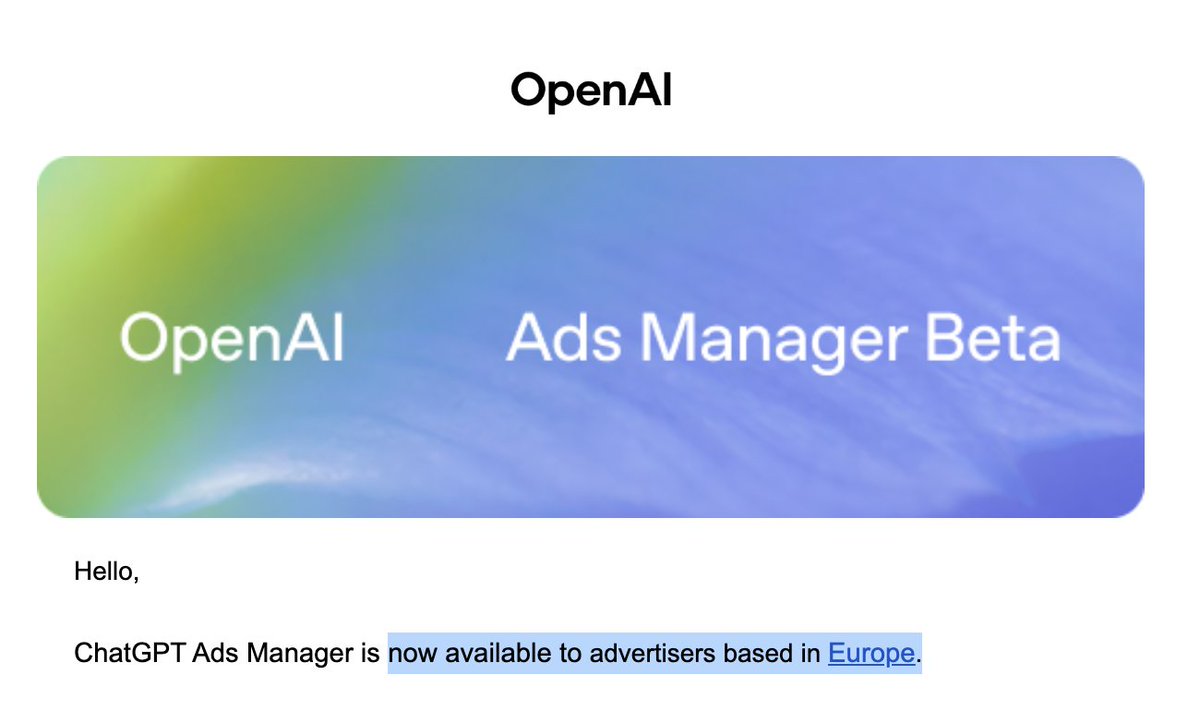
chatgpt just launched ads in 🇪🇺 and here's what my american friends who are winning do:
1. target conversations, not keywords
think about what your customer asks right before buying
"best CRM for a small agency
or
"cheaper alternative to hubspot."
go after buying intent first
focus on prompts like "best X for Y," "X vs Y," "X alternatives," and "recommend a tool for X."
2. make one ad for each problem
don't run generic ads
create separate ads for competitor comparisons, recommendations, pricing and specific pain points.
3. match the landing page to the conversation
if you're targeting
"calendly alternatives for teams"
send them to a calendly comparison page
not your homepage
more relevance = more views
4. steal targeting ideas from competitors
take your top 5 competitors and use chatgpt to generate the questions people ask right before choosing between them and your product.
5. track customers not clicks
add UTMs and use GA4 or PostHog to see which conversations actually turn into signups and paying customers.
6. start with a small budget
test multiple conversation angles with a small budget, kill the ones that don't convert and put more money into the ones that do.
the hack is simple:
figure out what your customer is asking chatgpt five minutes before they're ready to buy.
Most “intent” is third-party: behavior observed elsewhere.
Outbound teams can generate first-party signals from their own content.
Case study read. Pricing checked. Deck reopened a week later.
Not proof they’ll buy. A qualification signal telling you where to focus.
Don't personalize just {{first_name}} and attach the same deck in every email.
Give Claude a 347-row CSV + the HummingDeck API. Every prospect gets their own tracked link to the case study.
Follow up knowing who read what, and who came back.
@Seannywilson Wait, custom tracking domain + open/click tracking off?
If you’re sending any sales collateral (decks, cases), you can track engagement on that instead of opens/clicks.
Host HTML proposals and sales collateral with HummingDeck.
Drop the file. Get a tracked link.
See who opened it, what they read, when they came back, and if they forwarded it.
Email-gated. Bot-filtered. Works with Claude artifacts and v0.
@Founder_Benji Easy: share decks/proposals/white papers and other sales collateral as trackable links with HummingDeck. See who opens page-by-page, who returns and spends reading longer. Qualify based on that.
Cold email outbound is getting harder every year.
The open rate was the SDR's first checkpoint for 20 years. In 2026, it measures almost nothing: open rates climb while reply rates fall.
Three things broke it.🧵
Same path works for ChatGPT canvas, v0, Lovable, Bolt artifacts.
Make it with Claude or your favourite LLM. Ship it with HummingDeck.
Full walkthrough: https://t.co/zRhM1Z9lOH
More founders and sales teams are building decks with Claude Design
You can get a polished, interactive HTML deck in seconds.
The hard part is actually sharing it with an investor or prospect.
Here’s how HummingDeck handles it: drop the .html into HD, get a tracked share link. The artifact renders in a sandboxed iframe with per-slide engagement, click tracking, forwarding inference, and all standard share controls (gate, expiry, revoke, custom domain).
Email blocks the HTML.
Google Drive doesn't render it.
PDF export strips the interactivity.
Deploying to Vercel for a single send is overkill.
The deck is great, how do you distribute it now?
If your team is forecasting on open rate in 2026, it's forecasting on noise.
What broke the metric, why filtering won't save it, what to track instead:
https://t.co/4godmJwALs
Filtering can't save it. MPP, scanners, AI agents all render in legitimate infrastructure.
What still works:
- Reply rate (humans only)
- Time on shared content (bots don't read 4 min)
- Return visits weeks later (bots don't return)
https://t.co/Bm0lCL1SEW tracks the last two.