Meet FetchMan: a vision-based humanoid policy trained entirely in simulation that transfers zero-shot to diverse real-world scenes and objects.
Simulation has produced impressive locomotion policies that transfer to the real world. We wanted to see how far the same recipe goes for vision-based loco-manipulation. More below🧵
The most capable reasoning systems in AI scale inference compute along several axes: sequential compute to think longer, parallel compute to sample many independent attempts, and aggregative compute to synthesize prior traces into a new improved one. But during training, we only optimize how models use sequential compute. This creates a fundamental mismatch between how we ultimately deploy these systems and how we train them, leaving much of search and synthesis unoptimized.
We introduce SPIRAL, an RL framework for making all inference-compute primitives end-to-end learnable: models learn to coordinate sequential, parallel, and aggregative reasoning using only the reward of the final output. Work with @ifdita_hasan (co-lead), @michaelyli_ , @oshaikh13 , @yoonholeee , @DorsaSadigh , @chelseabfinn , @noahdgoodman 🧵
Human-robot interaction requires two-way communication. Robots capable of providing embodied feedback feel more natural and comfortable. Pets are a great example of this.
So @du_maximilian and I built a robot dog running partner! 🐕🏃🏻♀️See thread for cute robot & real pet pics :)
@amberxie_@jenngrannen@DorsaSadigh (7/7) There’s more to explore – currently we are limited to two drums and slower tempos due to arm limits. Scaling to a full setup and real-time speed is an exciting next step!
📄: https://t.co/NNwN73MfSH
🔗: https://t.co/969Tfm2zOC
💻: https://t.co/BHtdIj4qV7
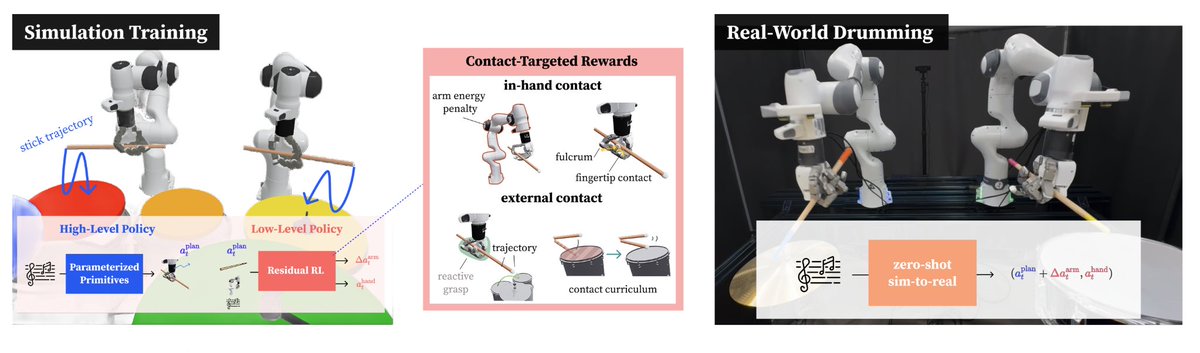
@amberxie_@jenngrannen@DorsaSadigh (6/7) Finger-driven control allows fine-grained control of the stick to follow precise trajectories, while arm-driven control cannot easily achieve such precision.
@amberxie_@jenngrannen@DorsaSadigh (5/7) The low-level policy learns dexterous skills with object-centric rewards and a contact curriculum to handle interactions. The curriculum is designed to first master dexterous skills, then progressively handle contacts, preventing early training failures.
@amberxie_@jenngrannen@DorsaSadigh (4/7) The high-level policy retargets object trajectories for motion planning, while residual RL on the arm enables small corrections crucial for high-dynamics tasks.
@amberxie_@jenngrannen@DorsaSadigh (3/7) Simulation enables scalable data collection, but suffers from a large exploration space. We address this with a hierarchical framework:
- A high-level policy handles long-horizon coordination - A low-level policy handles dexterous control and contact-rich interaction
@amberxie_@jenngrannen@DorsaSadigh (2/7) Learning a drum-playing policy is hard!
- Teleoperating dynamic, contact-rich, in-hand tasks is extremely difficult
- Learning from human demos is also challenging for in-hand, contact-rich tasks
- Planning-based policies struggle with the stochasticity of stick contacts
Introducing HandelBot 🎹🤖, a real-world piano playing robot!
Piano is extremely hard (even for humans!). We take a small but exciting step to replicate this beautiful skill w HandelBot. Our insight is combining sim priors w real world refinement & RL.
w/ @haozhiq@DorsaSadigh
Drumming 🥁 is a rich test bed for dexterous robot finger and hand control! This exciting work was lead by @hungchiehfang who is applying to PhDs this cycle.
We're hoping to have more fun real-world videos soon! (think Smoke on the Water 🤘)
Data collection remains a bottleneck in imitation learning for robotics: it’s tedious & often needs access to a robot. Can we make the data collection process more accessible and engaging? We introduce RoboCade, a platform for gamifying remote robot data collection 🎮🤖
(1/6)
Meet Scanford 📚🤖: a robot that improves foundation models by doing useful work in the wild.
Deployed for 2 weeks in the Stanford East Asia Library, Scanford scans books, helps librarians, and continually improves the VLM it relies on.
🔗 https://t.co/r2ZXyeKaIf
🧵1/8
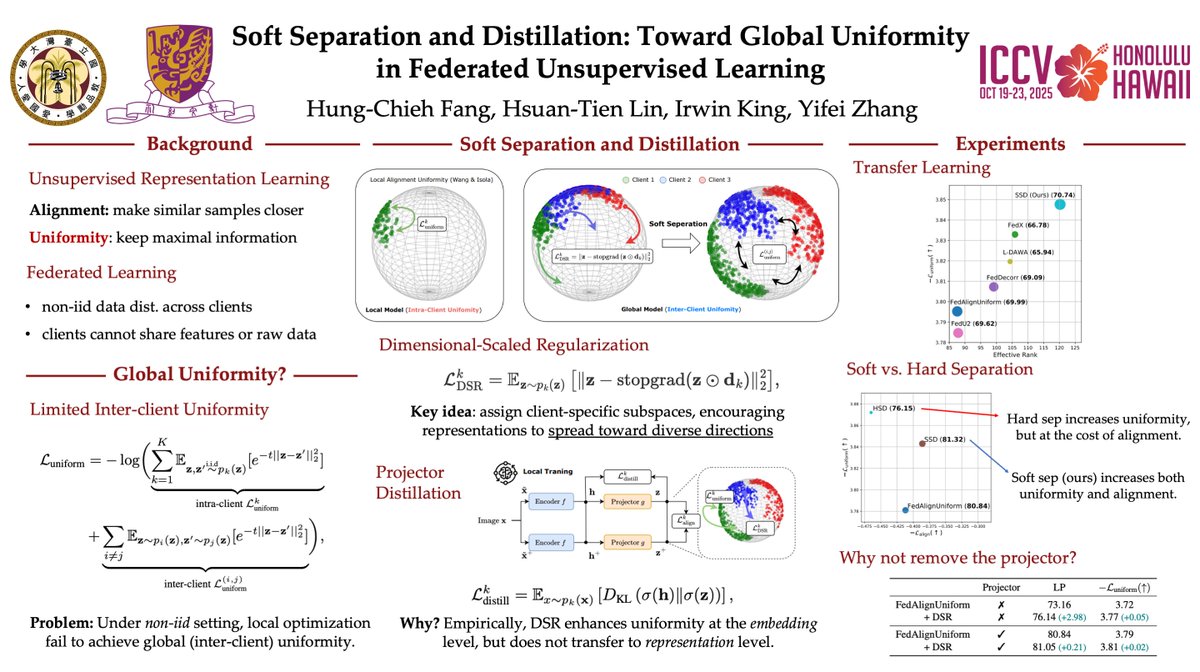
We study how to improve representation generalization in decentralized settings where data distributions are non-IID across clients. Our key idea is to enhance representation uniformity to maximize information through a "soft" regularization term that preserves semantic alignment.
I’m presenting in Hall 1, #274 — feel free to stop by and chat if you’re at ICCV!
Exploration is fundamental to RL. Yet policy gradient methods often collapse: during training they fail to explore broadly, and converge into narrow, easily exploitable behaviors. The result is poor generalization, limited gains from test-time scaling, and brittleness on tasks where strategic exploration is necessary. We introduce a framework for training a policy over sets of generations and use it to induce exploration.
Work with @ifdita_hasan (co-lead), @ellenjxu_ , @chelseabfinn and @DorsaSadigh at Stanford 🧵
Introducing Importance Weighted Retrieval, a simple modification to existing retrieval methods! Our importance sampling inspired approach helps us more effectively retrieve from prior datasets for few shot imitation learning!
#CoRL2025 Oral w/ Rahul Chand @DorsaSadigh@JoeyHejna
Kicking off #RLC2025 with our Workshop on Programmatic Reinforcement Learning! This workshop explores how programmatic representations can improve interpretability, generalization, efficiency, and safety in RL.