@xidulu@JohnCLangford Is there a better approach than sampling different numbers of passes? For instance, recurrently training on a fraction of data in a decoding-like manner.
The former still leaves a train-inference gap, while the latter keeps all inference scenarios in-domain.
1/ Sharing a new, interesting project I did during my internship at Microsoft AI Frontiers w/ @JohnCLangford
TL;DR: At decoding time, we feed **previous hidden state** into the input together with token embedding, and it boosts performance for free.
https://t.co/za3cZ4UwWV
SWE-Master: Unleashing the Potential of Software Engineering Agents via Post-Training
SWE-Master is an open-source and reproducible post-training framework for building strong software engineering agents, covering data synthesis, SFT, RL, and TTS.
📑 https://t.co/c4aOej5gZl
New preprint: "ClawGym: A Scalable Framework for Building Effective Claw Agents"
TL;DR: ClawGym is the first unified framework for large-scale data construction, capability training, and reliable evaluation of Claw Agents.
📑https://t.co/KjeUFGX3vS
💻https://t.co/osgirkifw5
Introducing "Towards Long-horizon Agentic Multimodal Search"
TL;DR: LMM-Searcher is a multimodal search framework that leverages a file system to manage visual context, enabling effective scaling to 100-turn interactions.
📑https://t.co/bR2pdl5Fip
💻https://t.co/RQXVmsg1B9
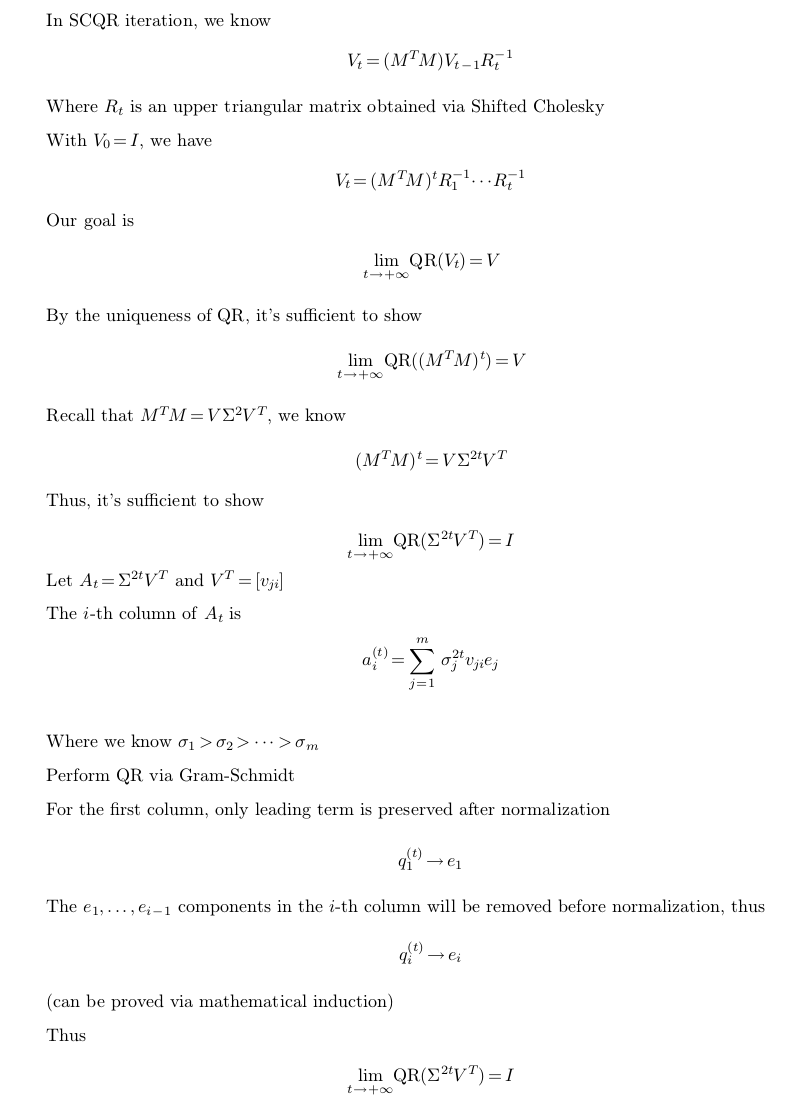
Inspired by @Jianlin_S , I found a better proof for the convergence (to SVD) of the iteration in this blog.
It turns out that ALL intermediate iterations are just preconditioners for the final QR.
The TurboQuant paper (ICLR 2026) contains serious issues in how it describes RaBitQ, including incorrect technical claims and misleading theory/experiment comparisons.
We flagged these issues to the authors before submission. They acknowledged them, but chose not to fix them. The paper was later accepted and widely promoted by Google, reaching tens of millions of views.
We’re speaking up now because once a misleading narrative spreads, it becomes much harder to correct. We’ve written a public comment on openreview (https://t.co/nDVjmNhATM).
We would greatly appreciate your attention and help in sharing it.
Large Language Models (LLMs) exhibit “slash patterns” in attention maps — a key mechanism behind prefilling acceleration.
We take a first step toward understanding why they emerge.
Main findings:
▶️ Slash patterns are OOD-generalizable
▶️ Queries and keys on these heads are near rank-one and carry little contextual information.
▶️RoPE is the primary source of the slash pattern.
Blog link:
https://t.co/uhE3y7i5xW
A thread 🧵
A fundamental solution to LLM training instability: Spectral Sphere Optimizer (SSO)
Design an optimizer fully from μP principles.
Outperforms AdamW and Muon on Dense 1.7B, MoE 8B, and 200-layer DeepNet
Paper: https://t.co/ODVW4FC3R5
Code: https://t.co/zFaXi2YpkS
5/
Incentives matter too.
Why should people share compute, bandwidth, or sensor data with robots?
Web3 offers tokens, DAOs, and marketplaces—basically, ways to align strangers around a shared machine economy.
4/
Then comes coordination.
Swarm robots, supply chains, logistics.
Smart contracts could be the neutral “rules of the game,” avoiding dependence on one company’s servers.
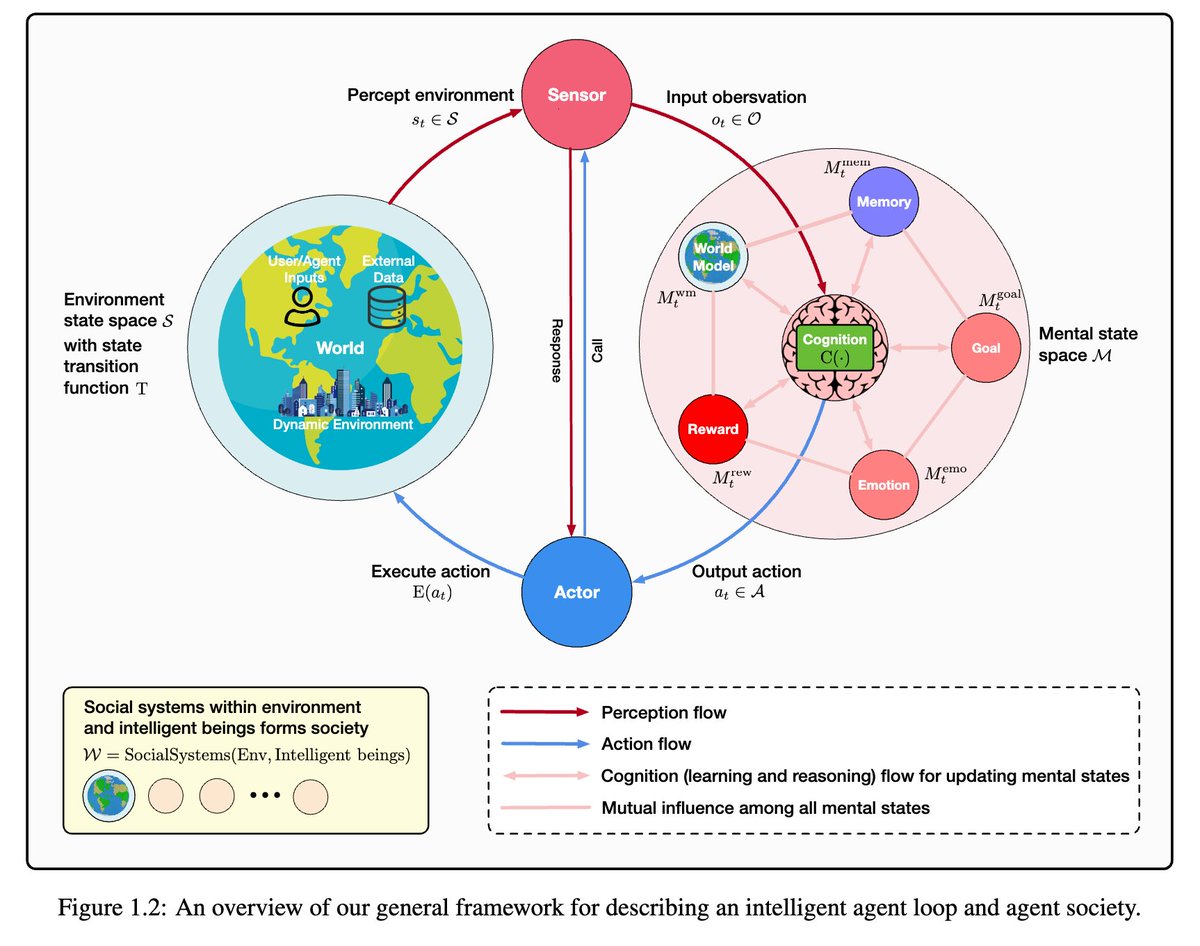
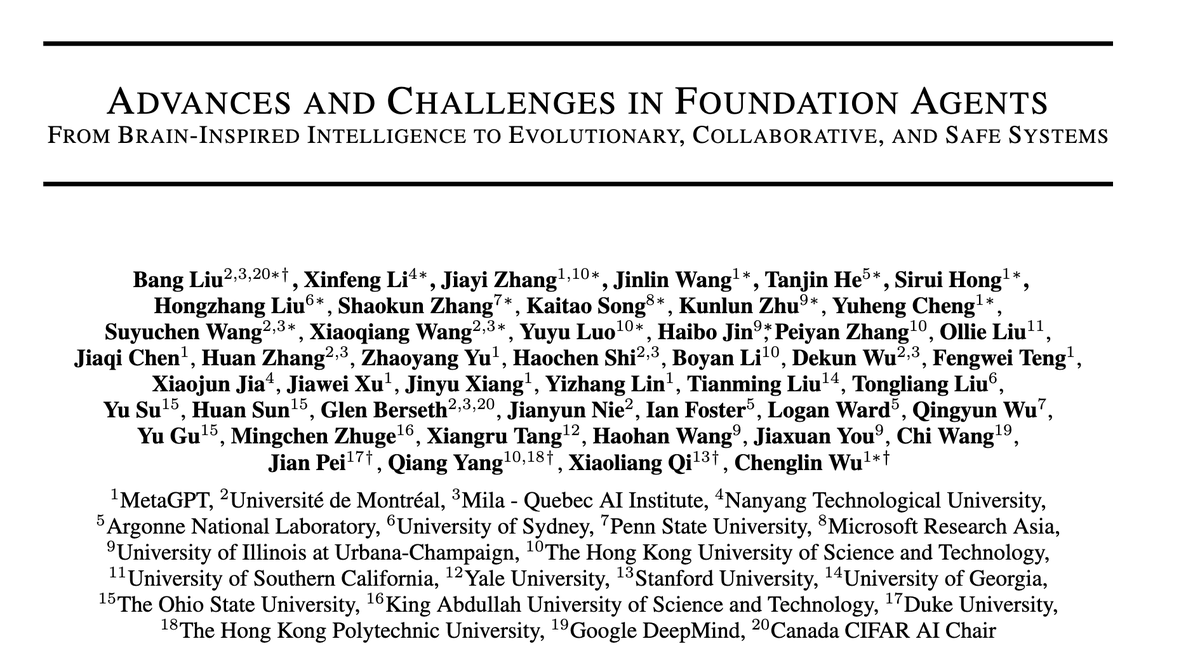
🧠264 pages and 1416 references chart the future of Foundation Agents.
Our latest survey dives deep into agents—covering brain-inspired cognition, self-evolution, multi-agents, and AI safety.
Discover the #1 Paper of the Day on Hugging Face👇:
https://t.co/CvtqGKyCYb
1/3