I am being careful but I think this needs to be said:
Proper definition of a perma bull.
Stock drops from $130 to $110.
"This is bullish. We're buying."
Drops to $90
"We're buying more"
Drops to $70.
"Even better opportunity."
Drops to $50
"This will be a historical dip"
Keeps falling all the way to $47, with barely a bounce along the way.
Then when finally bounces to $60 and suddenly it's "I told you so."
Come on.
$ASTS is down 65% from its highs. You can't ignore that kind of damage and pretend everything is perfectly fine because the stock finally bounced.
The market is clearly questioning the company's fundamentals, and the technicals have broken down.
That doesn't mean the company can't recover. But it also doesn't mean every dip is a buying opportunity.
It's perfectly fine to change your view on a company. It's perfectly fine to say, "I still like the business, but I'm going to wait for the stock to find a bottom before revisiting it."
You don't have to defend a stock all the way down just because you were bullish at $130 down to $70.
$ASTS is just one example. This happens on hundreds of stocks every year. And you've gotta protect yourself from being in these shituations.
Please understand this.
Easiest buy of 2026: $MSFT
Fear was everywhere. Negativity was at its peak.
Since then, shares are up roughly 50%.
This is why these two are Charlie Munger’s best lessons:
"The big money is made when you can stay rational while everyone else is emotional"
"If all you ever did was buy high-quality stocks on the 200-week moving average, you would beat the S&P 500 by a large margin over time." - Charlie Munger
Don’t forget these. Ever.
Let’s put the words back in context.
$AVGO and $INTC CEOs didn’t say more than what we already knew.
They were grilled on hard questions and answered as expected. Yes, demand is massive. Yes, supply stays tight for years. Yes, AI demand keeps growing.
On the future, they told the truth: the shortage will shift over time, companies need ROI to justify AI spend, and funding will be the critical factor to get there.
No cash, no hardware. No hardware, no ROI.
They never said capital is hard to find. They said it will be critical for it to keep flowing.
Is that new? No - see repost.
We’ve already seen $AAOI and $IREN tap the market with ATMs, $META and $AMZN ramped up bonds and $GOOG already offered new shares this year, the first mega cap to do so.
Companies are turning to the markets because private funding aren't enough/getting slimmer and bank debt is out of the question with interest rates.
We knew all of this. We just heard it from an insider for the first time.
Now, let’s start earnings season.
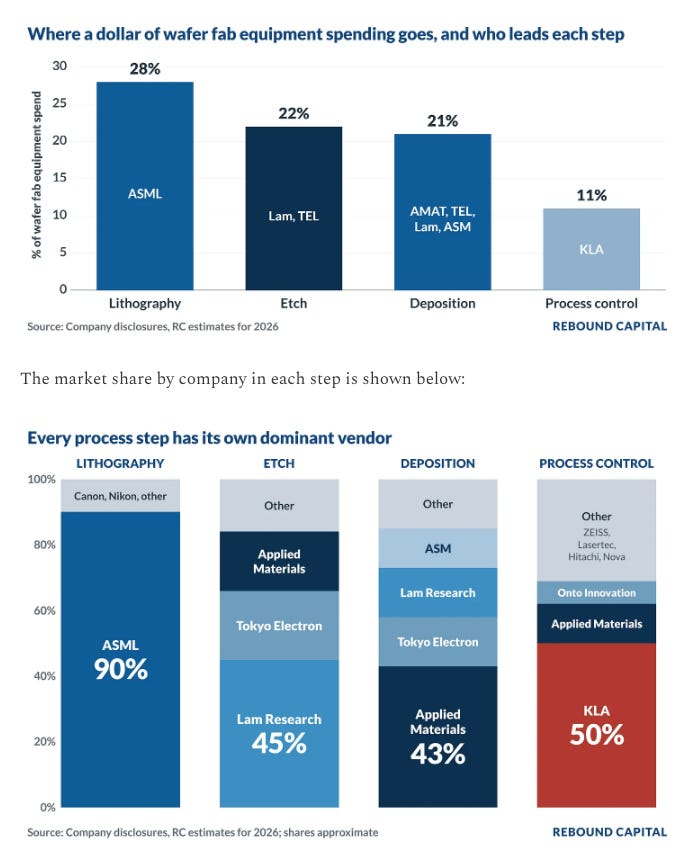
4 Companies form the backbone of semiconductor manufacturing:
1) ASML in lithography
2) Lam Research in etching
3) Applied Materials in deposition
4) KLA Corp in process control
Each company dominates its segment. The market knows this. All four trade at 26-31x NTM Earnings. Not cheap.
The issue may be the earnings number itself. Equipment spending is cyclical, and if AI growth slows, this may mark a local earnings peak.
Simply put, the market is already pricing in years of perfect execution and blow-out earnings. That’s why minor jitters cause double-digit drawdowns in these stocks.
We modeled all four companies to determine the price at which they would become value plays. Only one company is remotely close.
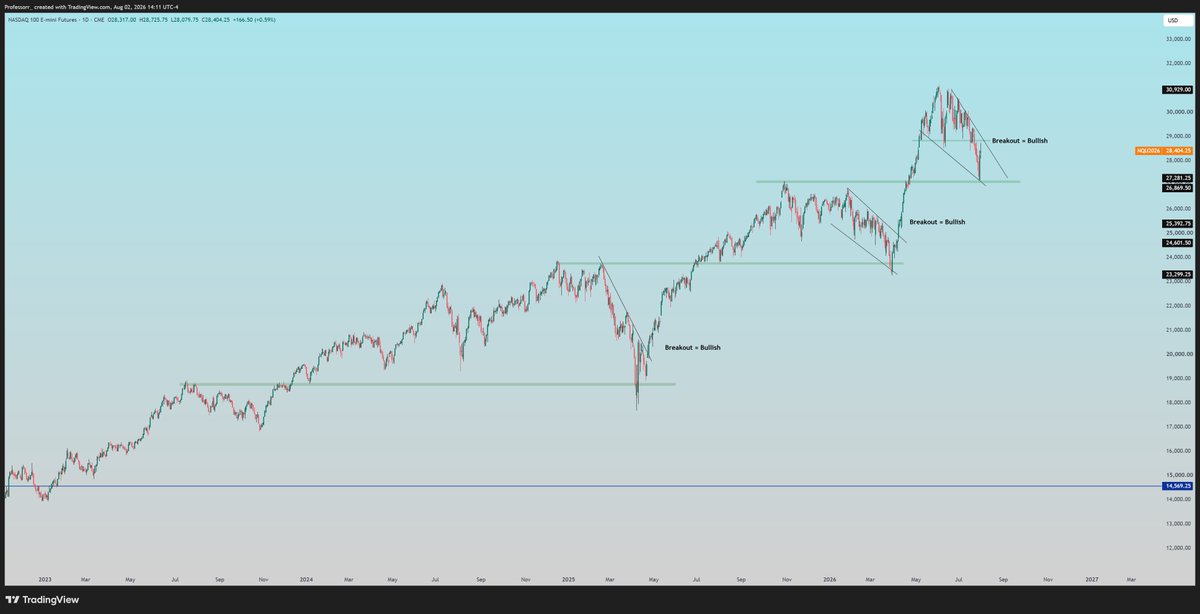
Let me share the one chart that will keep you on the right side of any market.
1. Let price reach a strong support
2. Draw a downtrend line
3. And get involved when price clears the DTL
You've gotta be comfortable to miss out on the exact bottom. The price of being right is usually higher
$QQQ $SPX $SPY
OH. MY. GOODNESS.
CITADEL HAS BOUGHT A MAJORITY OF THE PUBLIC ASSETS FROM LEOPOLD'S SITUATIONAL AWARENESS FUND.
So...Citadel scares everyone on Tuesday about a surprise rate hike during FOMC that WE ALL KNEW was not going to happen...
On Wednesday, the entire market freaks out about the rate hike which causes the selling to compound on itself creating 50-70% drawdowns across the board in high beta semicondcutor names...
Which means Leopold who we now know had $45B of assets and was 400% LEVERED ends up being the sacrifice as he gets liquidated at what theoretically could be the bottom due to not having the margin requirements to keep solvent...
AND THE PERSON WHO CAUSED THE SELLOFF WITH THE RATE HIKE FEARS ENDS UP COMING IN TO BUY HIS ASSETS FOR 40 TO 50 CENTS ON THE DOLLAR.
By the way, Leopold is getting married this weekend. I think he wanted to make sure he wasn't getting margin called during his wedding.
A vet on wall street in Ken Griffin takes out the young new kid.
ABSOLUTE. CINEMA.
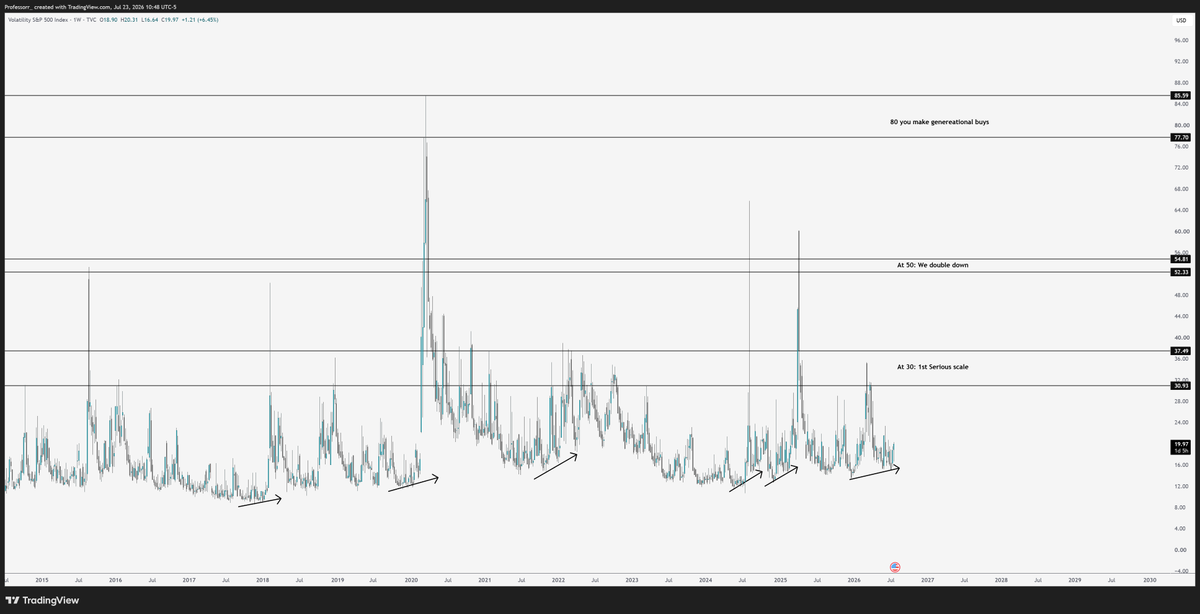
VIX guide to make best decisions.
At 30: You start smiling
At 50: You say work overtime
At 80: You buy and go away for a month
If you're serious about Investing. Now is the best time to look at this VIX chart.
Every year we get few pops to 30
Every few years we get a pop to 50
Every five years or so we get a pop to 80
You will see this play out over and over.
The finance community on this platform has a massive credibility problem.
The exact same people who shilled zero-revenue junk stocks at all-time highs as "generational buying opportunities" are doing it again today.
The stock has crashed 70% to 80% since their first alert, the financials are completely broken, earnings are deeply negative, and they are still calling it a "generational buy."
It is a trap. They are masking basic wealth destruction as long-term investing, and it leaves retail traders holding permanent bags.
As a professional, your criteria for a trade and a long-term investment must be completely separate:
1. Trading junk is fine. I will trade an unprofitable business all day long—as long as the technicals support the momentum. You play the wild trend, take your profits, and get out while you are green.
2. Investing is a completely different ballgame. You do not buy zero-revenue companies for the long haul. True investing requires real revenue, deep liquidity, and institutional-grade financial health.
This is exactly why 90% of my posts here are trading-focused. My goal is to help you extract cash from these wild market moves without ever letting a short-term trade turn into a permanent, devastating drawdown.
If a company has zero revenue, you trade the tape. You never marry the stock.
This is a very simple way to make millions in the stock market. Make sure you save this for your notes.
Most traders lose money the same way:
- You see a stock down 30% and think it's cheap. You buy the dip. It dips more. You buy again. It keeps falling.
- That's not buying the dip. That's catching a falling knife.
Here's what to do instead:
1. You never buy a downtrend. A stock falling is falling for a reason. The reason doesn't matter. The trend does.
2. You wait for the accumulation zone. This is where the stock stops making new lows. It trades sideways depending on the timeframe. Volume dries up. Nobody is talking about it anymore. That's the setup.
3. You then start buying in the accumulation zone. Not before. Not during the downtrend.
If you're stuck in a downtrending stock, buy more once you see accumulation start to happen.
Only buy DURING and AFTER the base is built. Not before.
This is all you need to do to make millions in the stock market. Save this. Screenshot it. You will need it.
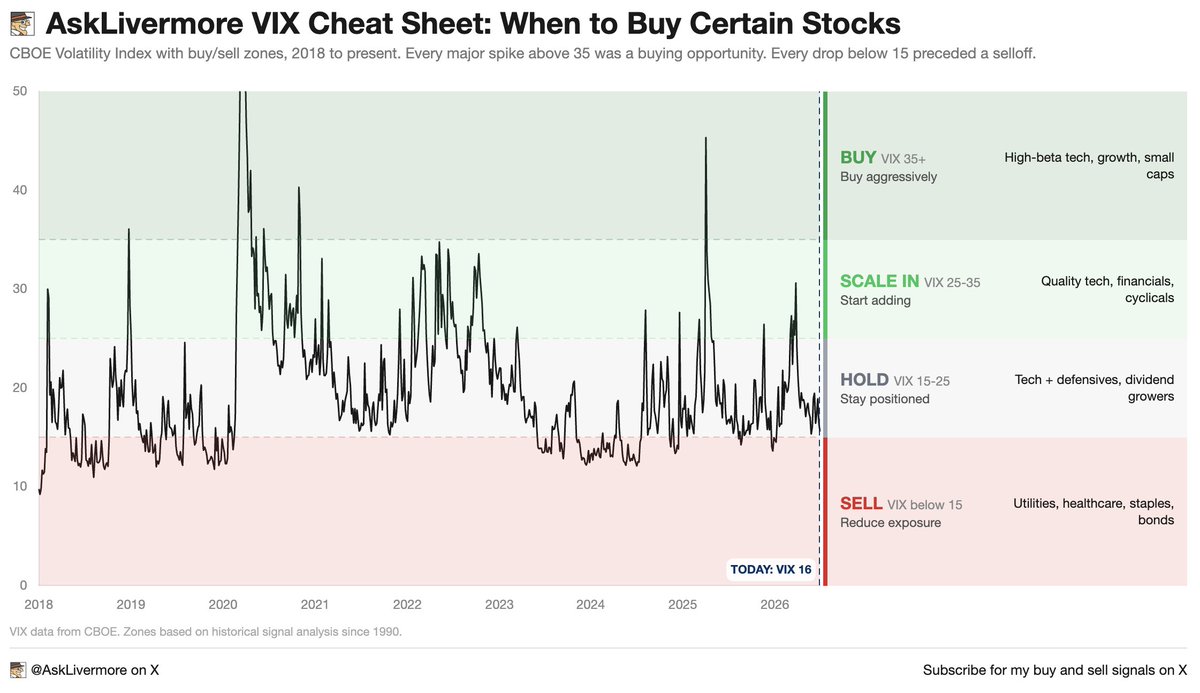
1. VIX above 35: buy aggressively
- High-beta tech, growth, small caps
- Every single time the VIX spiked above 35 since 2018 was a generational buying opportunity. COVID bottom. Oct 2022 bottom. Tariff crash. If you bought when everyone else was panicking, you made a fortune.
2. VIX 25 to 35: start scaling in
- Quality tech, financials, industrials, cyclicals
- This is where smart money starts building positions. Not all at once. Gradually. The fear is real but the opportunity is bigger.
3. VIX 15 to 25: hold
- Balanced: tech + defensives, dividend growers
- This is normal. Stay positioned. Don't chase, don't panic. Let your winners run.
4. VIX below 15: reduce exposure
- Rotate to: utilities, healthcare, staples, bonds
- This is when everyone is comfortable. Nobody is hedging. Nobody is worried. That's exactly when you should be.
- Every major crash in market history was preceded by the VIX sitting below 15 for weeks.
Right now the VIX is at 16. We're in the hold zone. Stay positioned but stay alert.
Bookmark this. The next time the VIX spikes above 35, don't freeze. Buy.
THIS DOCUMENT FROM ANTHROPIC WILL LITERALLY GET YOU PROMOTED
> the fastest way to reach a senior position is to automate your current job
this technical paper shows how to encode your daily workflows into Claude
build custom "Skills" to force the AI to do the heavy lifting:
> package your routines into automated folders
> the agent executes your tasks flawlessly in the background
> it connects directly to your local tools via MCP servers
hand off the junior work to the agent and easily claim your promotion
grab the exact blueprint right here 👇
Healthcare is not the endgame. It's just Phase 1.
This is the rotation playbook for the next 18 months.
Most of you are looking at healthcare right now and wondering if it's too late.
It's not. Healthcare has been the most consistent sector in midterm election years for 30+ years. 80% win rate in the back half. That's the most reliable sector pattern in modern market history.
Here's what you need to know:
- 22 healthcare companies beat the S&P 500 in 75%+ of midterm years from 1994 to 2022.
- Zero of them underperformed.
But the real money isn't just in healthcare. It's in knowing WHEN to leave healthcare and where to go next.
The mistake most traders make is they ride healthcare all the way through 2027 and miss the bigger move.
- Year 3 of the presidential cycle is the strongest year in the entire 4-year cycle. Average return since 1933: +17.2%. Positive 90% of the time.
And it's NOT healthcare that leads Year 3. The leaders flip completely.
2026-2027 playbook:
Phase 1, July to November 2026: Heavy in healthcare. Add defense. Staples, utilities.
Phase 2, November to February 2027: Start trimming healthcare. Build tech and financials slowly.
Phase 3, February through end of 2027: Full risk on. Tech, financials, consumer discretionary lead the move.
Average gain from midterm year low to Year 3 high: +46.9%.
Healthcare names I'm watching: $LLY $UNH $ABBV $MRK $AMGN $TMO $DHR $SYK $DXCM $IDXX $HCA $PODD
ETFs to look at: $XBI $LABU $ARKG $GNOM
This is your roadmap.
My dear followers.
Get READY for July, SURVIVE September, and ride the October-November move for 2026.
Here's how every sector PERFORMS month by month during MID-TERMS and what it means heading into July.
July:
- the BROADEST strength of the entire back half
- every single sector finishes POSITIVE
- tech, energy, and consumer discretionary lead with +4% moves
August:
- the rally STALLS
- half the sectors turn NEGATIVE
- biotech $XBI is the standout at +4.52% while energy $XLE and materials $XLB fade
September:
- this is the month to be CAREFUL
- nearly every sector DIPS
- utilities $XLU and real estate $XLRE get hit hardest
- if you're adding exposure, this is where you WAIT
October:
- the TURN
- STRENGTH comes back almost everywhere
- staples $XLP LEAD at +3.91%, but even the LAGGARDS catch a bid.
- this is historically where the midterm LOW gets put in.
November:
- CONTINUATION
- materials $XLB rip +4.57%. industrials $XLI +3.79%. the cyclicals take over
December:
- profit-taking
- almost every sector gives BACK
- tech DROPS -3.45%, energy -3.01%
- the back half rally takes a BREATHER before the post-midterm year kicks in
A lot of traders have setups. But they do NOT know the timing cycles.
I will always make sure you're STEPS ahead of everyone else.