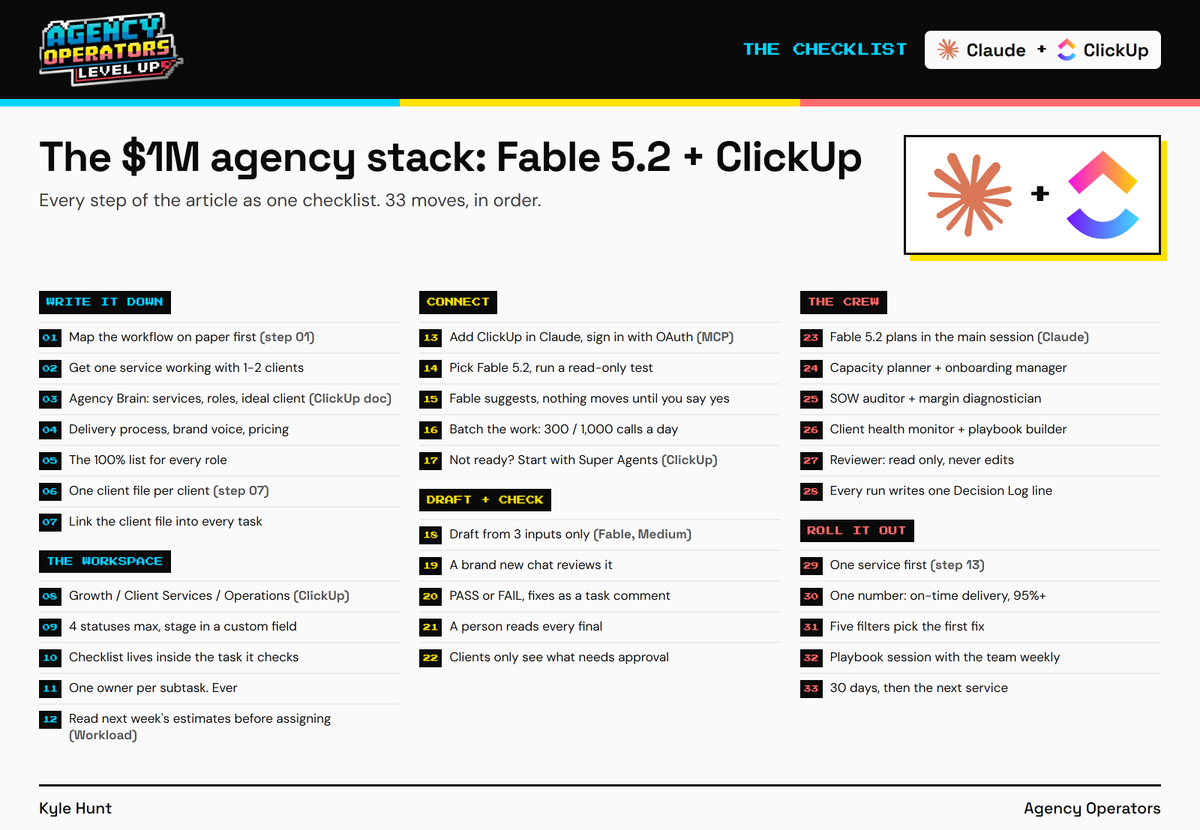
How I'd run a $1M agency without being the bottleneck, every step (Fable 5.2 + ClickUp):
1. Write the process down before any AI touches it. Map one service on paper first
2. Get that one service working with 1-2 clients before you automate anything
3. Not ready for Claude yet? Start with ClickUp's own agents (Super Agents). Give one instructions, the tools it can touch and a trigger
4. Let one agent summarize every call and turn the action items into subtasks (Zapier drops the transcript in)
the setup
5. Connect ClickUp to Claude. One line in Claude Code, or Connectors in the Claude app. It signs in with OAuth, so there's no key to find
6. Pick Fable 5.2 as the model and run a read-only test first. It maps your workspace and can't break anything
7. Fable suggests every change. Nothing gets created or moved until you say yes
8. Your plan caps MCP calls (300 a day on Unlimited, 1,000 on Business), so batch the work
the departments
9. Split the work like a real team. One chat doing every job forgets the client's rules halfway down
10. Fable 5.2 plans in the main session and hands each job to a department built for that one job
11. Capacity: reads next week's estimates and flags who's overloaded
12. Onboarding: turns a signed SOW into week zero tasks
13. Scope: grades last week's delivery against every SOW. Pass, fail or missing
14. Margin: finds where hours run past the contract
15. Client health: spots late approvals and quiet clients
16. Playbooks: turns repeat fires into playbook edits
17. Review: read only. Checks drafts, never edits them
18. Every department writes its result back into ClickUp. Nobody copy-pastes between chats
19. You step in at two points: before a client sees anything, and before anyone's hours or price change
the workspace
20. Three spaces: Growth, Client Services, Operations. One folder per client
21. Four statuses per list, max: To Do, Doing, Blocked, Done. The stage goes in a custom field
22. Every checklist lives inside the task it checks. Put it in a separate doc and nobody opens it
23. Every agent run gets one line in the Decision Log. When something breaks on a Friday, you know which agent did it
the brain
24. One universal brain doc every agent reads first (ClickUp Docs)
25. Ask every role one question: "What is 100% of the information you need?"
26. Fill it in: services, team roles, ideal client, delivery process, brand voice, pricing
27. If a role can't answer that question, that role will keep guessing
the client hub
28. One file per client: send context, target customer, past learnings, offer, brand guardrails, compliance, message order
29. Fable fills it from the SOW and 90 days of task comments. Gaps come back as questions, never guesses
30. A new service gets its own file. Paid social and email need different inputs
31. The exact same file goes into every brief for that client
32. No real brief? That's a systems failure you built
the work
33. Every deliverable becomes one parent task and one subtask per stage
34. No subtask gets two owners. Ever
35. Before anyone gets assigned, Fable reads next week's estimates. You see who's on 60 hours and who's on 12 (Workload view)
36. Fable drafts from three things only: the client file, the task and the checklist
37. A brand new chat reviews every draft. It never saw it get made, so it can't grade its own homework
38. Medium effort for drafts. High for the weekly plan and the review
39. A person reads every final before the client does
the client
40. Clients see what needs their approval. Everything else stays off their screen
41. Weekly update under 150 words, no internal task names
42. Pull the last 10 closed tasks per role and find the context that was missing
the rollout
43. One service, one number: on-time delivery. 30 days, then the next service
44. Pick the first fix with five filters: no waiting on anyone, doable this week, small, free or near free, hits the root cause
45. Every Friday the playbook department drafts edits from the week's fires. The person who does that work approves them
All of this is almost stupidly simple. Doing it is the hard part.
I've left the copy-and-paste prompts for every step in this article ↓
Why you should probably fire your best employee:
An agency owner I work with was about to give his best employee equity.
Then we looked at who actually made the calls. Her name was on about 80% of the decisions in the business.
I get why that felt like loyalty. It was a structural problem.
If she gets sick, quits or takes a month off, the agency stops.
So I told him to fire her from that job:
- Write down the decisions she makes every week
- Turn each one into a playbook someone else can run
- Give every client an owner who isn't her
- Let her approve the playbooks, not every task
Then give her the equity.
Your best person should own the system, never be the system.
@its_ronc Someone still needs to own the follow-up when an invoice goes overdue. Easy for it to sit there while everyone assumes someone else is chasing it.
Making the most profitable one-person agency comes down to 49 things:
the pricing
1. Pick one service and one kind of client before you add a second
2. Price from your P&L, never from what competitors charge
3. Set a floor price and stop selling under it
4. Aim for 60-70% gross margin per pod
5. If your close rate is above 40%, you're probably too cheap
6. Move legacy clients up over 60 days: reprice, rescope or sunset
7. Put an overage rate in every contract, and actually charge it
8. Charge more when a client wants off autopay. Chasing invoices is a cost
9. Model a hire before you make it. Watch what it does to your margin
the clients
10. Check gross margin per client every month, never just the blended number
11. Expect 10-20% of clients near or below zero margin. Reprice them or replace them
12. Track hours against every contract. Scope creep hides in plain sight
13. A client 60 days behind on payment is a client you're financing
14. Small clients cause most of the problems. At WKND they were 80% of ours, so I shut that division down
15. One client file per client, linked into every task (ClickUp)
16. Clients see what needs their approval. Everything else stays off their screen
the team
17. Build pods. Every client gets an owner who isn't you
18. A good pod lead can run 8-10 accounts
19. One owner per task. Ever
20. Write down the decisions your best person makes, then turn them into playbooks
21. Hire the role the math requires, never the one that feels urgent
22. Two people at $45K can cost you more than one at $75K
23. Give a new hire more than 15 minutes of welcome. I've watched A-players leave over it
24. Build every playbook with the people who do the work
the ops
25. Four statuses per list, max: To Do, Doing, Blocked, Done (ClickUp)
26. Every checklist lives inside the task it checks
27. Hold revisions under 10%. Most agencies I work with run 50-100%
28. Most revisions come from the brief, not the team. Fix the brief first
29. Track every client fire. About 80% of the ones I've tracked were preventable
30. One number for delivery: on-time rate. My bar is 95%+
31. A daily, weekly and monthly tracker, so a fire shows up before the damage does
32. A 13-week rolling forecast, never a flat line of this month's MRR
the AI
33. Write the process down before AI touches it
34. Connect ClickUp to Claude (MCP) and let Fable 5.2 plan the week
35. One universal brain doc that every agent reads first
36. One department per job: capacity, onboarding, scope, margin, client health, playbooks, review
37. A brand new chat checks every draft, so nothing grades its own homework
38. Export your revision comments into Claude and ask for the top reasons. The pattern shows up fast
39. A person reads every final before the client does
40. Use AI to kill busywork, never judgment
the founder
41. Audit your own calendar for one week. I've seen founders spend 3% of it on strategy
42. Got 12 things to optimize? Ignore 11 of them
43. Get yourself out of account management
44. Ask yourself: if I disappeared for 30 days, what would break?
45. Keep a Decision Log, so you know who decided what and when
the loop
46. Every Friday, turn the week's fires into playbook edits
47. Every month, rank clients by margin. Fix one, replace one
48. Put the hours you get back into client work, or you just bought someone a longer lunch
49. Run it lean for as long as you can. My first solo year did $382,428 at 87% margins
Write it down and price it right. Then let the agents run it.
This is EXACTLY how I'd build one from zero.
@jasonfromjeeves Yep, the agency still has to pay the platform while it's waiting on the client. That payment timing needs to be clear before the spend starts.
Things I find on agency founders' calendars:
- 3 client emails approved, 2 hiring decisions, 4 timelines reviewed. In one week, at $1.8M
- 3% of the week on strategy ($2M founder)
- 15+ hours a week of "small" work ($3.4M founder)
- 19 hours a week on unqualified calls and follow-ups
- 47 unread messages before 9am
- One person's name on about 80% of the decisions
- "When do you work on the business?" "Nights and weekends."
- The same top priority for 6 weeks straight
- Still doing account management, like a human switchboard