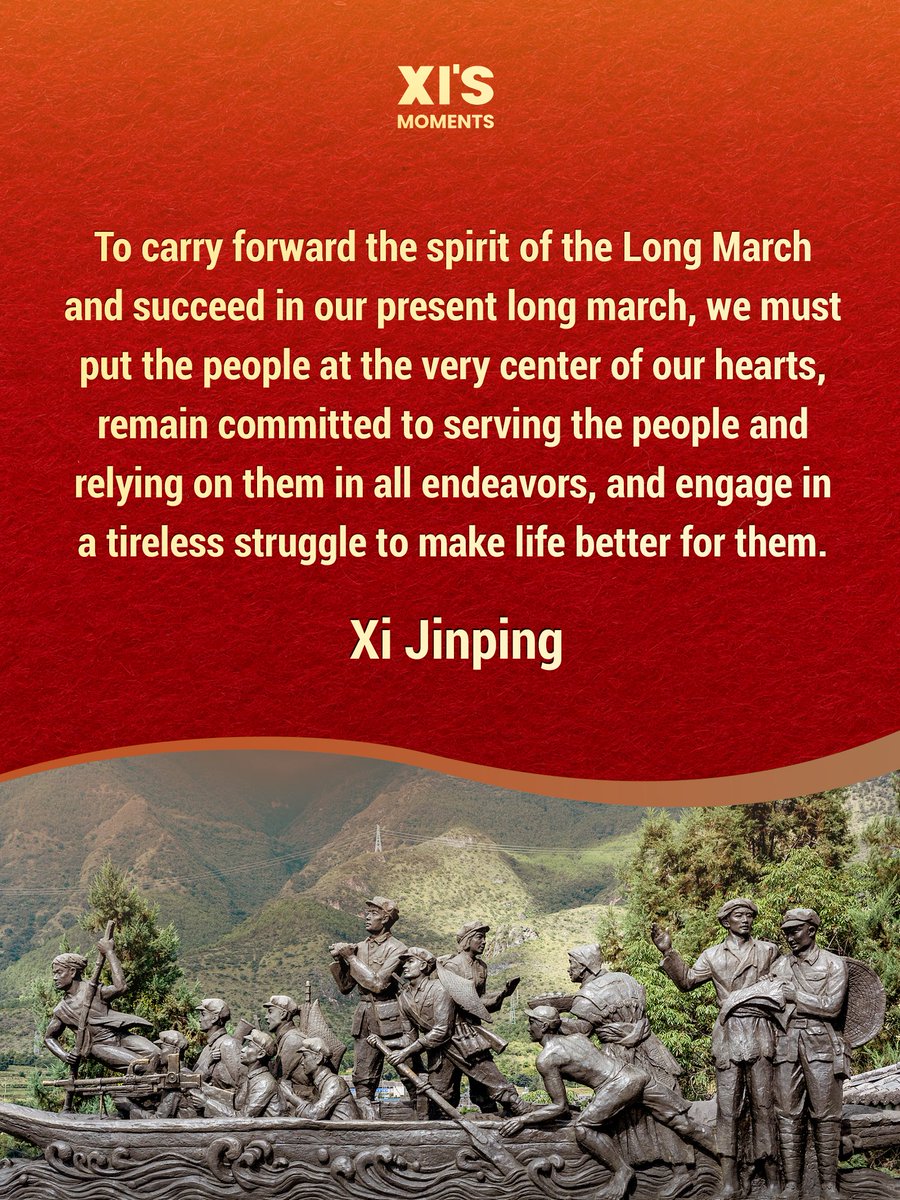
As China marks the 90th anniversary of the victory of the #LongMarch, let's revisit some of President Xi Jinping's remarks on its enduring spirit and the importance of carrying it forward. (3)
#XiJinping#XiQuotes
Learning from the Past: State Governance in the New Era through the Lens of the Zizhi Tongjian
Editorial note: In accordance with the editorial instructions, all references to "General Secretary" have been rendered in the first person ("I"), following the convention of a formal address; every classical allusion is annotated with its precise source (text, volume, date); the Chinese text has been polished; an English translation is provided in parallel. Throughout this text, "I" refers to the speaker himself.
I. Opening: The Partition of Jin by the Three Families, and the Primacy of Discipline and Order
The Zizhi Tongjian opens with its first great event: the partition of the state of Jin among the three families. In recording this, Sima Guang was not narrating a transfer of power; he was writing about titles and order—when rites and music fall into decay, the world falls into chaos. In his commentary "Chen Guang yue" ("Your servant Guang observes"), he states plainly: "I have heard that nothing under Heaven is greater for the Son of Heaven than ritual; nothing in ritual is greater than the proper station; nothing in station is greater than the correct title." The essence of ritual lies in this: the bonds of hierarchy are never broken, and ranks are never usurped.
[Sources] "The partition of Jin by the three families" and the commentary "Chen Guang yue" are found in the Zizhi Tongjian, vol. 1, Zhou Annals I, 23rd year of King Weilie (403 BC); "Chen Guang yue" is Sima Guang's own historical commentary. "Rites and music fall into decay" derives from the Analects, "Yang Huo."
Applied to our own day, this is the fundamental principle of upholding the Party's overall leadership. Across the 1,362 years it chronicles, the Tongjian proves the same truth again and again: once the bonds of order are loosened, no state, however strong, can hold together. The "Two Upholds" and the centralized, unified leadership of the Party Central Committee are not abstract slogans; they are iron laws distilled from a millennium of order and chaos.
[Sources] The Zizhi Tongjian covers the 1,362 years from 403 BC to AD 959. The "Two Upholds" mean resolutely upholding the authority and centralized, unified leadership of the Party Central Committee, and resolutely upholding the core position of the Party's leader in the Party Central Committee and in the Party as a whole.
II. Zisi Recommending Gou Bian: the Distinction Between Talent and Virtue, and the Priority of Appointments
The second episode: Zisi recommending Gou Bian. The Marquis of Wei refused to employ Gou Bian because, years before, as a minor official collecting taxes, he had taken two eggs from the people. Zisi replied: when a sage employs men, it is as when a skilled craftsman works with timber—he takes what is serviceable and sets aside what is not. Even a towering catalpa, thick enough to be embraced, though it has a few feet of rot, is not cast away by a master carpenter. How, then, could a man fit to shield the state be discarded over two eggs?
[Sources] Zizhi Tongjian, vol. 1, Zhou Annals I, "Zisi speaks of Gou Bian to the Marquis of Wei." Original text: "The sage's employment of men is like the craftsman's use of wood: he takes what is good and sets aside what is flawed; even a great catalpa with a few feet of rot is not rejected by a good craftsman."
This is precisely the logic of selecting and appointing officials in the new era. Sima Guang declares in the Zizhi Tongjian: "In the art of governance, nothing takes precedence over the selection of men"; and on talent and virtue he writes: "Talent is the vehicle of virtue; virtue is the commander of talent." The distinction between the two runs through the entire work. Today's requirements of "loyalty, integrity, and responsibility" and the "Three Distinctions"—which separate errors made in the course of pioneering reform from deliberate violations—have their roots here.
[Sources] "In the art of governance, nothing takes precedence over the selection of men; and the way to know men is a difficulty even for sages" — Zizhi Tongjian, Wei Annals V. "Talent is the vehicle of virtue; virtue is the commander of talent" — Zizhi Tongjian, vol. 1, Zhou Annals I, Sima Guang's discussion of talent and virtue.
III. The Water That Carries the Boat: the People as the Root of the State
The third episode: Emperor Taizong of the Tang dynasty and "the water that carries the boat." The Tongjian records Wei Zheng remonstrating with Taizong, urging again and again that "the people are the root of the state." Taizong himself said: "Water can bear the boat, and it can also capsize it." Light corvée, modest taxes, letting the people rest and recuperate—a golden age was never built by harsh laws alone.
[Sources] "Water can bear the boat, and it can also capsize it" derives from the Xunzi ("Duke Ai"): "The ruler is the boat; the common people are the water. The water bears the boat, and the water capsizes it." Wei Zheng cited it to admonish Taizong; see Zizhi Tongjian, Tang Annals, and Zhenguan zhengyao ("The Essentials of Government of the Zhenguan Reign"), vol. 1, "On the Essentials of Government." "The people are the root of the state; with the root firm, the state is at peace" — Book of Documents, "Songs of the Five Sons."
This is the historical resonance of the people-centered philosophy of the new era. "The land and rivers are the people, and the people are the land and rivers." The fight against poverty, common prosperity, whole-process people's democracy—the ancient words "the people are the root of the state" have today found a more solid footing than ever before.
[Sources] "The land and rivers are the people, and the people are the land and rivers" — from the address at the Party-wide Campaign on History Learning and Education, February 20, 2021.
IV. "To Correct One's Faults Is True Ability": Self-Revolution and the Preservation of the Original Aspiration
The fourth: "To be able to correct one's faults is true ability; to be free of faults is not what is most prized." This saying comes from the memorial that the Tang chancellor Lu Zhi submitted to Emperor Dezong, as recorded in the Zizhi Tongjian. In 2019, I quoted it in "Carrying the Original Aspiration and the Mission Firmly in Mind, and Advancing Self-Reform," stressing that our Party is great not because it never errs, but because it can rely on its own strength, in the spirit of self-revolution, to forge and temper itself.
[Sources] Zizhi Tongjian, vol. 229, Tang Annals XLV (Lu Zhi's memorial to Emperor Dezong: "Thus the intention of the sages and worthies is clear: to be able to correct one's faults is true ability; to be free of faults is not what is most prized"). I quoted it in the speech "Carrying the Original Aspiration and the Mission Firmly in Mind, and Advancing Self-Reform," delivered on June 24, 2019, at the 15th group study session of the Political Bureau of the 19th Central Committee (published in Qiushi, no. 15, 2019).
This is the ancient root of full and rigorous Party self-governance and of self-revolution. In 1945, in a cave dwelling at Yan'an, Comrade Mao Zedong answered Huang Yanpei's question about the "historical cycle" of dynastic rise and fall, offering the first answer—let the people supervise the government. In 2021, at the Sixth Plenary Session of the 19th Central Committee, I offered the second answer to the same question—self-revolution. From the sense of vigilance embodied in "think of danger in times of safety, and of turmoil in times of order," to the political courage of "turning the blade inward"; from the selflessness of "if one is free from selfishness, the world will of itself be just," to the sober composure of "neither seduced by praise nor intimidated by slander"—a millennium of order and chaos distills into a single sentence: to forge iron, one must be strong oneself.
[Sources] "Think of danger in times of safety, and of turmoil in times of order" — Wei Yuan (Qing dynasty), Mofu, "Xuepian VII." "If one is free from selfishness, the world will of itself be just" — Ma Rong (Eastern Han), Classic of Loyalty, ch. 12. "Neither seduced by praise nor intimidated by slander" — Xunzi, "Against the Twelve Masters." "To forge iron, one must be strong oneself" derives from the statement "to forge iron, one must first be strong oneself," made to the press on November 15, 2012; the phrasing "must be strong oneself" has been in use since the 19th National Congress of the Communist Party of China.
V. Zhao She Enforcing the Law: the Law Does Not Defer to the Powerful
The fifth: Zhao She enforcing the law. When the household of Lord Pingyuan refused to pay taxes, Zhao She applied the law and executed nine of the lord's stewards. Lord Pingyuan flew into a rage and would have killed Zhao She, who answered with a single sentence: "You are a noble scion of Zhao. If you let your household defy the law, the law is weakened; a weakened law leaves the state weak; a weak state invites the armies of the feudal lords. If Zhao is destroyed, how will you keep the wealth you enjoy today?" Lord Pingyuan was won over, recommended Zhao She to manage the state's revenues, and Zhao was well governed.
[Sources] Zizhi Tongjian, vol. 5, Zhou Annals V, 44th year of King Nan (271 BC); also in Sima Qian, Records of the Grand Historian, "Biographies of Lian Po and Lin Xiangru."
This is the ancient lesson of law-based governance: the law does not defer to the powerful, and kin and stranger are treated alike. Sima Guang said: "The law is the common instrument of the world. Only he who holds the law well applies it alike to kin and stranger, leaving no one untouched, so that no one dares to rely on privilege to break it." This is of one lineage with today's principle that all are equal before the law.
[Sources] "The law does not defer to the powerful; the plumb line does not bend to the crooked" — Han Feizi, "On Standards." "The law is the common instrument of the world" — Zizhi Tongjian, vol. 14, Han Annals VI.
VI. The Beauty of a Well-Blended Broth: Mutual Learning Among Civilizations, and a Community of Shared Destiny
The sixth: "The beauty of a well-blended broth lies in the harmony of differing flavors." This saying comes from the biography of Xiahou Xuan in the Records of the Three Kingdoms: the excellence of a stew lies in blending different tastes. I quoted it in my keynote speech "Working Together to Build a Community with a Shared Future for Mankind," delivered at the Palace of Nations in Geneva, to make the point that the diversity of human civilizations is a basic feature of our world; differences among civilizations should not be a source of conflict but a driving force for the progress of human civilization.
[Sources] Records of the Three Kingdoms, Wei Book, "Biography of Xiahou Xuan": "The beauty of a well-blended broth lies in the harmony of differing flavors; the benefit of superior and subordinate lies in mutual complement." The speech was delivered on January 18, 2017, at the United Nations Office at Geneva (the Palace of Nations).
In the same speech, I also cited "The sea admits a hundred rivers; its greatness lies in its capacity" to stress openness and inclusiveness, and "A single stick is easily snapped; a bundle is hard to break" to set out a vision of common, comprehensive, cooperative and sustainable security. These allusions are of one piece with the wisdom of "take with moderation and use with restraint" found in the Zizhi Tongjian—for, facing global challenges, humanity is a community in which all rise and fall together, and no country can stand apart.
[Sources] "The sea admits a hundred rivers; its greatness lies in its capacity" — couplet by Lin Zexu (Qing dynasty): "The sea admits a hundred rivers; its greatness lies in its capacity. A cliff stands a thousand yards; its firmness lies in the absence of desire." "A single stick is easily snapped; a bundle is hard to break" — Book of Wei, "Account of the Tuyuhun" (Achai's lesson of the arrows; also in the History of the Northern Dynasties). "Take with moderation and use with restraint, and one will always have enough; take without measure and use without restraint, and one will always fall short" — Zizhi Tongjian, vol. 234, Tang Annals L (Lu Zhi's memorial).
"When the Great Way prevails, the world is shared by all." From the ideal of the Great Unity in the Book of Rites to the new-era vision of a community with a shared future for mankind, what China has always pursued is harmony among all nations and peace under Heaven. This is not expansion; it is breadth of mind. It is not the export of a model; it is sharing.
[Sources] "When the Great Way prevails, the world is shared by all" — Book of Rites, "Li Yun" ("Conveyance of Rites"). "Bring harmony to all nations" — Book of Documents, "Canon of Yao."
VII. The Bright Mirror: Using History as a Mirror to Forge the Future
The last: Sima Guang, citing an ancient saying, wrote: "A bright mirror serves to reflect one's form; ancient events serve to illuminate the present." I quoted this sentence at the conference marking the 95th anniversary of the founding of the Communist Party of China. Reading history is not nostalgia; it is to see clearly the road before us.
[Sources] "A bright mirror serves to reflect one's form; ancient events serve to illuminate the present" — Chen Shou (Western Jin), Records of the Three Kingdoms, Wu Book, "Biography of Sun Fen" (also in the History of the Later Han, "Biography of Feng Yan," and in the Zizhi Tongjian). I quoted it on July 1, 2016, at the conference marking the 95th anniversary of the founding of the Party.
The Tongjian is a record of the past, yet every page answers questions of today—how to govern the Party, how to employ men, how to settle the people, how to build the state, how to examine oneself, how to deal with the world. The thought of the new era did not grow out of thin air; it grew from the soil of five thousand years of civilization. The "Two Integrations" are the most solid footnote to this truth.
[Sources] The "Two Integrations" mean integrating the basic tenets of Marxism with China's specific realities and with China's fine traditional culture; set forth in the report to the 20th National Congress of the Communist Party of China.
I was delighted to meet Dr. Omar Mohammad, a historian and writer whose work I have long admired, in person today. For years, Omar's work was famous the world over without anyone knowing his name.
His anonymously authored blog, Mosul Eye, became a rare, reliable source of information from inside northern Iraq during the darkest period of ISIS's control over the region. Omar refused to let his city be destroyed in silence, and he continues to tell the story of Mosul and its struggle for a better future today.
His new book documents the work of bearing witness—sometimes while risking everything. I hope it inspires a new generation to defend freedom and transparency as he did and does.
Chinese Premier Li Qiang attended the opening ceremony of the 140th China Import and Export Fair, also known as the Canton Fair, and delivered a keynote speech.
🔷 China is committed to promoting the continuous integration and common growth of its domestic market and the international market, and building an open world economy.
🔷 China is willing to import more high-quality products, especially high-value-added products, and hopes that more countries will work with China in the same direction, lift restrictions and actively promote the optimized and balanced development of trade.
🔷 China will always be a trustworthy and reliable good friend of developing countries, and is willing to join hands with the vast number of developing countries on the journey to modernization.
The green louse is outraged at the US cutting off military intel. Without it, it goes blind, panics, and runs around. What did it expect? If you’re rude to your sponsors, they get angry. Trump isn’t Scholz. He doesn’t like being a liver sausage or bloodsucking bug bites.
“Long time no see!” China's Wang Yi met Russia's Lavrov in a cordial atmosphere.
Chinese Foreign Minister Wang Yi met with his Russian counterpart Sergey Lavrov in Baku on October 14. During the meeting, Lavrov joked, “Long time no see!” Wang replied: “Yes, it has been so long!” This encounter came less than three months after their previous talks in Kyrgyzstan on the sidelines of an SCO event. #ChinaDiplomacy
I had such a lovely time meeting the attendees at @theXtakeover and signing books.
Thanks to @teslaownersSV for inviting me as a Keynote Speaker.
Your audience was the best!🥰🥰
Take note, my brooch was a gift from @POTUS 🤩🤩
TIMELESS- The Art of Reinvention and Resilience at Any Age 📕
https://t.co/W9KRc2Ll0N
#ItsGreatToBe78