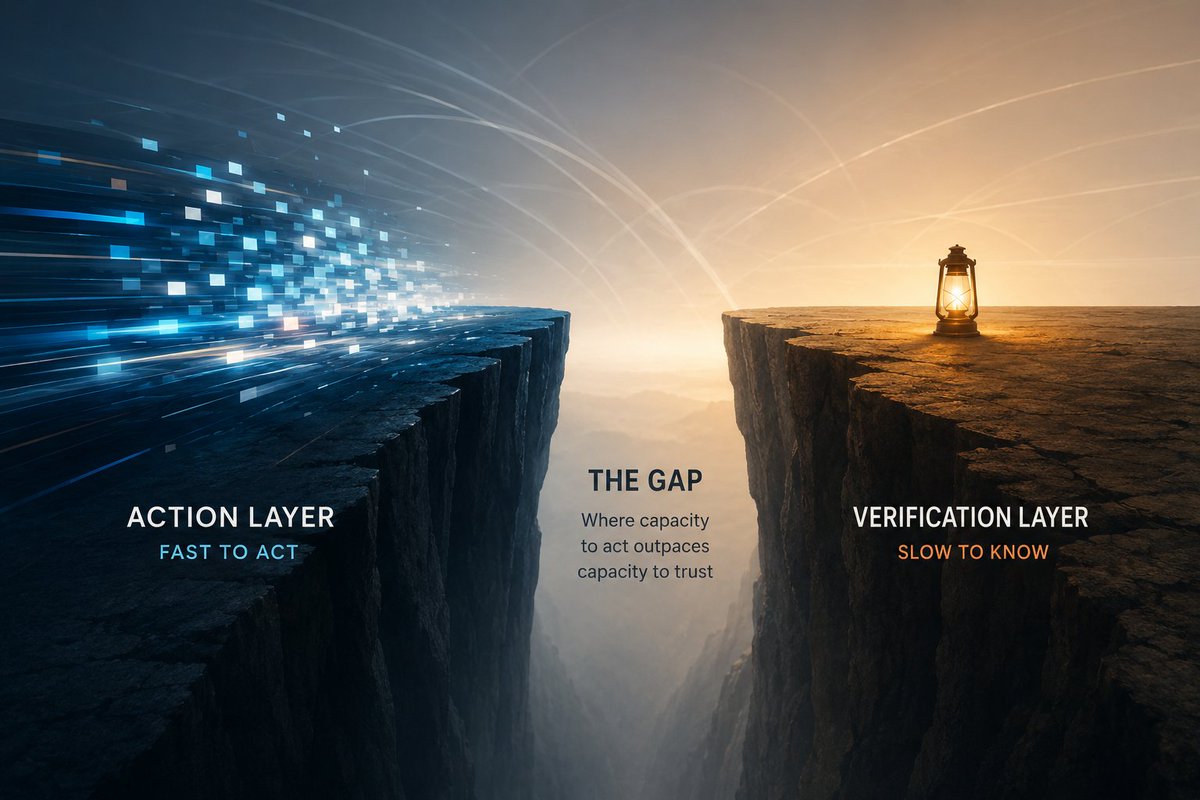
Jev is a good idea: stop using generative models for decisions that should return probabilities.
I looked at the architecture, calibration and open reproductions.
My take: useful pattern, strong product, narrow moat.
The model assesses. Code decides.
https://t.co/8NRKw8vzSP
31% more pull requests now merge with no review at all.
That is Faros AI telemetry across ~22,000 developers as #AI coding tools arrived. Throughput genuinely rose. #Review did not keep pace, and it did not degrade gracefully. It got skipped.
The practical version is two questions rather than one.
Is there a fast test that settles this?
Can it be undone?
Automate hard where a test exists. Spend human attention where none does and the door only swings one way.
because benchmarks are public and competitive.
So the routing question is whether the property has a fast oracle. If yes, automate it. If no, that’s where the human stays.
“More review raises the floor, it doesn’t move the ceiling” is the line.
Worth adding: a reviewer from a different lab doesn’t move it either.
Different lineage decorrelates knowledge errors, not objectives. Labs differentiate on data and converge on evaluation, …
We just shipped M5 Max runners for macOS and ARM Linux CI.
GitHub tops out at M2 Pro for macOS. We're running M5 Max for both macOS and native ARM Linux builds. Faster hardware, lower price.
https://t.co/NpIQ225QKU
We came out of stealth with Avrea!
The CI I wish existed when I was paying the GitHub Actions bill. Faster runners, lower cost, one line to migrate.
https://t.co/MFBwJJv2Px
My favorite feature is ability to SSH directly into your runner. 30 sec to setup, one line diff in your Github workflow.
A salary was never just money.
It was proof that someone needed you tomorrow.
What happens when survival no longer depends on employment?
Link in reply.
https://t.co/MQlyzR3iMI
GGUF is the boring choice for running a 70B at home. It's also the right one for almost everyone, and the reasons aren't what the benchmarks suggest.
Quantization stack, May 2026: what works, what's a trap, and the math corrected.
https://t.co/vp31nS9MOH
This is uncomfortable for engineers who built careers on implementation prestige.
It should be.
The engineers who thrive now will not be the ones who can merely build software.
They will be the ones who understand exactly which human pain is expensive enough that removing it changes behavior.
Software is getting cheaper. The market is also done being impressed by it.
For years, technical skill scarcity warped the economics. Building distributed systems, scalable backends, internal tooling. These commanded attention because few people could.
Implementation itself carried scarcity value
The technical layer does not disappear.
It becomes substrate.
Important. Invisible. Worth less per hour to anyone outside the discipline.
Engineering prestige migrates underground while public attention chases the next demo.