@moog77 Feels like there should be some sort of prize, maybe a seat in the House of Lords?
Got to love Kier Starmer sharing the stage for his first speech as PM with Elmo, makes you proud to be British.
@TrystanLea I think it's saying that not all of the ventilation for a room comes from outside, there's also air flow between rooms. There's also a method in there to use an airtightness measurement for the whole house as an input to the calculation.
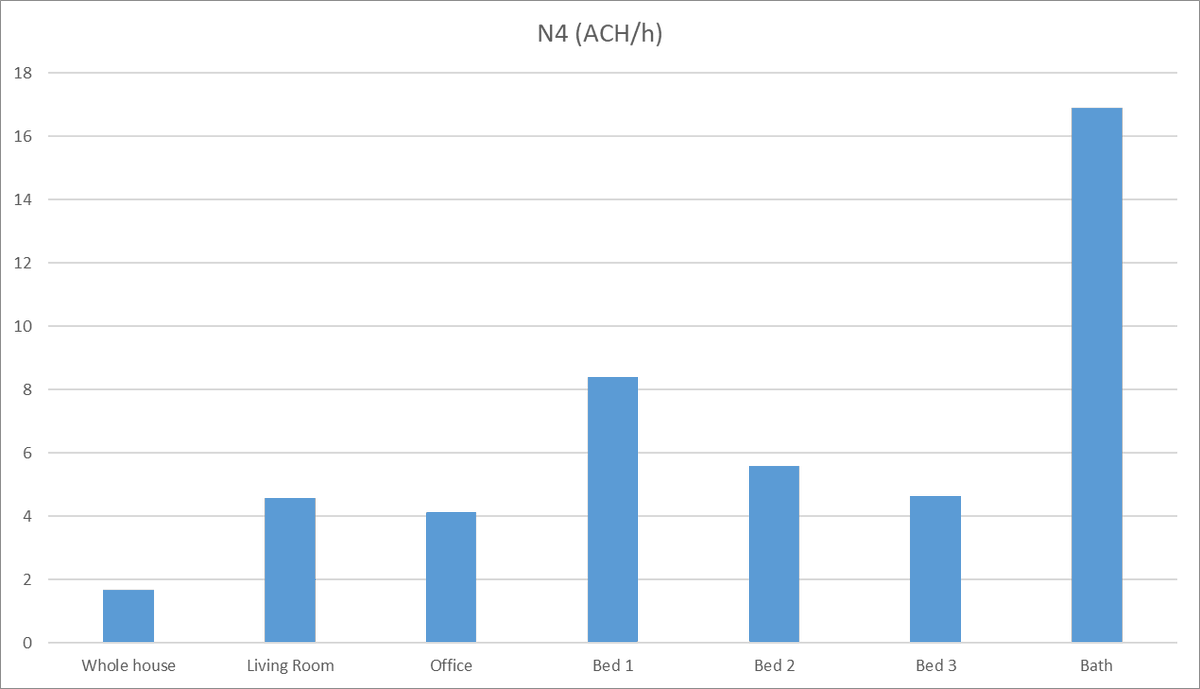
@moog77@TrystanLea Yes, internal doors closed. I used Pulse for these measurements, so that will drive air movement by elevating the pressure in the room being measured. Could make the results misleading. Generally - I guess cross ventilation, pull through from decentralised mech vent, wind washing
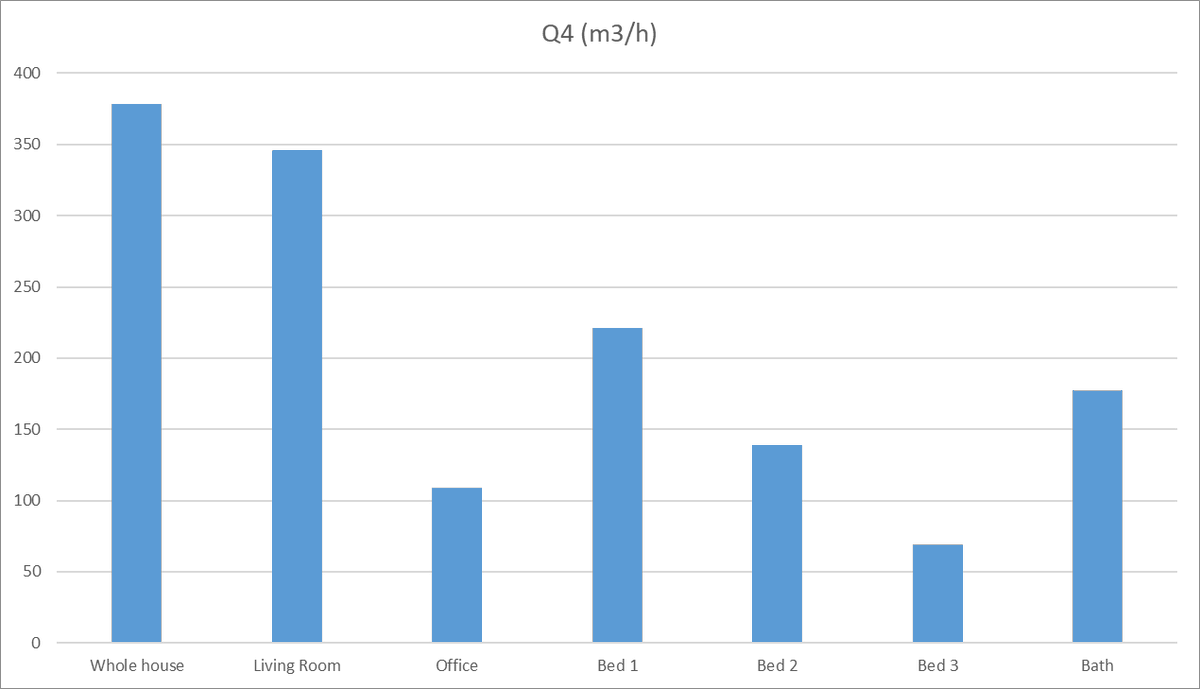
@moog77@TrystanLea Here's flowrate. Maybe this is showing that there's actually way more internal air movement than internal-external (sum of rooms much much bigger than the whole house measurement)?
@TrystanLea Purely for my own interest, I measured the airtightness of each room in my house. Here are the results... tbh I haven't got my head around what they mean yet! Bathroom is very leaky (pipework into floor void between floors mostly), no clue what this means for that ratio though!
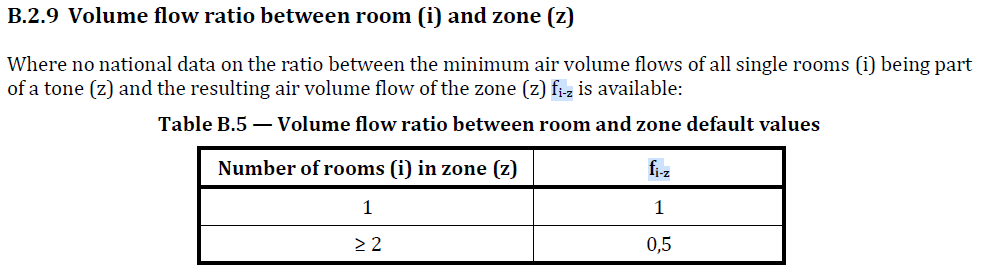
@TrystanLea In Annex B, a ratio is given which can be used when there is 'no national data available' (I'm not aware of any). A ratio of 50% effectively means that 50% of a room's ventilation would be to the rest of the house, and hence 50% to outside. Again - this is my own interpretation!
@Zapaman@TrystanLea@glynhudson @tomasmcguinness How did you calculate them? Really interesting how solar gains varies with sun path, certainly makes it tricky!
@TrystanLea Not sure how that's implemented in calculators or if it varies between them. Interesting to consider when thinking about how to use an airtightness measurement (though 12831 has a specific method for this) or in the context of apparently large room infiltration figures.
@TrystanLea 12831 also says that for any ventilation heat transfer at room level (mech or natural) not all of the air moves from inside to outside. It has a standard assumption in an annex that only 50% does, the other 50% assumed to between rooms and ignored for heat loss.
@TrystanLea@glynhudson @tomasmcguinness How are you calculating the heat gains? And I think some of DHW causes a useful space heat gain too, depends what sort of use it is for how much.
@glynhudson @tomasmcguinness @TrystanLea It's a really good metric to show how utilised the HP is, which is probably what one is really interested in. I would say imperfect for measuring the house's heat loss, but then maybe that's not the most useful metric here anyway.
@glynhudson @tomasmcguinness @TrystanLea Cool - I love the format. Really clear & insightful. For a measurement of building heat loss, does it consider other heat gains (solar/other elec use/metabolic)? What time span are the datapoints? That'll even out lots for the trendline, but might need to think about thermal mass
@heatfutures @tomasmcguinness @glynhudson@TrystanLea I think the measurements (could be U-values or airtightness) need to work with the calculations, rather than being an either or. A heat loss measurement only tells you overall heat demand which helps with sizing, still a looong way to go in a HP design after that of course!
@heatfutures @tomasmcguinness @glynhudson@TrystanLea Wearisome amount of detail available here & always happy to talk about them: https://t.co/zBRTqnvfwv
The CIs can be high sometimes depending on circumstances (e.g. large party walls/few temp sensors in a large space), best to be clear & open about them though I think.
@Damon_BPHR @Sjh1822 Have been thinking of this for my house (bit less than 3kWp), but not sure how to manage distribution or what to heat up bath water with. Nice side benefit of AC available in summer.