⚡ The AI power value chain, fuel to rack. Five stages, and every one is a bottleneck somebody owns.
1️⃣ Fuel: $CCJ $BWXT → uranium demand is a decade contract, not a trade
2️⃣ Firm generation: $CEG $VST $TLN → the only megawatts data centers will sign for are the ones that never blink
3️⃣ Next-gen reactors: $SMR $OKLO $NNE → the 2030s supply answer, priced today on execution faith
4️⃣ Power gear & cooling: $GEV $VRT → the picks-and-shovels inside the picks-and-shovels, backlogs measured in years
5️⃣ Storage & firming: $EOSE $FLNC $TE $BE → the layer that turns intermittent grid into 24/7 compute
The frame that matters: a token is refined electricity. 🔋 Every query monetizes an electron that traveled this entire chain, and every stage takes its toll on the way through.
Ledger: stages 3 and 5 are execution stories with real binary risk. Sized accordingly or not at all.
Follow the electron. It knows where the margins are.
DYOR. Not FA.
⚡ The AI trade has quietly changed its unit of account, and most portfolios haven't noticed.
2023-2024: the scarce unit was GPUs. Whoever had allocation won. The trade was silicon.
2025-2026: GPUs became purchasable. Power did not. The scarce unit is now the energized megawatt: sited, permitted, interconnected, and firm. A transmission queue takes 4-7 years. A substation transformer has a multi-year lead time. No amount of capex compresses a permitting calendar. 🏗️
Follow the unit and the map redraws itself: generation, grid gear, storage and firming, cooling, and the ex-miners whose stranded-looking sites turned out to be the most valuable real estate in the buildout, because they come with the one thing you cannot expedite: an interconnect that already exists.
Tokens are refined electricity. Every query monetizes an electron that survived a queue.
The ledger: power names are execution stories with long builds and financing risk, and policy can reroute the map with one rule. The unit of scarcity will migrate again someday. It always does.
But today, the constraint IS the investment. Price the electron.
$EOSE $TE $IREN $DGXX
DYOR. Not FA.
“What is the next great technology?”
I focus on AI investing and my other half @FrankDPrestia focuses on AI technology and infrastructure. He’s an AI strategist and innovation theorist. ⚡️
🏛️ Every generation of investors believes markets evolved past the old cycles. Every generation funds the proof they didn't.
The technology changes. Canals, railroads, radio, dot-coms, AI. The balance sheet changes. The cycle doesn't, because the cycle was never made of technology. It's made of people, and people ship with fixed firmware: fear, greed, envy, the need to belong, the terror of being left out, the deeper terror of being caught alone in a loss.
That's why the sequence never varies. Skepticism, adoption, belief, leverage, euphoria, denial, panic, despair. Then the survivors write rules, the rules work, a new generation arrives that never paid the tuition, and the rules get called outdated. The market has no memory, but it doesn't need one. It runs on a species that forgets on schedule. 🔁
Charts are just emotion with timestamps. Support is where regret bought last time. Resistance is where relief sold. Every pattern that "works" works because a million nervous systems respond to the same pain the same way, every cycle, without instruction.
Machines were supposed to end this. Instead we trained them on our own history and taught them to panic faster.
You can't exit the cycle. You can only decide, in advance and in writing, who you'll be at each stage of it. That decision is the entire edge. It has always been the entire edge.
Nothing in the market is new. Especially the people certain that this time it is.
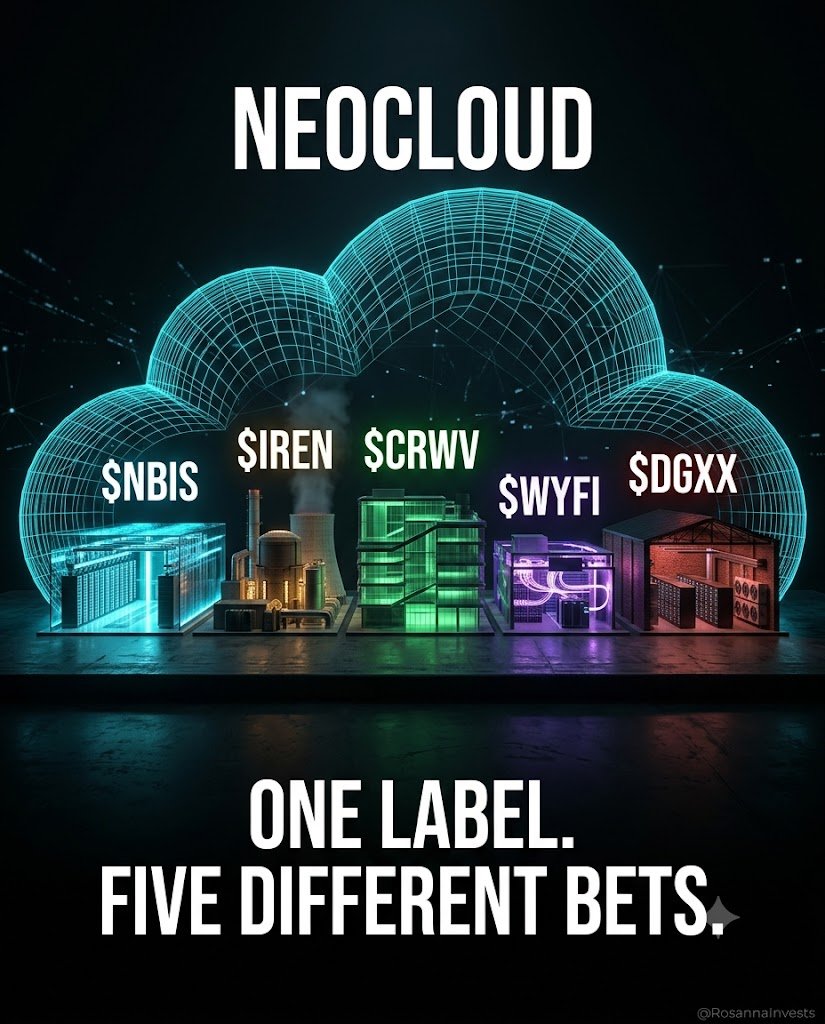
☁️ "Neocloud" might be the most dangerous word in this market. Not because the businesses are bad. Because one label is pricing five different companies.
$WYFI $DGXX $CRWV $IREN $NBIS
Under that single word right now:
→ Companies that own their power, and companies that rent it
→ Contracts with investment-grade anchors, and contracts with startups burning runway
→ Balance sheets funding growth with equity, and ones stacking converts on vendor debt
→ Operators converting megawatts today, and stories converting them in 2027
When the label trades as one basket, the strongest name in it gets sold at the weakest name's multiple. That's the entire opportunity. Basket selling is indiscriminate by construction, and indiscriminate is where sorting pays. 🔍
The four questions that separate the tier: Who owns the electrons? Who signed the anchor? What's the debt stack? What converts THIS year?
The ledger: capex-hungry, financing-sensitive, and the funding window is the tripwire for every one of them. The label will keep trading as one trade. The filings never did.
DYOR. Not FA.
🚨$IREN co-CEO @danroberts0101 said it plainly:
"The world is structurally short compute." And the cheaper compute gets, the more of it we want. That's not a contradiction. That's the oldest pattern in industrial economics. JEVONS PARADOX⚡
⚡Jevons noticed it in 1865: as steam engines got better at burning coal, Britain burned more coal, not less. Efficiency made coal cheaper to use, cheaper use widened what was worth doing, and the new uses consumed more than the savings returned. Every "AI efficiency will fix the energy problem" argument runs straight into this. Falling cost per token is the reason demand explodes, not the reason it stops.
⚡And here's the part the efficiency crowd skips: the bill is physical. You get invoiced in megawatt-hours, not joules per token. A model distills in a week. A substation takes five years. The constraint doesn't disappear when software improves. It relocates, and it never leaves the physical world.
My other half @frankdprestia wrote an excellent piece on exactly this. He’s an AI strategist and innovation theorist who writes on the intersection of AI technology, infrastructure, consciousness, law, blockchain, and more. A great follow too. Read it. 👇
🌍 The infrastructure the next decade runs on. Eight lanes, one map. 🧵👇
💡 Photonics → light replaces copper. The interconnect is the new bottleneck.
$CRDO $AAOI
⚙️ AI infrastructure → the compute buildout, still early on megawatts actually energized.
$NBIS $IREN $WYFI
🤖 Physical AI → intelligence that acts. The models are leaving the chat window.
$OUST $AMBA
🛸 Autonomy & drones → machines that operate themselves, and the defense budgets that want them.
$ONDS $MRLN
⚡ Energy & storage → the buildout's binding constraint. No electrons, no tokens.
$TE $EOSE $QS
🪨 Critical minerals → the hard constraints under everything. Geology doesn't do earnings guidance.
$MP $ASPI $UAMY
🚀 Space → the orbital economy: coverage, imaging, launch. The high ground, literally.
$ASTS $RKLB $PL
The thesis in one line: own the chokepoints the digital economy can't function without. Logos change. Layers don't. 🔑
The ledger: infrastructure de-rates violently when positioning crowds, and the past six weeks were the live demonstration. Chokepoints don't exempt you from drawdowns. They exempt you from irrelevance.
Own the layers, not the logo.
DYOR. Not FA.
🌈 Six worlds. One map. The money is where they touch.
🟡 Photonics: $AAOI $CRDO $SIVEF → light replacing copper, because electrons ran out of headroom
🟢 Compute & neoclouds: $NBIS $IREN $WYFI → the buildout's shovels
🟠 Semis & memory: $MU $SNDK $ADEA $PENG → the substrate everything rides on
🔵 Physical AI: $AMBA $AUR $ONDS → intelligence leaving the screen
🔴 Energy & storage: $TE $FLNC $BE → the buildout's fuel line
🟣 Space: $ASTS $RKLB $PL → the layer above all of it
The insight isn't the circles. It's the seams. Compute × energy decides who scales. Photonics × semis decides who connects. Space × defense decides who gets funded regardless of rates. Single-category companies compete on price. Intersection companies compete on physics. ⚡
Ledger: intersections cut both ways, two worlds de-rating hits twice as hard. The past six weeks proved it.
Own the intersections. That's where pricing power lives. 🌎
The market is a Jenga tower. 🧩
Every pull works → leverage added, volatility sold, one more chase → and the tower keeps standing. That's the trap: standing gets mistaken for stable. Every successful pull teaches the table that towers don't fall, while the structure quietly leaves the building.
Then one block ends it → and everyone blames the block. Wrong defendant. The collapse was manufactured by every prior pull. The last block just collected the bill.
A physicist proved this in 1987. Per Bak built a sandpile, dropping grains one at a time until it reached what physics calls a critical state → where the next grain might do nothing, or trigger an avalanche that reshapes the whole pile. Bak proved WHICH grain is unknowable. Not hard to predict → unknowable. The avalanche isn't caused by the grain. It's caused by the state of the pile.
The trigger is trivia. The structure is destiny.
And this isn't metaphor → econophysicists have shown market returns follow the same power laws as avalanches, earthquakes, and forest fires. No bell curves protecting you → fat tails, where the rare event is the main event arriving on schedule with no date attached. And at the critical point, everything correlates → your fifteen "diversified" positions become one position, precisely when it matters. Crashes need no cause. A steep enough pile IS the cause.
Every great trader arrived at this same law through losses instead of equations:
⭐️ Taleb → stop predicting the grain, own convexity to the avalanche. Be what gains from disorder.
⭐️ Tudor Jones → defense first, always. Offense is a bet on which block. Defense is a position on the tower.
⭐️ Druckenmiller → size so being wrong is survivable. He lost $3B in six weeks the one time he forgot → and he already knew better.
⭐️ Annie Duke → judge decisions, never outcomes. In a power-law world, outcomes carry luck you can't audit.
⭐️ Lynch → know what you own. When the avalanche comes, knowledge alone tells you whether to buy the rubble or flee it.
⭐️ Tepper → the avalanche IS the opportunity, for whoever kept capital to meet it. He built his fortune buying what the 2009 panic buried → bank debt nobody would touch at any price. You can only shop the rubble if you weren't standing under it → "there is a time to make money and a time to not lose money," and knowing which is which is the whole career.
Six careers. One conclusion. The tower, not the block.
And two thousand years earlier, a Greek slave carved it first. Epictetus: some things are within our power, and some are not → and every ounce of misery comes from confusing the two. The market's direction, the Fed, the avalanche's timing → not in your power. Your size, your leverage, your cash, your exits written in advance → entirely in your power. The Stoics even rehearsed disaster while calm → premeditatio malorum → so it arrived already handled. A tripwire list, written in Latin.
The law, in three languages:
Physics → you cannot predict the avalanche. You can only choose your exposure to the pile.
Trading → you cannot know the outcome. You can only control size, survival, and process.
Stoicism → you cannot command events. You can only command yourself.
Same law. Every discipline that studies uncertainty seriously ends up carving it into the wall.
Everyone at the table is watching the next block. The entire edge → the only durable one → is keeping your own base wide while they pull.
🚨The table hides a better finding than the headline.
Near term: 5 of 6 of these Julys were green after OpEx. The selling that defines the first half tends to exhaust by expiration. That's mechanics, not magic: the hedges roll off. ✅
Full year: split the sample by the January-June column. Every terrible year here (2001, 2002, 2008) was ALREADY down 7-14% by June. The years that entered July green, 2004 and 2006, finished +9% and +14%. ✅
That scary right column was never a July signal. It's a "was the year already broken" signal. ✅
2026 walks in at +9.55%. Strongest first half in the sample, and OpEx was yesterday. ✅
n=6, so base rates, not prophecy. But condition the data before you fear it. 😎
⚡ The AI interconnect supply chain, wafer to test. 20 names, 7 stages, one thesis: the market owns the top, the asymmetry lives at the edges. 🧵
🔸 Wafer → $AXTI $IQE. InP substrate, the true upstream.
🔸 Light → $LITE $SIVEF $POET. The external light source layer.
🔸 Optics & modules → $COHR $AAOI $FN. Where the ramp is measured in ports.
🔹 Interconnect → $CRDO $MRVL $AVGO $ANET. Electrical to optical, end to end. Marvell just paid $3.25B for Celestial AI to own more of this shelf.
🔹 Packaging & foundry → $TSEM $LPKF $GLW. The neutral arms dealers.
🔹 Test & analog → $AEHR $VIAV $SMTC $MTSI $CIEN. Validation hasn't run yet. That's the tell.
Why the edges: the top of this chain is priced for the buildout. The edges are priced like it's optional. Same demand signal reaches every stage with a lag, and the lag is the trade. ⏱️
Ledger: edge names are small, execution-sensitive, and the first cut in any de-gross. Six weeks ago proved it. Size accordingly.
DYOR. Not FA.
📦 Every shelf of the AI storage pyramid is now spoken for. All three layers. At once.
🔥 HBM + DRAM, the hot layer → shortage through 2027+
$MU $SKHY $PENG
🌡️ NAND flash, the warm layer → 5-year supply deals signed
$SNDK $KXIAY
🧊 Nearline HDD, the cold layer, 80% of hyperscaler bytes → sold out through 2027
$WDC $STX
This has never happened simultaneously. Hot memory shortages are normal in booms. Cold storage selling out is not: it means the models aren't just training, they're RETAINING. Every token generated becomes data that has to live somewhere, forever.
The market prices AI as a compute story. The pyramid says it's also an inventory story, and inventory that's pre-sold for years is the closest thing to visibility this sector ever offers. 📊
The Risk: allocation booms end when capacity catches up, and every layer above is racing to add it. Sold out is a snapshot, not a guarantee.
But right now? The constraint is the investment. 🔑 DYOR
🏪 The AI stack has a middle, and it's the least discussed layer in it.
The landlords get the coverage: the megawatts, the buildings, the GPUs. Deservedly → they're the buildout. But that business is capital-hungry by design, and every dollar of growth has a construction bill attached.
The middle runs on different economics. 🏗️ $DOCN 🌐 $NET 📦 $AKAM buy compute wholesale, wrap it in developer tools, and sell finished AI by the token. Asset-light. Margin scales with usage, not with construction.
Here's the structural point: 100,000 builders are about to ship AI products, and most will never rent a rack directly. They'll buy from the middle. Landlords get paid for the building. Merchants get paid every time a token moves. 🪙
The ledger: merchants carry platform risk, and the hyperscalers can squeeze from above. That fight is real and worth watching.
But in every gold rush, the picks sell once. The tolls collect forever.
DYOR.
📉📈 The strangest six weeks I've tracked in a while. The prices went one direction. The filings went the other.
$EOSE → stock red YTD. Record revenue, record $807M backlog, collections above revenue, Pentagon added to the customer list.
$AAOI → cut in half from the high. Broke ground on 400K sq ft of new capacity against $324M of hyperscale orders.
$ASTS → down 59% from the peak. Placed $1B of 7-year converts overnight at a $149 effective conversion price, institutions oversubscribed.
$NBIS → down a third. ~$50B contracted.
Two ledgers, one company, opposite directions. That's not a market being wrong. That's a market pricing flows while the businesses price demand: de-grossing, margin unwinds, systematic selling, none of which reads an 8-K.
The discipline: sometimes price is early and the filings catch down. Watch conversion, not headlines, and the next two earnings weeks are the arbitration.
But price and fundamentals cannot diverge forever. One of them closes the gap, and it's usually the one that wasn't forced.
DYOR. Not FA.
🚨The most important market-structure chart of the month, and it explains the whole year. 🧐
Everyone keeps asking how the index stayed calm while semis fell 13% and the high-beta tier fell 50. Here’s the mechanical answer: a record cohort INSIDE the index now trades against semis. The two legs cancel. The S&P has become a pair trade with itself. ✅
Which rewrites what index calm means. A quiet tape used to say risk is low. Now it says correlation is NEGATIVE → the risk didn’t leave, it netted. Same reason index puts failed every high-beta book this year: you can’t insure a dispersion event with an instrument whose legs offset. ✅ (see other post on index puts)
Semis stopped being just a sector. They’re a factor now, like rates or oil, with a long and short cohort inside every benchmark. ✅
🏛️ High beta is a pendulum, and many forget the second half of the physics.
The same qualities that carried these names up triple digits are what's carrying them down by half. Thin floats, levered holders, narrative fuel, systematic flows that chase what's moving. None of that switched sides. The amplitude was always the deal, and you don't get to keep the upswing and vote out the return trip.
Traders watch Fibonacci’s Golden Ratio: 1.618 on the extension, 0.618 on the retracement. Same number, read from opposite ends of the arc. I don't think the market obeys sacred geometry. I think enough people watch the same levels that the levels become real, and either way the lesson holds: the swing that overshoots in one direction has never once ended at equilibrium on the way back.
Pendulums don't stop in the middle. They pass through it.
The mechanics under the design: FORCED selling overshoots fair value going down for the same reason euphoria overshoots it going up. More sentiment driven. Flows, not fundamentals, set the extremes. Fundamentals set where it eventually hangs.
Position for the arc you're actually in. Size for the fact that it swings. ⚖️
The second ruler, drawn. Same five cycle peaks, scaled both ways.
Left: the ratio - MD/GDP. Right: the debt against the collateral that actually secures it - MD/MC. One doubled. One never left its band. On upper end of band and likely to have come down after this July clearing. 👍
Sources: FINRA/NYSE margin statistics, primary. Market caps Wilshire-based approximations, and the band conclusion survives any reasonable series: a $3T disagreement on the denominator moves the June bar a 1/10 of a point.
🚨This chart deserves the attention, and the July 16 FINRA release just extended it: June FINRA margin debt printed $1.502T. First print in history above $1.5T. Up $281B in a single Q, +49% Y/Y, and net credit balances crossed negative $1T for the first time. 🧐
One addition to the chart. Margin debt is collateralized by portfolios, not by national income, and scaled to total equity MC it sits near 2.3%: inside the same 1.8-2.3% band it has occupied at every cycle peak since 2000. The GDP ratio doubled largely because equities re-rated against GDP, not because leverage re-rated against its collateral.
Both readings are true, and they answer different questions. One measures how large the fuel load has grown relative to the economy that has to absorb an accident. The other measures how stretched the borrowers are against their own collateral. Record fuel, ordinary stretch.
What the level cannot do, on either ruler, is date anything. This is the June 30 snapshot, taken at the very top, one day before the July flush. The print that matters is July's, due mid-August: leverage clearing while price stabilizes is how de-grosses end. That's the tripwire, stated in advance.
The record is the fuel. The change is the fuse. 😎
🚨 Earnings season starts Tuesday. Guidance will move every stock in my book → and I'll be listening closely, because forward numbers are where re-rates begin.
But guidance is a promise. Backlog is a receipt → and receipts are how you know which promises to believe.
So here's the screen: companies walking into earnings with the revenue already SIGNED → sitting in RPO and contracted backlog, waiting to become prints:
→ $WYFI $921M contracted → more than 10x its annualized revenue. Anchor live and billing.
→ $IREN $3.1B in contracted ARR → megawatts already spoken for.
→ $ONDS $457M backlog, up from $68M at year-end → against a $4.3B pipeline.
→ $NBIS a $27B hyperscaler deal underneath everything else.
→ $RKLB, $EOSE, $PL, $ARM: billions more signed across launch, storage, imagery, and licensing.
The playbook: when guidance gets raised WITH backlog growing faster than revenue, the raise is underwritten → believe it. When guidance gets raised on air, that's a request, not a receipt. The gap between the two is where the trade lives. ⚡️
Guidance moves the stock. Backlog tells you whether to believe the guidance. Read them together → trade the gap. 🤝