One thing I’ve noticed from trading more actively is how quickly market narratives turn over.
Themes used to have real staying power. Now the market can move on within weeks. I’m not sure how much of this is driven by AI, but the pattern is hard to miss: software gets sold at a record pace, attention shifts to high-short-interest names, and everyone is already searching for the next bottleneck or story.
According to J.P. Morgan, weekly retail outflows from software and services recently hit their highest level since the data series began. At the same time, social-media interest was clustering around high short interest names like GRND, RH, NBIS, and CAKE, alongside memory, AI infrastructure, and space names like SNDK, MU, VRT, and RKLB.
It doesn’t feel like capital is rotating neatly from one theme to the next. It feels more like several stories are lighting up and burning out at once. Sometimes the entire market seems to trade like a meme. Positions don’t stay in one place for long, while social media and AI have shortened the gap between discovering a narrative, spreading it, and exhausting it.
But a discarded theme bouncing back doesn’t mean it has reclaimed the center of the market. If earnings estimates keep rising and capital continues to flow in, it may still be a trending asset. If the move is driven mainly by short covering, an event, or a sudden spike in attention, it is probably still a trade.
SpaceX holding up despite a large lockup expiry may be another example. Maybe less stock was sold than expected. Or maybe the market had already moved past the unlock and started pricing in the next story.
In a market where narratives have shorter shelf lives, finding a good story is no longer enough. The harder question is whether it is still a trend, or whether it has already become just another trade.
The Shortening Shelf Life of Market Narratives
Looking at this week's @QFEX earnings calendar, there are quite a few important dates lined up. Hood, MSFT, Google, and others.
https://t.co/wth6oLdZwM
GPU Prices Are Hitting Record Highs. So Is the Cost of Financing AI.
Two indicators that seem contradictory are rising at the same time across the AI infrastructure market.
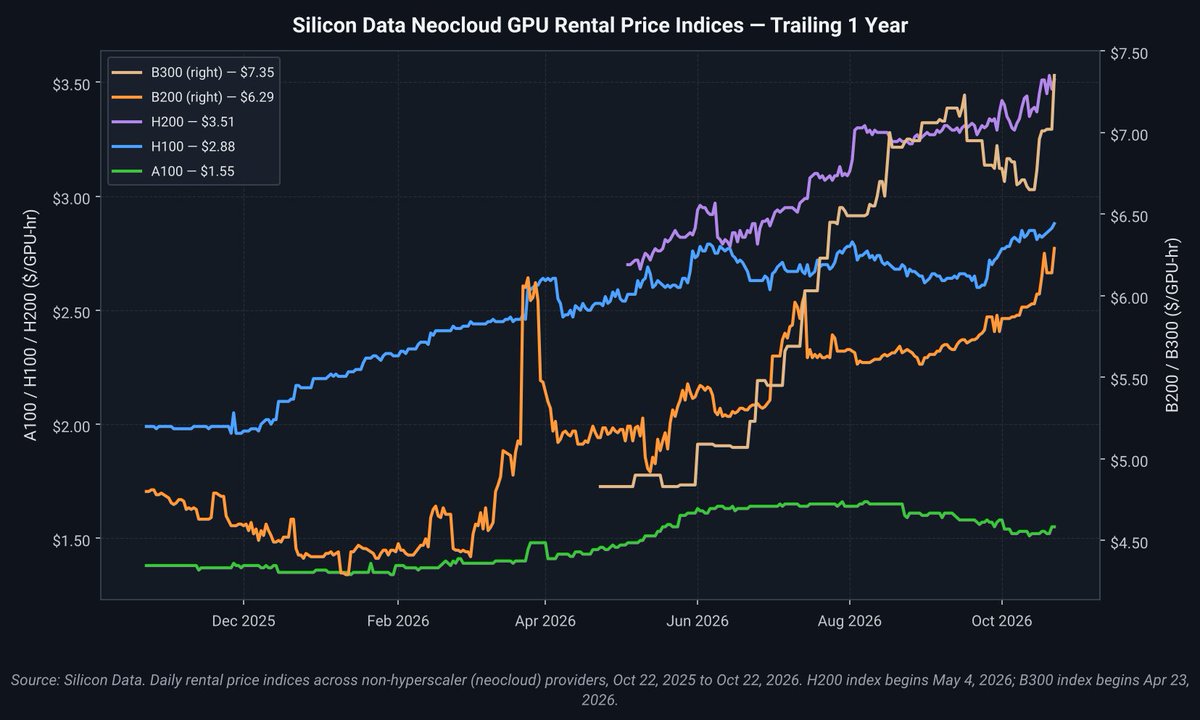
According to Silicon Data, on-demand GPU rental prices across neocloud providers have reached record highs:
- B300: $7.35 per GPU-hour
- B200: $6.29
- H200: $3.51
- H100: $2.88
- A100: $1.55
Even the A100 index, which had recently shown some weakness, appears to be turning higher. At least in the spot-like GPU rental market, demand for AI compute remains strong.
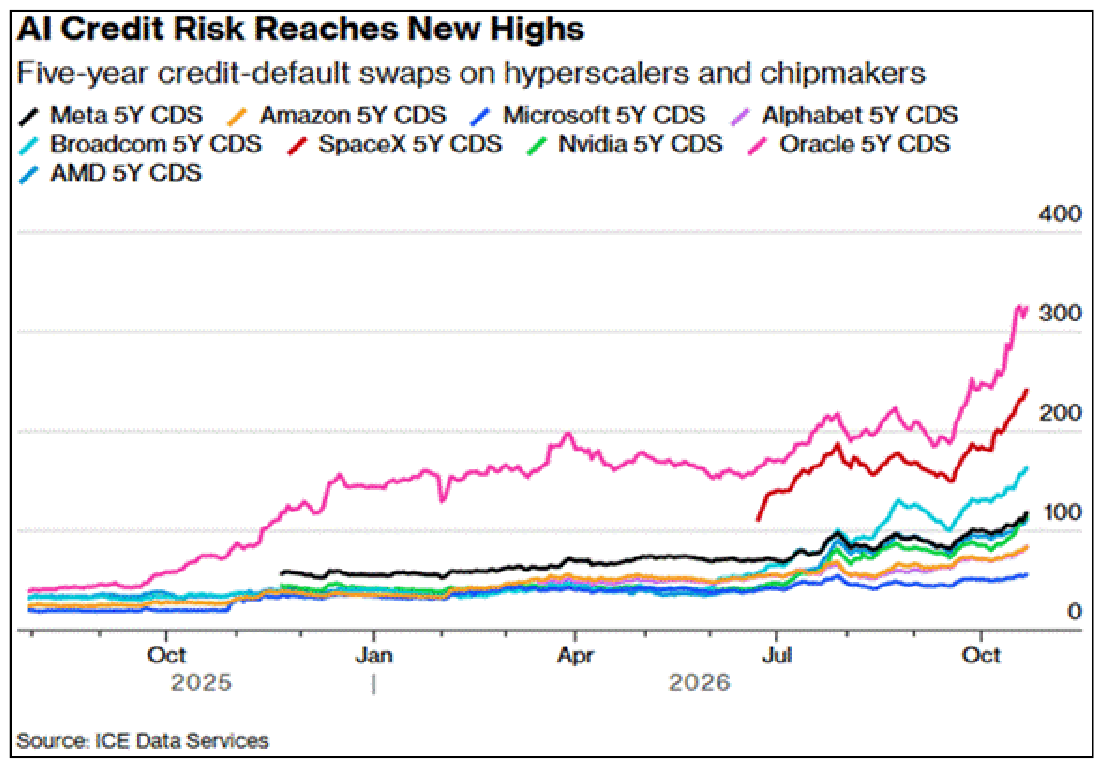
At the same time, 5 year CDS spreads across hyperscalers, semiconductor companies, and other AI linked names are widening rapidly. Oracle’s spread has climbed to roughly 300 basis points, SpaceX is above 200 basis points, and names such as Broadcom and Meta have also moved higher.
A CDS is essentially the market price of insuring against default on a company’s debt. A rising spread does not mean default is imminent, but it does indicate that investors are assigning a higher cost and greater risk to lending that company money.
The next AI bottleneck may therefore be less about securing GPUs and more about financing them on sustainable terms.
Higher GPU rental prices create more revenue potential for data-center operators. But expanding supply still requires enormous upfront investment in accelerators, power, land, networking, and cooling infrastructure.
As credit spreads widen, the return generated by those GPUs must clear an increasingly demanding hurdle: interest expenses, electricity costs, depreciation, and other operating costs.
This means GPU ownership alone is no longer enough to evaluate an AI infrastructure business.
Rental price × utilization − electricity − depreciation − cost of capital
The gap is likely to widen between operators that can keep this equation positive and those that must continually borrow at expensive rates to expand their GPU fleets.
AI compute remains scarce. But turning that scarcity into sustainable cash flow will increasingly depend on one critical variable: the price of capital.
Sources:
https://t.co/HpJoIOKsO5
https://t.co/5e4N3vSAxm
Another day, another round of on-demand GPU rental indices surging across the board and reaching ATHs. Even the A100 index, which recently saw some softness, seems to be inflecting a little.
Many market commentators expect oil prices to fall back to prewar levels once the conflict in the Middle East ends and the Strait of Hormuz reopens. The 1990 Gulf War is often cited as a precedent. But today’s energy market is different in several important ways.
During earlier crises, major producers had enough spare capacity to replace much of the disrupted supply. Some spare capacity still exists today, but it may not be large enough or accessible enough to offset a serious disruption around the Strait. Much of the available capacity is concentrated in the same region, which limits its value when shipping routes themselves are at risk.
The United States shale industry may also be a less powerful buffer than it once was. Production remains strong, but companies are now more focused on financial discipline and shareholder returns. Even when prices rise, new supply may take time to reach the market.
The end of the conflict would certainly remove part of the war premium from oil prices. However, shipping, insurance, and security costs are unlikely to normalize immediately. Buyers may also need to rebuild inventories, while the possibility of another disruption could remain in the market for some time.
Oil prices could therefore fall sharply after a ceasefire without returning all the way to their previous level. The Gulf War remains a useful historical reference, but it should not be treated as a direct roadmap. The structure of the market has changed, and the price floor after the conflict may be higher than many investors currently expect.
Nebius Is Turning Idle GPU Capacity Into a Real Time Market
The easiest way to understand Nebius is to think of it as operating a GPU hotel
- Longterm contracts: Customers reserve large blocks of rooms for an extended period.
- On-demand: Customers pay a fixed rate for reliable access whenever they need it.
- Spot GPUs: Customers rent temporarily idle capacity at a discount, but Nebius can reclaim it with 60 seconds’ notice.
Historically, spot capacity was always priced below on-demand capacity because it could be interrupted at any time.
That model is now changing in three steps:
1. October 1: Nebius increased on demand prices for H100, H200, B200, and B300 GPUs by roughly 17–21%.
2. October 8: It introduced dynamic spot pricing, with prices recalculated as often as every 15 minutes based on available capacity and customer demand.
3. November 2: Nebius will remove the rule requiring spot prices to remain below on-demand rates.
This means customers may soon pay more for interruptible GPUs than for regular on-demand capacity if they urgently need compute and availability is limited.
Why this matters
1. Nebius can monetize idle GPUs more efficiently
Previously, spot prices could not exceed on-demand rates, regardless of how much urgent demand existed. Removing the ceiling allows Nebius to capture more revenue from the same hardware when demand spikes.
However, removing the cap does not automatically mean prices will rise above on-demand rates. That will only happen if real customer demand supports it.
2. GPU scarcity is becoming visible through pricing
According to @OrnnExchange, Nebius’s B200 spot price in us-central1 moved from approximately $0.99 per GPU-hour between October 14 and 18 to around $4.00–$4.70 over the following few days.
That suggests increasing demand for available capacity. But the price was still below Nebius’s B200 on-demand rate of $8.50 per GPU-hour.
So far, the data confirms rising spot demand, not that spot GPUs are already trading above on-demand prices.
3. GPU capacity is becoming easier to value as a financial asset
Historically, lenders struggled to estimate what a GPU cluster might earn after its long-term customer contracts expired.
A transparent spot price gives lenders a better way to estimate:
- The revenue potential of idle GPUs
- The collateral value of GPU infrastructure
- How much debt a data center can reasonably support
If GPU futures develop alongside this market:
- AI companies could hedge against future compute-price increases.
- Neocloud providers could hedge against falling rental rates.
- Lenders could better assess the risks of financing GPU data centers.
In other words, GPU time is beginning to resemble electricity or oil: a commodity with observable prices that can support collateral, financing, and derivatives.
Bottom line
Nebius has started selling idle GPU capacity through an auction like pricing system that can update every 15 minutes. By removing the price ceiling, it is moving toward a market where GPU time receives a real-time price based on immediate supply and demand.
Ornn is building the pricing indices and financial infrastructure intended to turn that compute capacity into something that can be valued, financed, and eventually hedged through futures.
This policy change does not yet prove that Nebius’s financial performance has improved. In the upcoming earnings report, the key indicators will be utilization, realized revenue per GPU-hour, and management’s comments on spot demand.
The following quarter may be even more important because the removal of the spot-price ceiling does not take effect until November 2.
Sources:
https://t.co/FFIiwh3NjK
https://t.co/GtDF1amkDc
$NBIS’s Problem Isn’t Demand. It’s Turning 5 GW Into Revenue.
$NBIS closed at $165.47 on October 16, down 25% over five sessions and 42% from its recent high. The key issue is not whether AI demand exists, but how quickly Nebius can convert contracted power into active, revenue generating capacity.
Nebius expects to end 2026 with 5 GW of contracted power. William Blair estimates only about 0.6 GW will be active this year, meaning nearly 90% of that capacity has yet to generate revenue. That gap represents both the upside and the main execution risk.
Demand is well supported:
- RPO as of June 30: $37.49B
- Microsoft: $17.4B base contract, potentially rising to $19.4B
- Meta: $12B of dedicated capacity plus up to $15B for eligible capacity Nebius cannot sell elsewhere
- Q2 revenue: $582M, up 454% YoY
- AI Cloud ARR: $3.0B
- AI Cloud adjusted EBITDA margin: 50%
Recent contracts generated more than $20M in annual contract value per MW, while management estimated a 22 month payback period for Q2 deals. Nebius argues that its full stack software and infrastructure model can produce more revenue per MW than simply renting GPUs.
But the buildout is extremely capital intensive. Q2 capex was $5.7B, while first-half purchases of property, equipment, and intangible assets reached $8.13B. Nebius had $8.04B in cash and expects more than $9B of customer prepayments in 2026, but it also raised roughly $2.8B by selling 12.7M shares through its ATM program.
The central question is whether Nebius can activate its 5 GW pipeline on schedule and convert $37.49B of RPO into revenue and cash flow without major cost overruns or excessive dilution.
The numbers to watch are active power, capex per MW, customer prepayments, and margins.
If you're looking for a good place to trade NBIS, consider @QFEX :
https://t.co/ShQL4gW5NP