The first $TAO ETF is built to hold Bittensor's token and never stake a single coin of it.
On a network where staking is the whole point, that is not a footnote.
It is the entire story of what you would be buying.
Start with where it actually stands, because the headlines are running ahead of the facts.
Grayscale's Bittensor Trust, GTAO, is still an OTC product.
The conversion into a real spot ETF on NYSE Arca is pending SEC review, not approved and not live, with a decision window the market is watching closely right now.
When that approval headline finally lands, everyone will cheer the access.
Almost nobody will mention this next part.
The prospectus states the trust holds TAO directly and stakes none of it.
TAO that sits unstaked earns no emissions while the network pays everyone who staked.
So the cleanest institutional wrapper for $TAO is, by its own design, exposure to idle TAO.
Now add the costs sitting on top.
Expense ratio: 2.50% every year
NAV per share: around $3.68
Market price: around $4.50
You would be paying an annual fee to hold TAO that earns nothing, while OTC buyers right now pay well above the underlying value just to get in.
Here is the frame that actually helps you.
An ETF is not a better way to own $TAO.
It is a more convenient one, and that convenience costs you the staking yield, a yearly fee, and a premium that can evaporate the moment a real ETF makes the OTC version redundant.
If you legally cannot self custody or stake, that trade can still be worth it.
If you can do both yourself, the wrapper charges you more to earn less.
The ETF story is about access. The filing is about yield. Only one of those two ever shows up in your returns.
Not financial advice. Products like this carry real risk, including loss of principal and wide gaps between price and NAV.
Save this for the day the approval headline drops. Be the one in the replies who already read the filing.
Safe and Effective Confined Space Inspections ✅
Sky-Futures specializes in advanced inspection and mapping services, including confined space inspections, non-destructive testing, 3D modeling, digital twin creation, and more.
For more info visit https://t.co/6qpzJCQ6LI
3 years, billions in TVL, and still growing.
USDY just turned 3, reaching $2.1 billion in market cap and now a top 3 tokenized Treasury.
Three years in, it's proven tokenized Treasuries can meet an institutional standard, while keeping the benefits tokenization offers:
→ Nearly 30,000 holders
→ Live across 6 blockchains
→ $8.5 billion transfer volume
→ Permissionless onchain transfers
→ 24/7 instant mint and redemption
USDY is a tokenized note backed by short-term U.S. Treasuries and bank deposits. It was one of the earliest signals that tokenization could reshape how financial products are issued, accessed, and used.
Anthropic’s engineer reduced Claude Code to one loop and showed why most agent stacks are overbuilt:
00:00 - the “simple thing that works” rule
00:14 - instructions and powerful tools are enough
00:29 - act, observe, correct and repeat until the task is done
I thought Claude Code was powered by a complicated graph of hidden agents, but watching him reduce the whole system to one persistent loop changed how I think about agent design.
save and watch - the article below shows the exact point where one loop stops being enough and needs an independent reviewer.
EZPR CEO Ed Zitron explains how the AI data center buildout needs $1.6 trillion a year in revenue, and it's all riding on OpenAI and Anthropic (two companies that can't pay their own bills):
Ed starts with the sheer scale of what's being built.
Sightline Climate reported roughly 190 gigawatts of data center capacity built or under planning in the coming years. Working that out at a PUE of 1.3 and $12 million per megawatt, Ed calculates that over $1.6 trillion of annual revenue is needed to satiate those data centers.
So who is going to generate that revenue?
Here's where the picture gets ugly.
@edzitron argues the market has a false understanding of where AI money actually comes from:
"Everyone believes that AI is coming out of cash flow, that AI is coming out of this diverse revenue base, when it's really not. It's extremely narrow."
He cites reporting from The Information: 89% of the largest AI companies' revenue comes from just OpenAI and Anthropic.
The interviewer pushes back, asking whether an industry this expensive naturally has to be concentrated.
Ed clarifies that he's talking about concentration of revenue: two companies carrying the entire industry's income while themselves surviving on outside money.
Because here's the problem with your entire industry depending on two customers:
"OpenAI and Anthropic need continual flows of capital. They do not pay their bills out of existent cash flow. So when anything happens to that cash, I think that's the first domino to fall."
His verdict on whether they can carry a $1.6 trillion a year burden:
"Having two customers is not going to do that. Even though they're the most spendy, Anthropic, OpenAI, well, they can't afford anything. They need venture capital, but they're only going to spend $400 billion a year. And that's if they get that, which I don't believe they will."
And the cash those companies depend on is not guaranteed. Ed points to OpenAI's delayed IPO as a potential flash point:
"Remember, this company was meant to go public this year. They failed about a month or two ago, and now the New York Times has reported that they're considering delaying until 2027. That's lethal for a number of people."
Add in the practical reality that data centers take 12 to 36 months to build, and you get a timeline mismatch stacked on top of a funding mismatch: infrastructure requiring $1.6 trillion a year, an industry whose revenue routes almost entirely through two companies, and those two companies spending at most $400 billion a year of borrowed confidence.
If the flow of venture capital slows before these businesses become self-sufficient, the dominoes start falling.
TODAY: @BlackRock launches two tokenized money market funds, BSTBL on Ethereum and BRSRV across multiple blockchains, both designed to qualify as eligible reserve assets for GENIUS Act-compliant stablecoin issuers.
The rollout of powerful new tools is inspiring a generation of day traders who are trying to crack Wall Street’s secret code and create automated money machines. Bloomberg's @song_eleanor explains https://t.co/B1bsOhWMqF
🇺🇸 JAMIE DIMON, CEO OF CHASE, GOES ON NATIONAL TV AND SAYS:
"CRYPTO IS BETTER THAN THE CURRENT FINANCIAL SYSTEM!" THE "EXPERIMENT" PHASE IS OVER.
THIS IS THE PIVOT OF THE CENTURY 🔥
🔍 6G ISAC: The Surveillance Architecture Nobody Asked For 🧵
This is one of those technologies where the engineering is genuinely impressive, and the implications are genuinely terrifying, both at the same time. Let me break down what’s actually happening here.
2/7
📡 How ISAC Actually Works
Integrated Sensing and Communication (ISAC) isn’t some fringe research project — it’s a foundational design element of 6G. The core principle is straightforward:
- Radio waves already bounce off everything in a room — walls, furniture, you
- Traditional networks treat those reflections as *noise* to be filtered out
- ISAC treats them as signal — a radar system piggybacking on your internet connection
Think of it this way: your current Wi-Fi router is like a flashlight you use to read a book. ISAC turns it into a flashlight that also maps the room, tracks movement, and measures vital signs — all from the scattered light you weren’t using anyway.
The >90% detection accuracy with a single link is notable. With multiple links, the spatial resolution gets good enough to track position: no phone, no wearable, no consent click-through required.
3/7
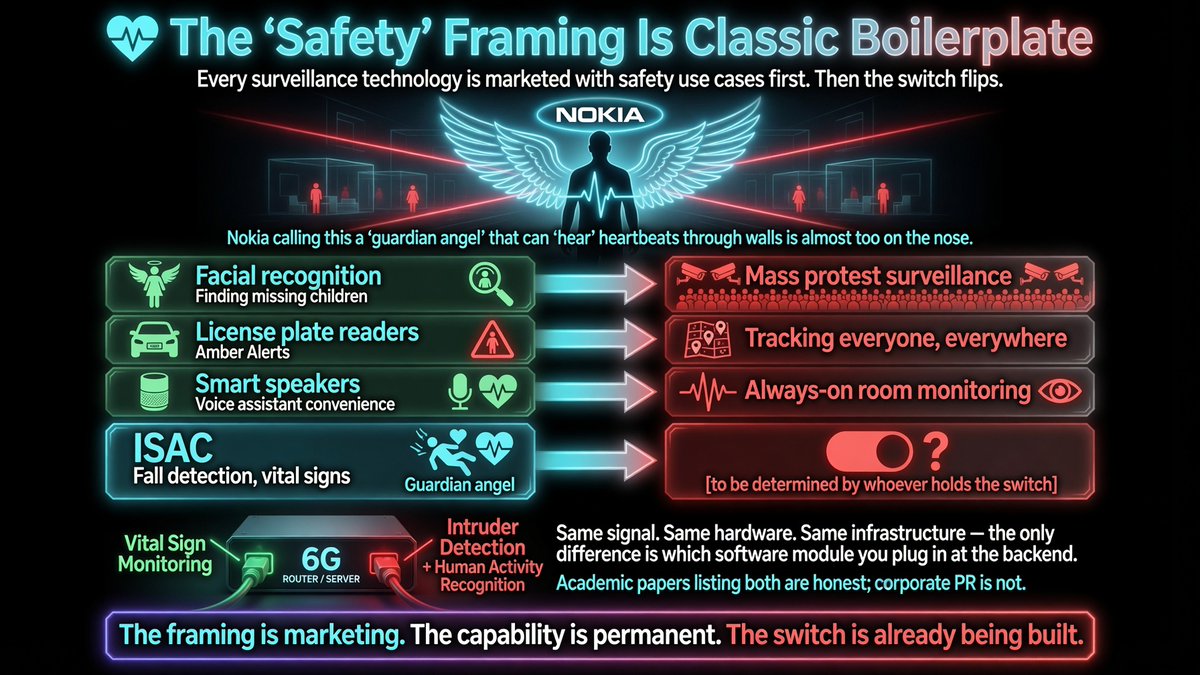
🫀 The “Safety” Framing Is Classic Boilerplate
Nokia calling this a “guardian angel” that can “hear” heartbeats through walls is almost too on the nose. Every surveillance technology gets marketed with safety use cases first:
View the last image below.
The academic papers listing “intruder detection” and “human activity recognition” alongside “vital sign monitoring” are being honest in a way the corporate PR isn’t. Same signal, same hardware, same infrastructure — the only difference is which software module you plug in at the backend.
4/7
🏢 The Real Concern: Network Sensing as a Service
This is where it gets concrete. Qualcomm is already working on standards for “network sensing as a service” — which means carriers monetizing the location and movement data their towers passively collect.
The business model writes itself:
1. Carriers deploy 6G with ISAC built in (they have to — it’s in the standard)
2. Data brokers buy aggregated indoor presence/movement data
3. Advertisers, insurers, law enforcement, landlords become customers
4. You never opted in because you were never asked
The Turkey field trial combining cellular and Wi-Fi signals for “robust near real-time indoor human presence detection” shows this isn’t lab stuff anymore. It’s in field testing. The infrastructure is being designed right now.
5/7
🧱 What It Can’t Do (Yet)
Credit where it’s due — the media thus far are honest about limitations:
- Individual identification isn’t reliable from radio signatures alone (yet — but gait recognition from radar signatures is an active research area)
- Environmental dependency is real — accuracy tanks when you move a system trained in Apartment A to Apartment B
- Wall materials matter — concrete, brick, and newer energy-efficient windows with metallic coatings attenuate signals significantly
But these are engineering problems, not fundamental barriers. Machine learning models get better with more data, and carriers deploying at scale will have plenty of data.
6/7
⚖️ The Standards Problem
The media also correctly flag that privacy protections are being written into the standards by the same companies building the surveillance capability. This is the regulatory capture playbook:
“We’ve included privacy protections in the standard” — says the company that wrote the standard, sells the equipment, and monetizes the data
The parallel to the internet itself is instructive. HTTP, TCP/IP, and the early web protocols had essentially zero privacy or security baked in because nobody anticipated the surveillance business model that would be built on top of them. We’re still paying for that oversight decades later with an endless parade of privacy regulations trying to bolt security onto fundamentally insecure infrastructure.
ISAC represents a chance not to repeat that mistake — but only if the privacy architecture is genuinely independent of the companies profiting from the surveillance.
7/7
🏠 The Bottom Line
The technology is real, it works, and it’s being baked into 6G standards years before most people will ever hear the term “ISAC.” The capability to detect presence, track movement, and monitor vital signs through walls without consent is not a bug — it’s a designed feature.
The question isn’t whether the technology exists. The question is who controls the switch, who gets the data, and whether anyone outside the industry gets a real say in either before the concrete is poured.
History suggests the answer to that last one is “no” unless people make enough noise to force it to “yes.”
He just quit.
He was a primary editor for Diary of a CEO.
So I asked him to tell all of his secrets for how he helps the Diary of a CEO be the number 1 podcast on YouTube.
00:00:00 Why Trailers Are Essential for Podcast Growth
00:03:30 Why Most People Are Doing Trailers Wrong
00:06:36 From Film and TV to Diary of a CEO
00:11:48 Retention Rates and What They Actually Mean
00:14:52 What Actually Makes a Podcast Good
00:17:00 Why the Guest Is 50% of Everything
00:22:59 What Makes a Great Podcast Host
00:26:31 Red Flags in Podcast Trailers
00:30:33 The Jefferson Fisher Hook Breakdown
00:34:16 The Louis Tomlinson Hook Breakdown
00:42:35 The 15 Point Checklist for the Perfect Trailer
00:45:28 The Oz Pearlman Hook (41 Second Rule)
00:48:06 The Laughter Track Hack
00:54:11 Sound Design and Visual Details
00:57:04 How to Choose Music Like a Film Director
01:00:02 Disney Imagineering Lesson
01:02:46 The Vanessa Van Edwards Hook Breakdown
01:07:02 The Kevin Hart Narrative Arc Breakdown
01:16:40 The A-B-C Storytelling Framework
01:20:13 The Easiest Win You Can Implement Right Now
01:22:36 How Diary of a CEO Uses AI
Patrick Collison, CEO of Stripe, on whether AI is centralizing power or spreading it:
"There's a fear that AI is going to be this hegemonic, centralizing, totalizing force where a small number of companies gobble up a very large share of the economy."
"Based on the trend lines we can see, I think we are heading towards a more decentralized world and one with more broad-based prosperity."
"There's a fear that AI is going to be this hegemonic, centralizing, totalizing force... I think there are going to be many thousands of winners."
A https://t.co/ifyWE6VyDH swap looks like one click in the UI.
On TON it is a tree of separate transactions linked by messages across wallets, Jettons, Router and Pool. 🧵
Why tokenize now? Because the race to rewire financial markets has reached a turning point 🏁 Learn why the next era of finance belongs to those building regulated infrastructure with @Alan_Konevsky.
Sign up here: https://t.co/7VUurvUGcO
The 5 Phases of AI
The AI world is splitting into two camps in 2026: those who think we're basically there, and those who think we're nowhere close. Both are watching the same curve.
Explore more at https://t.co/kU4GBmV0sl
Hashgraph x ioBuilders ⚡️️The Institutional Operating System for Tokenized Finance is Here
"If you need to tokenize at scale, you have no reason to not engage us. That value proposition doesn't exist anywhere else." - Eric Piscini, CEO of Hashgraph
Hedera mainnet and HashSphere private environments are now accessible via Asseto, the most powerful tokenization stack in institutional finance:
• Issuance, lifecycle, trading, settlement
• Lending platform launch with top institutions
• HashSphere x Hedera x Cross-ledger protocol
"The asset should never have to leave the system it was born in. You have issuance, lifecycle, trading, settlement, one platform, one data model, one audit trail." - Carlos Matilla, CEO of ioBuilders
Hedera technology can cover every part of the institutional stack. Now, with Asseto, institutions have that combined power at their fingertips.
@Genfinity | @ioBuilders | @Hashgraph
Full Interview:
"We're not going to tokenize everything just for the sake of it."
Chetan Karkhanis, SVP at @FTI_US, tells @_dsencil tokenization only makes sense when it's cheaper, better, and faster.
With a $14T market and just $15B tokenized, it's still early.
Watch the thesis unfold 🔽
Tokenization is moving beyond funds and stocks into global trade.
Injective co-founder Eric Chen joined @CoinDesk to discuss POSCO International and LG’s pilot to tokenize trade receivables and why Injective is leading the way for global trade settlement.
✅In News: Model Distillation
1. What is Model Distillation?
2. Why AI firms use it
3. Why the US is concerned
4. What are "Reasoning Traces"?
5. China–US AI rivalry
6. Security & IP concerns
7. Is Distillation Illegal?
8. Open vs Closed AI Models
9. Way forward
🧵👇