If you’re running a live AI product today ask around if you measured true end-to-end latency from the user’s device; not just server-side inference time, but real user-perceived delay. Because the gap between those two numbers is where product teams usually get surprised.
Most GPU infrastructure conversations revolve around compute power and pricing.
But there’s a cost almost nobody budgets for and it doesn’t show up on your cloud bill.
It shows up in your product metrics.
Latency doesn’t just slow your AI app down. It pushes users away.
This is exactly why infrastructure location matters.
Many affordable GPU providers startups rely on are hosted in the US or Europe.
That often means 180–250 ms round-trip latency before inference even begins.
Running closer, for example from the UAE where proximity and sea cables bring down latency dramatically for Indian users can reduce that baseline to ~30–50 ms.
Across a multi-call pipeline, that delta compounds rapidly.
Token budgets can cut inference costs 20-40% according to Ventum Consulting (https://t.co/antYSynxN7). You set a cap, train users to be concise, and track per-endpoint usage.
But you are still paying per token, which means your bill scales with user behaviour you cannot fully predict. The pricing model is built for the provider's economics, not the buyer's budget cycle.
#AIInfrastructure #AIaaS #Inference #AICosts #LLMOps #FinOps #CloudCosts #GenAI
GCC markets are adopting AI agents rapidly, but infrastructure is struggling to keep pace.
A recent report from Cybersecurity Insiders highlights a growing gap: AI adoption is accelerating faster than regional data sovereignty architecture can support.
Many cloud providers treat regional data residency as a checkbox feature. Compute may run locally, but key management, telemetry pipelines, and audit logs often still rely on global control planes.
That creates a widening gap between regulatory expectations and how infrastructure actually behaves.
GCC data localisation frameworks define which data must remain inside Saudi Arabia, the UAE, or Qatar, when it can cross borders, and under what safeguards. But sovereignty goes beyond compute location.
It requires regional key custody, identity-based access control, and full visibility into how data moves between services.
For teams building Arabic NLP systems or deploying AI agents that process GCC user data, infrastructure needs to be hosted in-region with genuine sovereign controls.
Hyperscalers will eventually close this gap. But most AI teams cannot wait 18 months for roadmap features.
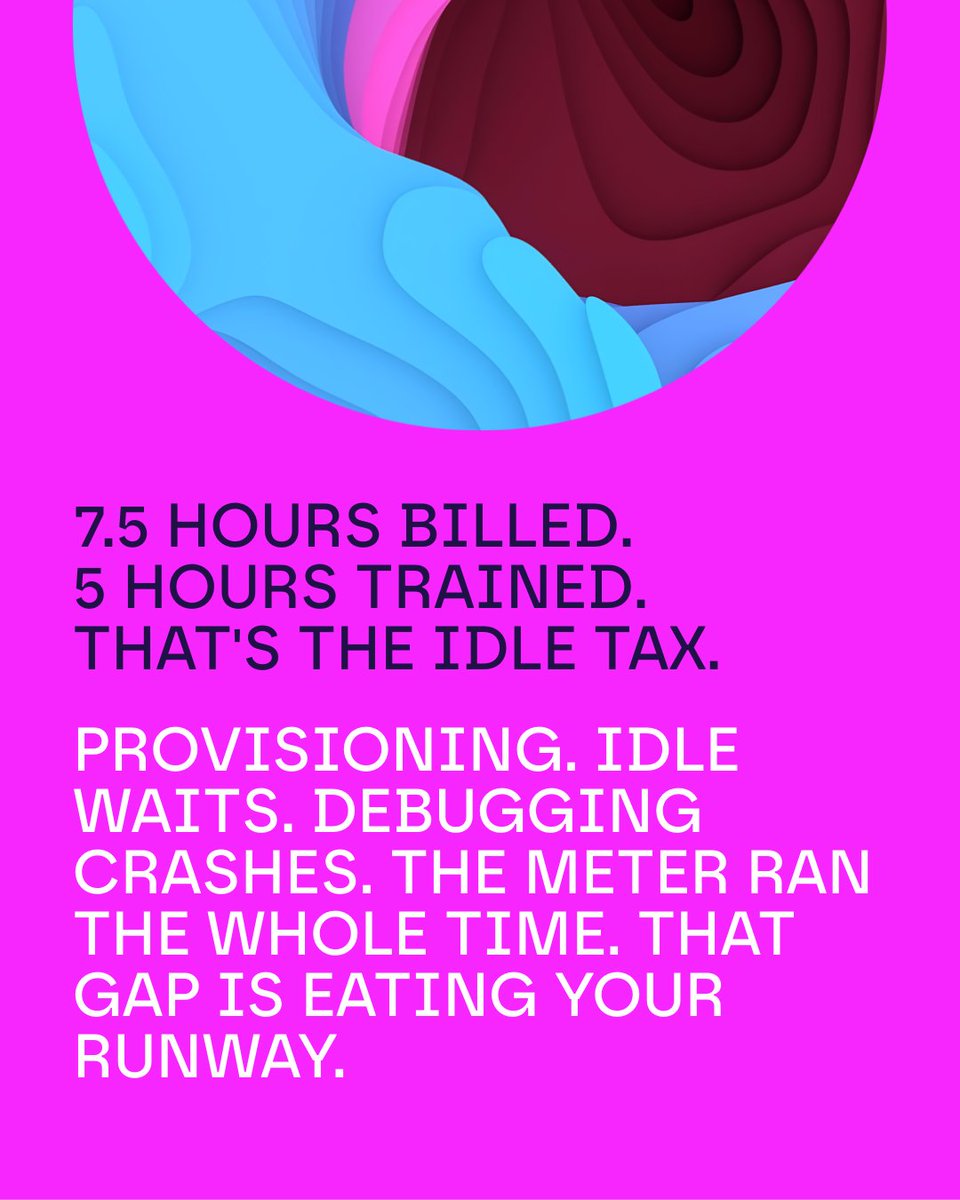
Hourly GPU pricing was designed for web servers. Not for bursty, experimental AI workloads.
That mismatch has a cost, and most teams don't see it until it's too late.
Swipe to understand the Idle Tax, and how to calculate what your training actually costs before you spin up a single instance.
The truth about GenAI latency:
<50ms = must-have
>100ms = feels slow, users leave
US/EU clouds to MEA/India = 180-250ms
Hyperfusion: <50ms RTT with local inference nodes, OpenAI-compatible APIs, zero code changes.
Stop losing users to distance.
Funding headlines tell half the story.
What actually determines whether a startup executes on their AI roadmap is the infrastructure underneath.
For MENA builders: local GPU capacity (NVIDIA H100s) + data sovereignty + OpenAI-compatible APIs = you can fine-tune models on your own data, deploy to production, and iterate fast without compliance concerns or latency penalties.
That compression of the iteration cycle is what lets you ship faster than competitors stuck rebuilding integration layers.
"We can't risk surprise AI bills."
This is the #1 blocker we hear from teams trying to ship AI in production.
The answer isn't better models. It's transparent per-million-token pricing with budget alerts built in.
Predictable costs make AI actually usable. Everything else is secondary.
Estimating AI costs shouldn’t be guesswork, but cloud pricing makes it that way. Bill shock kills projects.
Hyperfusion Chat gives you accurate cost projections in minutes. Input your requirements and get a realistic budget before you build.
Validate early. Adjust scope. Avoid surprises.
Try it here: https://t.co/54ktDytWsh
While fundraising gets the spotlight, AI scaling is decided by infrastructure.
In the UAE & GCC, GenAI needs regional, flexible compute, not expensive vendor lock-in or cloud bill shock.
Open-weight models + fixed-price local GPUs = lower latency, data sovereignty, predictable costs, real scale.
Provisioning GPUs for peak demand means underutilized infrastructure burning money. Hyperfusion optimizes GPU use with near-zero latency, OpenAI-compatible APIs, and better resource allocation across clusters.
AI infra needs an upgrade. Forget cloud bill shock and latency spikes. Hyperfusion delivers AI-as-a-Service with local GPUs, predictable pricing, faster inference, and full data control. OpenAI & Hugging Face compatible. Scope your project + get $10 free credit here: https://t.co/54ktDytWsh
Buying GPUs and building AI stuff are two different puzzles. Lots of teams waste resources on infrastructure that doesn't deliver, stuck in long queues or dealing with high costs from hyperscalers. That's just wasted time and money. At Hyperfusion, we're changing that. We're focused on getting your models into production, fast and affordably.
Latency isn’t a model issue. It’s RTT, routing, and subsea cable paths.
US/EU-hosted inference adds 100–250ms for MEA & India users. Local inference drops that below 50ms.
That’s why Hyperfusion runs inference in the UAE.
https://t.co/q8ihqRiV14
AI doesn’t fail because of models. It fails because infrastructure is too far from users. Hyperfusion brings low-latency AI compute to India, MENA, and Eastern Europe, with local data residency and OpenAI-compatible APIs.